

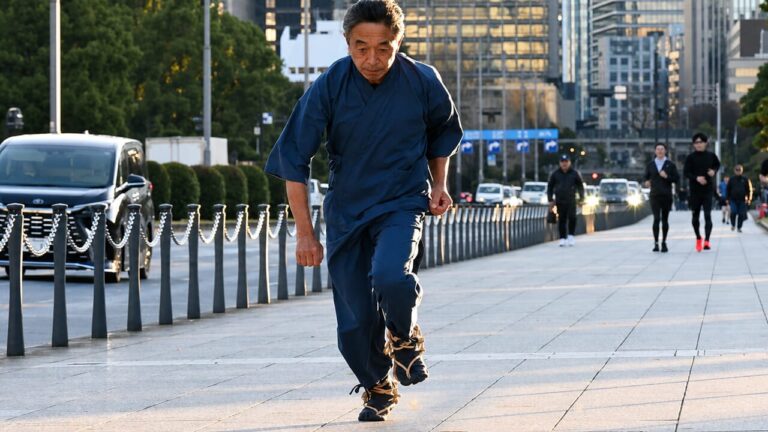
A man runs sideways moving his arms in circular trajectories, or advances leaning forward with very short steps. This is not a comic sketch, but the Edo running style, a running technique inspired by feudal Japan that is becoming popular on social media. The trend was launched by Katsunori Oba, 61 years old, an independent scholar who has been interested in the biomechanics of ancient Japanese couriers from the Edo period (1603-1868) for over a decade. According to Oba, this approach does not focus on speed, but on energy efficiency and the reduction of joint impacts. A fascinating promise, especially for runners struggling with knee pain, even if for now his theses should be considered more as a personal reconstruction than as a scientifically validated method.
The race of the Japanese couriers
Oba says he began his research by analyzing period prints and historical accounts of hikyaku, the couriers who transported goods and messages across the country during the Edo period. The researcher’s goal was to understand how it was possible to optimize body movement to cover long distances without modern technological supports. The journey that separates Tokyo from the capital, Kyoto, is approximately 500 kilometres. And Oba says that Edo period couriers could cover it in just 3 days.
Starting from these sources, Oba reconstructed and reinterpreted some walking and running techniques, then adding personal elements. The result is a form of running that alternates between very short steps, a forward-leaning posture, lateral movements, and arms that don’t swing in the way we’re used to in modern running.
View this post on Instagram
The method codified by Oba combines ancient walking techniques, called Nanba (sometimes also written as Namba) and a lesser-known form of lateral running called yoko-hashiri. The most eye-catching style, and shared online, among those created by the researcher is a strange “crab” run, in which the body advances slightly off-axis with respect to the line of progression, reducing the asymmetric stress on the feet, accompanied by funny circular movements of the arms.
A second, more recent approach instead involves a very high step frequency, which according to Oba’s findings can reach 288 steps per minute. This setting shifts most of the workload to the calf muscles, taking pressure off the knees and reducing the impact shock that typically wears out long-distance runners’ joints.
Check out this post on Instagram
It is a principle which, in a much more moderate form, also finds some confirmation in modern biomechanics: slightly increasing the cadence can reduce some loads on the knees and hips. But there is a big difference between a small increase in step frequency and a “ninja” run at almost 300 steps per minute.
The inspiration in Namba-aruki
From a technical point of view, the Edo running style has its roots in Namba-aruki (or Namba-bashiri when applied to running), a traditional way of walking, of which there is actually historical evidence. Unlike modern Western walking, which involves the alternating and crossed movement of arms and legs to balance the torso, the Namba method involves the simultaneous advancement of the arm and leg on the same side. This synchronous movement avoids twisting of the pelvis and spine. It should be less tiring, especially for a person who wears rope sandals and not modern shoes with cushioned soles. And it seems it was useful to the samurai of feudal Japan, to prevent their swinging katana from hitting passers-by, and more generally to anyone who found themselves walking wrapped in a kimono.
Reality or fantasy?
If the postural effectiveness of the Edo period walks is indeed confirmed in tradition, the epic narrative of the couriers’ performances cited by Oba is dubious to say the least. In fact, the 500 kilometers that divide today’s Tokyo from Kyoto were not normally covered by a single courier, but by a relay with over 52 stations in which each runner had to cover only a fraction of the total distance.
For private or confidential messages there was the possibility of using solitary couriers, but the travel times to cover the entire route were considerably longer, reaching at least 6-8 days. Nothing that incredible. Oba, however, assures that he will continue to work on his research, with the aim of reconstructing a model of the Edo period race that is historically accurate and scientifically valid, so that it can be preserved as the country’s cultural heritage. He even plans to test the method on an entire route from Tokyo to Kyoto. If he achieves the desired results, he will have demonstrated two things: in the Edo period the Japanese ran in a very strange, but also very effective way. Otherwise, only the first of the two statements will remain valid.
Dossier is the exclusive subscription investigative section of The Vermilion. If you want to support our journalistic work and subscribe, visit our showcase by clicking here.