

Reconvert to the military to save factories and jobs. The European automotive sector could find itself faced with this alternative given the sector’s difficulties in making ends meet. The same international context, moreover, ensures certain profits for anyone who decides to invest in defense. The war in Ukraine and the progressive deterioration of the geopolitical framework have pushed Brussels to launch the European rearmament plan. And companies like Volkswagen and Renault intend to invest in defense so as not to close their factories.
The agreement
The news was anticipated by Financial times: Volkswagen is in negotiations with the Israeli company Rafael Advanced Defense Systems for the conversion of one of its plants to the production of missile defense systems.
According to the British newspaper, the German car manufacturer intends to convert its headquarters in Osnabrück, in Lower Saxony (Western Germany), to the creation of components for the Iron Dome, the area defense system – renamed “iron dome” – which protects Israel from the rain of missiles and enemy planes.
For the Financial timesit is the “most striking example yet of how the German automotive industry, whose profits have collapsed due to growing Chinese competition and the slow transition to electric vehicles, is seeking partnerships” with the military sector.
Some components of the iron dome would be built in Osnabrück, as well as everything that makes the system function possible. From heavy trucks to launchers, up to electricity generators. German aid would not include the production of projectiles fired from the Iron Dome. With this conversion, Volkswagen would guarantee all 2,300 jobs: “But it is up to the workers to decide whether they want to be part of the project,” a source told the Financial times. The start of production could come in 12 or 18 months.
The Osnabrück plant had already captured the interest of the German arms giant, Rheinmetall, in 2025. The company had explored the possibility of taking over the ownership of the warehouses that the car group wanted to close with a view to saving money. The deal was tied to whether tank orders increased or not. Then nothing was done anymore. However, this would not be a first for Volkswagen in the defense sector. The company manufactures military trucks through a joint venture between its subsidiary Man and Rheinmetall.
The outlook for Renault
Volkswagen is not the only one moving into the sector. In France, Renault would have reached an agreement with Turgis Gaillard, a French group specializing in aerospace and defense. The company would have been contacted by the Ministry of the Armed Forces to make its skills available to the military giant with the aim of developing a national drone industry.
The project would aim to produce 600 units every month. The development of the structures and components would be delegated to the Le Mans and Cléon automotive plants.
The (disproven) hypothesis about Stellantis
A separate discussion must be made for Stellantis. Last year numerous rumors circulated, promptly denied, about the Cassino plant. According to the latest Fim-Cisl report on the Stellantis group, in 2025 the production of the Cassino plant collapsed to 19,364 units, recording a -27.9 percent compared to 2024, the worst figure in the history of the site. In 2017, the first year with the Alfa Romeo Giulietta, Giulia and Stelvio production, 135,263 units were reached. The total number of employees in the plant has dropped to 2,200 and the future of the plant is worrying.
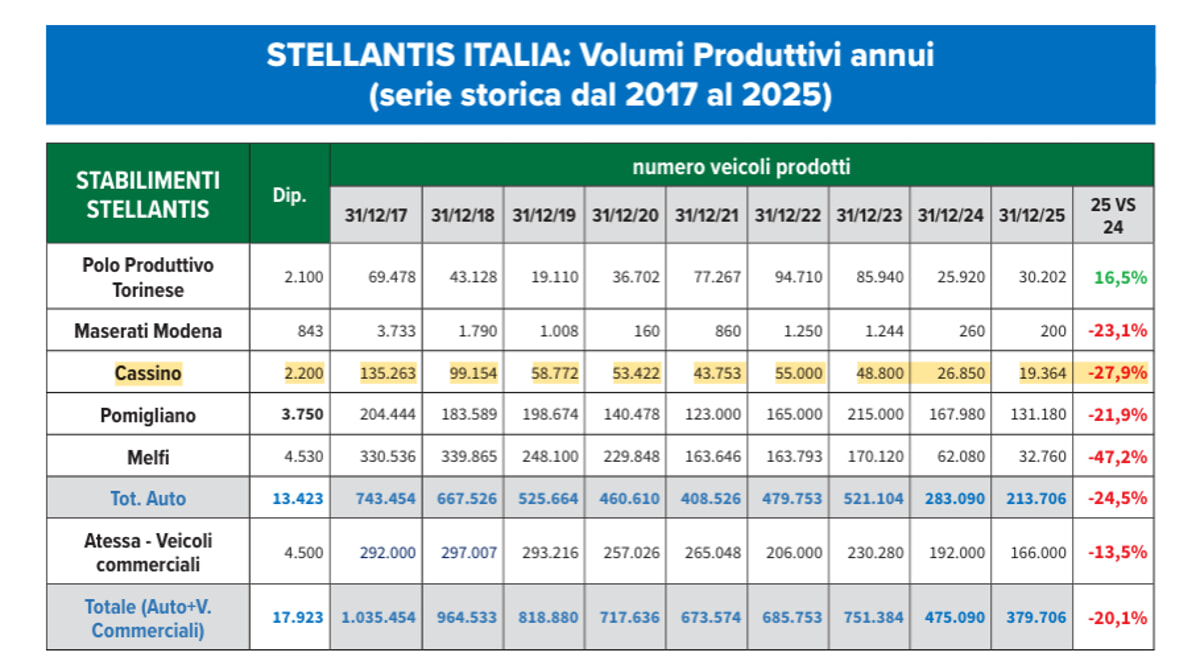
Cassino is the only area where the plan announced in December 2024 has not been implemented. The launch, initially scheduled for the end of 2025, was postponed and, as of January 2026, a new date had not yet been announced. In 2026 there were only 16 working days and for Ferdinando Uliano, general secretary of Fim Cisl, the prospects are not rosy: “It is estimated that in 2026 only 13 thousand units will be produced”.
For this reason, the rumors about the conversion of part of the headquarters had aroused interest. Also because they had been relaunched by Gioacchino Ferdinandi, mayor of Piedimonte San Germano, where the factory is located. In a post on Facebook, the mayor had spoken of a reconversion of the site “towards strategic production, in particular in the defense sector, with a direct role for Leonardo”. And he concluded by writing that “the hypothesis is finding concrete confirmation”.
However, the two companies had replied bluntly: “There is nothing true, it’s fake news.” Leonardo also wanted to reiterate that the “two sectors (defense and automotive, ed.) are profoundly different”. Although Ferdinandi spoke of a “Leonardo-Rheinmetall joint venture” in his post, the hypothesis is not confirmed in the companies’ industrial plans.