

The climate phenomenon known as El Niño could reach unprecedented levels in 2026, with the risk of further warming of global temperatures. At the moment we are still in the field of hypotheses, but according to the forecasts of the European center for medium-range weather forecasts (Ecmwf), the chances of seeing an “enhanced” version of the climate model capable of influencing the weather in different areas of the globe are increasing. What would the consequences be on a global level? We talked about it with the meteorologist and climatologist Giulio Betti.
El Niño and La Niña
When we talk about El Niño and La Niña, we are referring to Enso, an acronym for “El Niño-southern oscillation”, a periodic climatic phenomenon that concerns the variation in water temperature in the Pacific Ocean. El Niño is the warm phase, in which surface waters undergo anomalous warming, while La Niña is the opposite phase, in which cooling occurs. According to data published by the US National Oceanic and Atmospheric Administration (NOAA) last month, there is a 62% chance that an El Niño episode will occur in the coming months: “If El Niño were to form – explained NOAA’s Climate Prediction Center -, the potential intensity remains very uncertain, with a one in three chance that the episode will be ‘strong’ between October and December 2026”.
What would be the consequences of a more intense event than usual? Phenomena such as “super” El Niño, with more significant and widespread effects, occur on average every 10-15 years, but this is not an official classification. The intensity of El Niño is measured with the Oceanic Niño index (Oni), which includes three classes. El Niño is defined as “weak” when the Oni is greater than or equal to 0.5 degrees but does not exceed 0.9 °C. In the range between 1 and 1.4 °C we speak of a “moderate” El Niño, while it moves to the “strong” level from 1.5 degrees upwards.
“The strongest of the last 140 years”
El Niño can affect global temperatures and increase the risk of extreme phenomena, from floods to record heat waves. According to a Washington Post analysis, a “super” El Niño event, characterized by a 2-degree Celsius rise in Pacific waters, could trigger a violent atmospheric response peaking between December 2026 and January 2027. As a result, the western United States, Europe, India and parts of Africa would experience a warmer-than-normal summer. At the same time, tropical regions such as the Caribbean and Indonesia would risk drought and extreme temperatures, in a context that would see an increase in cyclones in the Pacific at the expense of Atlantic ones.
The fear, also expressed by Paul Roundy, professor of atmospheric sciences at the State University of New York at Albany, is that the next event could be more intense than that of 2015 when sea temperatures in the central equatorial Pacific reached 2.8 degrees Celsius above average: “There is a real potential for the strongest El Niño event in the last 140 years.” Beyond “clues”, such as a rare triple cyclone configuration in the Pacific, we are not yet able to accurately predict the intensity of El Niño: no two events are the same, especially with climate warming.
Possible global effects
But what could the possible effects be? We asked Giulio Betti, meteorologist and climatologist at the Bioeconomy Institute of the Cnr and the Lamma Consortium (Laboratory for Environmental Monitoring and Modelling): “Uncertainty still prevails regarding the intensity, but we can confidently state that El Niño will arrive and will be moderate or higher. Should it record an anomaly greater than 2 degrees centigrade in a particular area of the Pacific, we could witness a very strong event, like those occurred in 1982-83, 1997-98 and 2015-16”.
If El Niño really were to present itself in a more intense manner, the effects on a global level would be multiple: “We are currently in a neutral phase – Betti explained to The Vermilion – with El Niño expected to reach maturity after the summer. The consequences will manifest themselves between autumn and the beginning of 2027. In Australia, Indonesia and South Africa there could be a strong drought and an increase in the risk of fires. At the same time, central and northern India risks a drastic reduction in monsoon rains. These are scenarios that would already occur in a normal context, but which are accentuated by the effects of El Niño. Floods are instead likely in Peru, Ecuador and East Africa, with potential extreme rainfall on the Arabian peninsula, where very strong heat waves would be followed by sudden flood breaks. The situation is particular in Brazil, which would find itself divided in half: risk of drought in the northern Amazon and very intense rainfall in the southern Amazon”. 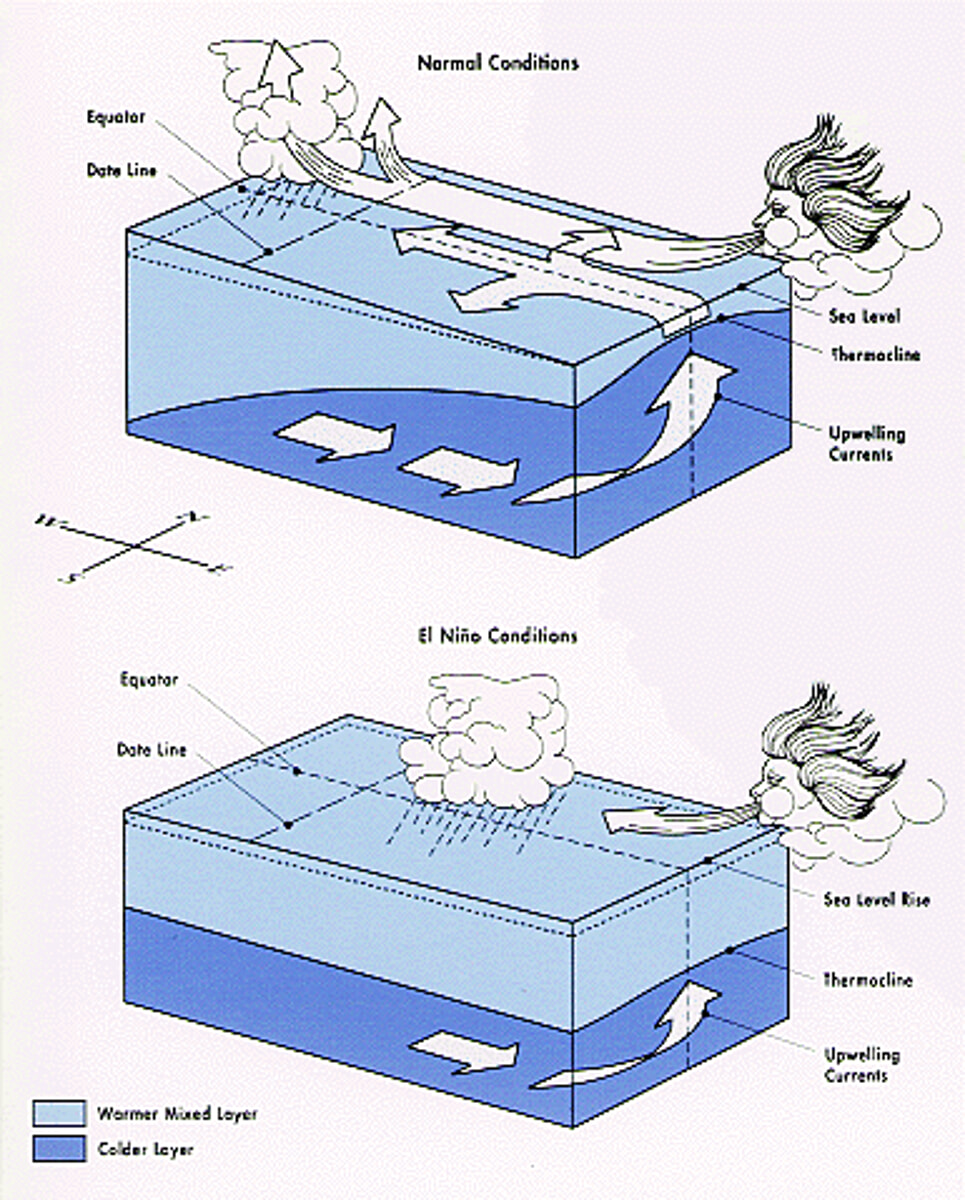
Coral bleaching
One of the most dramatic consequences concerns marine ecosystems, as underlined by the expert: “If a very intense episode really occurred, we could witness the so-called ‘coral bleaching’, a death caused by waters that are too warm. The increase in temperature breaks the bond with the algae, causing the death of the corals. This is one of the biggest problems, also because in recent years we have witnessed bleaching events even during the La Niña phase.”
The consequences for Europe
Predicting the impacts on the Old Continent is more complex: “Understanding what would happen in Europe is difficult – Betti further explained – because we suffer the effects indirectly and the evolution is always uncertain. Excluding the summer, a ‘super’ El Niño could bring a phase of low winter rainfall and temperatures above average, with a mild autumn and acute phases of bad weather. If it were only ‘strong’, however, the opposite could happen: a minimal variation is enough to change completely the effects on the European territory”.
Climate change
The increase in strength of El Niño is also linked to ongoing climate change: “The increase in global temperatures affects the intensity of El Niño, an already extreme event which, starting from an already hot thermal base, will inevitably have more intense effects. A strong El Niño – concluded the climatologist – contributes to global temperature records. The contribution in absolute terms is between 0.1 and 0.3 degrees centigrade, but it is precisely that tenth of a degree that decides whether one year is warmer than another. Numbers that may appear tiny, but which on a climatological level represent an enormous variation with effects of global significance.”