

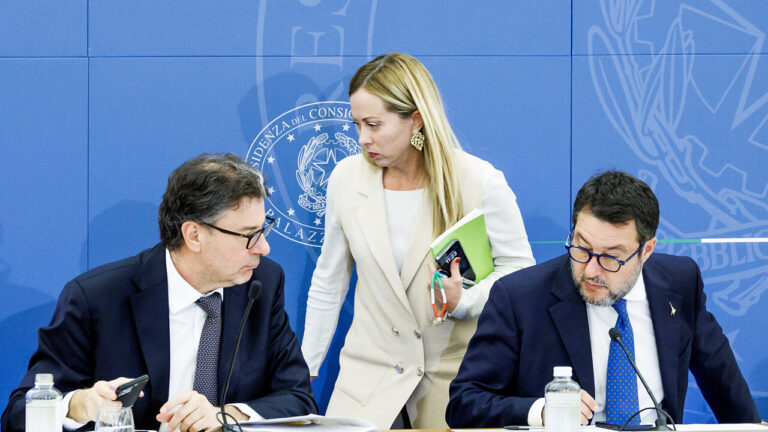
The government is preparing to intervene again on the high cost of fuel with an extension of the excise duty cut, but this time in different ways. The provision, expected in the Council of Ministers, should have a more limited duration – around two weeks – and above all it will no longer be uniform. The discount, in fact, will be calibrated differently between petrol and diesel, favoring the latter.
Excise duties, the government saves the discount: extension from 1 May. Higher cut for diesel: how much will a full tank cost
Meloni: “The cut will not be horizontal.” More discount on diesel
Prime Minister Giorgia Meloni specified this in recent hours: “We are evaluating not to make the cut in a horizontal manner. Petrol has increased on average by 6%, diesel by 24%, it could be a cut that has a greater impact on the price of diesel”.
The choice arises from the price trend, which in recent months has affected diesel more than petrol. For this reason the executive aims to concentrate the benefit above all on diesel, with a more substantial cut compared to green fuel. In previous interventions the discount had been identical for both fuels, equal to 24.4 cents per litre, but now the objective is to rebalance the impact of the increases. The extent of the reduction still remains to be defined in detail, as does the precise duration of the extension, which should in any case be shorter than previous interventions.
Government hunting for resources. Tax credit for road haulage to stop the strike
The weight of the measure on public finances also affects the choices: so far the cut in excise duties has cost hundreds of millions of euros, with a daily expense of around 20 million. For this reason, the new intervention should remain within an overall ceiling of close to half a billion. At the same time, the decree should also include a strengthening of the tax credit for the road haulage sector, with the aim of offsetting at least half of the increased costs incurred by operators and avoiding the announced stop of trucks from 25 to 29 May (after the tragedy which led to the cancellation of the strike, previously scheduled for April 20th to 25th).
“We are working to increase this reimbursement, with the aim of covering over 50% of the costs incurred. The road transport strike is my priority and that of the government”, said the Minister of Infrastructure and Transport Matteo Salvini in the last few hours. “Meet the right requests of these companies that are working at exorbitant costs, to avoid the blockade of the country”.
What’s in the housing plan: 50 thousand public homes towards renovation
Alongside the fuel chapter, the Housing Plan also arrives on the table of the Council of Ministers today, 30 April, one of the most awaited, announced and repeatedly postponed measures. The project aims to address the housing emergency with a structural intervention, making available overall resources that should be around 4 billion euros, with the possibility of reaching up to 5 billion in the medium term thanks to additional funds.
The objective is to increase the supply of affordable housing, with the creation of over 100 thousand new homes over ten years, aimed above all at young people, families and more vulnerable categories. This is accompanied by a broad plan for the recovery of existing assets, with the renovation of around 50 thousand council houses that are currently unused or unusable, to quickly put them back on the market.
The plan should also include simplification measures to speed up interventions and targeted support tools, including funds dedicated to specific categories such as separated or divorced parents. The resources will be distributed over time, with an initial immediate allocation and further funding coming, among other things, from cohesion funds.