

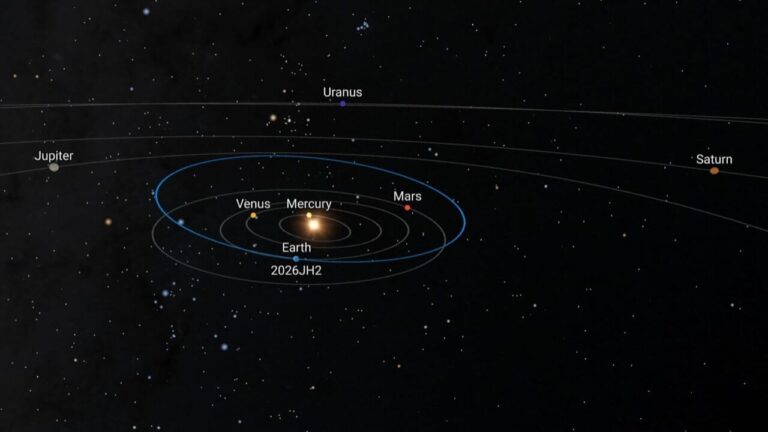
Eyes rolling. Today evening, Monday 18 May, a large asteroid will pass close to Earth’s orbit, offering a unique space show and, obviously, in total safety.
Asteroid 2026JH2
As explained in a note from ESA, the European Space Agency, the celestial body called 2026JH2, with a diameter between 15 and 30 meters, will pass “close”, in astronomical terms, to the Earth in the next few hours, reaching a distance of only 91,593 kilometers (56,913 miles), equal to about a quarter of the distance between us and the Moon. The object, discovered last May 10 by astronomers from the Mount Lemmon Survey in Tucson, Arizona (United States), belongs to a class of asteroids called Apollo, which orbit around the Sun on trajectories that intersect the Earth’s orbit. As mentioned, at its closest approach the object will be about 24% of the average distance between the Earth and the Moon and about two and a half times the distance at which hundreds of geostationary satellites, which provide services such as telecommunications and weather forecasts, orbit.
Safe passage
There will be no problems for our planet, as explained by Richard Binzel, professor of planetary sciences at the Massachusetts Institute of Technology and inventor of the Turin Scale, a tool for classifying potential collisions of space objects with the Earth: “Object 2026JH2 will pass safely near the Earth. This is a normal event: objects the size of a car pass between the Earth and the Moon every week. Objects the size of a school bus, however, pass near us several times per year. Only recently have we developed investigative tools sensitive enough to detect them.”
How to see it
The passage of the asteroid will also be visible by particular instruments, as underlined by the astrophysicist Gianluca Masi, head of the Virtual Telescope Project, who will follow the event with a live streaming: “It is an encounter in total safety, yet spectacular, with the object which will also be observable with modest telescopes, with a diameter of 150-200 millimetres. From Italy, the object will be better observable from 9.45pm onwards, when it will be at approximately 25 degrees above the horizon, in a south-south-east direction, between the constellations of Virgo and Hydra, rapidly moving towards the south, and then descending below the horizon about an hour later. Its magnitude will be around 12.0, therefore within the reach of small instruments, which will be able to show it easily, especially photographically, highlighting its rapid movement between the stars”.
The dimensions