

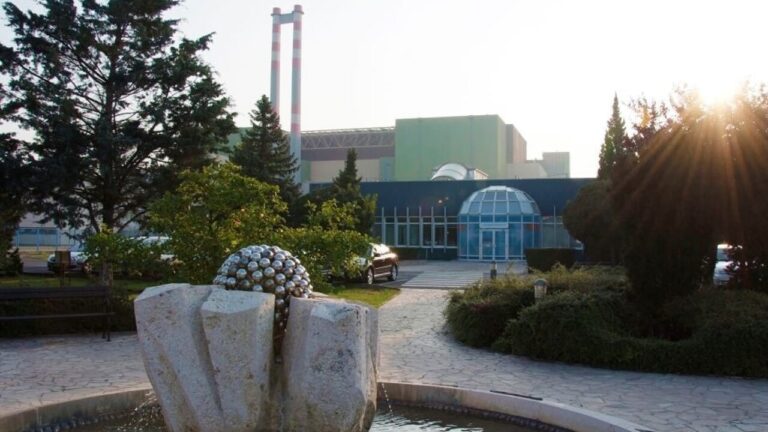
Extreme weather puts all energy sources in crisis (but it is not an excuse for saying no to nuclear power)
Hungary in energy crisis, let’s clarify. Two days ago, the Paks nuclear power plant, the only one in Hungary, sufficient to supply 40% of the country’s electricity needs, was completely stopped due to the too low level of the Danube, from which it supplies water to cool the condensers. The Romanian Cernavoda power plant, further downstream along the same river, stopped one of the two units.
Hungarian Prime Minister Peter Magyar has declared the situation an energy crisis, although it is expected that the situation will be resolved in a reasonably short time. Obviously this was misrepresented by the Italian media, which spoke of the river being too hot and/or the quantity of water being insufficient. In reality, things are not exactly like this: the Danube is a river with a very large flow rate and, despite the heat wave, the temperature is still within the environmental limits for withdrawal and release by the nuclear plants located along the river.
Even some pro-nuclear pages have misinterpreted the news, attributing the forced stop to the fact that Paks is not equipped with evaporative towers and therefore, again, to problems related to the temperature of the water at the time of release: it is true that the evaporative towers reduce water withdrawal by 97% and therefore the water reintroduced into the basin hardly causes a problematic rise in temperatures, but the problem this time is not in the temperature of the water.
The problem is quite simply that in Paks the intakes are located too high compared to the current river level: the water simply cannot be withdrawn. Put like this, it seems like a silly design mistake, but in hindsight it’s easy to say: in reality it’s the first time in 44 years that the power station has had to stop for this reason, a sign that the design had been done well.
Simply, such a level of drought in the Danube was absolutely unthinkable at the time. This, more than telling us something about nuclear power, tells us something about the seriousness of the problem of global warming (especially in Europe, which is an AGW hotspot: the consequences on our continent are more intense than elsewhere) and about the need to act quickly to counter it and adapt.
In these hours, however, Romania is preparing a temporary dam along the Danube (built by demolishing some rock formations along the banks with explosives), to raise the level of the river so as to be able to supply the plants again. In the long term, however, the doubling of the Paks nuclear power plant also includes work to place the water intakes lower down and the construction of evaporative towers.
Speaking of evaporative towers, an interesting technological solution that can be used in systems under construction in the near future and in the future is to install additional cooling fans in the evaporative towers, to be activated in the event of a heat wave: in this way, with a minimal loss of efficiency, respect for environmental balances and full operation of the system in any condition can be guaranteed. This system already exists: the Civaux power plant in France uses it (2 reactors of 1,500 MW, not bruscolini), which is located on the Vienne river. Since the flow of the river is lower than that of the other large French rivers (Seine, Loire, Garonne, Rhone, etc.), the risk of it warming is greater (less water = less thermal capacity) and therefore the risk that the temperature of the basin exceeds the environmental limits set for release becomes important.
With the additional fans, the water leaving the condensers, already partially cooled in the evaporative tower, is brought to an optimal temperature of 24.5 °C before release, which means that during heat waves cools the river (which often rises above 25 °C) instead of warming it.
This solution, until now a niche one, will also be used in the future in the Bugey power plant, where the construction of two new EPR2 reactors is planned: this will serve not only to guarantee the operation of the reactors themselves, but also that of the other 4 Bugey reactors and that of the power plants located further downstream along the same river (the Rhone), namely St. Alban, Cruas and Tricastin.
Those who have exploited the news in recent days to attack nuclear power have obviously chosen the most convenient target. However, it would instead be appropriate to explain how we plan to plan the hydroelectric plants of the future – given that the drought is also hitting hydroelectric production hard in Italy (at its lowest level in the last 3 years) – and also wind power plants: heat waves are characterized by little or no wind and in fact wind power in Europe in the last two months has performed below the seasonal average.
This is not a polemical question: it is a serious problem. In a future that will be dominated by increasingly extreme and difficult to predict meteorological events, the security of energy supply also depends on choosing to invest in sources that are least dependent on the weather as possible.
I find it hard to believe that solar and wind power offer many guarantees in this sense.