

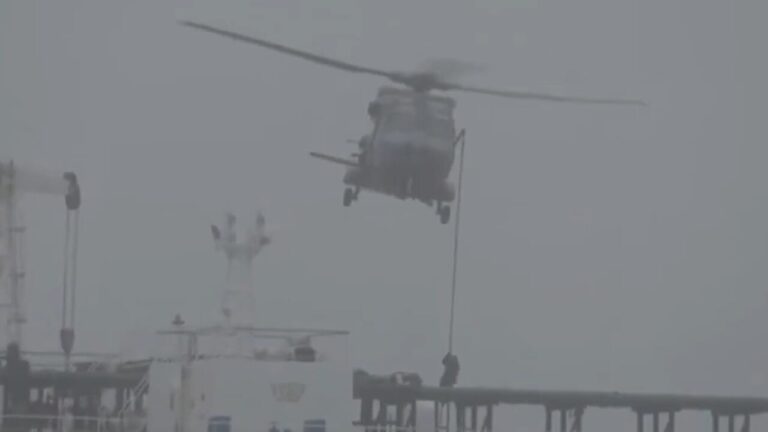
New clash between France and Russia on the sanctions front linked to the war in Ukraine. The French Navy has intercepted and stopped the tanker Tagor in the Atlantic Ocean, a vessel believed to be part of the so-called “shadow fleet” used by Moscow to circumvent international restrictions on oil exports. The operation, which took place in international waters over 700 kilometers from Brittany, was confirmed by French President Emmanuel Macron, who spoke of an intervention conducted with the support of several international partners, including the United Kingdom.
How the operation took place
According to French authorities, the ship had departed from the Russian port of Murmansk and was sailing under a Cameroonian flag believed to be irregular. The French military went on board to check the documentation and, once anomalies relating to the nationality of the vessel and the registration of the flag had been ascertained, they decided to divert the tanker to an anchoring point for further checks. There were 23 crew members on board.
The operation would not be without tensions. The Brest prosecutor’s office reported that the ship’s commander, a Russian citizen according to the first available information, refused to carry out orders given by the French authorities. For this reason, the investigators explained, it was necessary to take control of the vessel. The French judiciary opened an investigation for failure to demonstrate the ship’s nationality, lack of a valid flag and refusal to obey maritime authorities.
Macron’s words and the Kremlin’s response
Macron claimed responsibility for the intervention, calling it a demonstration of Europe’s will to combat the evasion of sanctions. “It is unacceptable that some ships circumvent international measures, violate the law of the sea and contribute to financing the war that Russia has been waging against Ukraine for over four years,” the French president wrote on social media, also underlining the environmental and safety risks posed by vessels that operate without respecting international standards.
The Kremlin’s reaction was harsh. Spokesman Dmitri Peskov called the tanker’s detention an “illegal” action that “bordered on international piracy.” According to Moscow, the operation would not be compatible with international law, despite the assurances provided by Paris. Peskov also assured that Russia is taking measures to ensure the safety of its ships and commercial cargoes.
The Russian shadow fleet and the possible diplomatic case
Tagor was already known to Western authorities. According to the French maritime prefecture, the tanker was subjected to both European and US sanctions and in recent years it would have changed flag several times, a practice frequently used by ships of the so-called “shadow fleet” to make it more difficult to trace commercial activities.
Russia’s “shadow fleet” is made up of hundreds of oil tankers and freighters that Western governments say allow Moscow to continue exporting oil and other raw materials despite restrictions imposed after invading Ukraine. The European Union has blacklisted nearly 600 vessels suspected of being part of this network.
It is not the first time that France has intervened against ships suspected of belonging to the shadow fleet. In recent months the French Navy has already stopped other tankers linked to Russian energy trafficking. In some cases the owners were able to resume sailing after paying administrative fines, while in others legal proceedings were initiated. The Tagor episode, however, represents one of the most relevant cases recorded so far, both due to the distance from the French coast and the harsh diplomatic confrontation it immediately provoked between Paris and Moscow.