

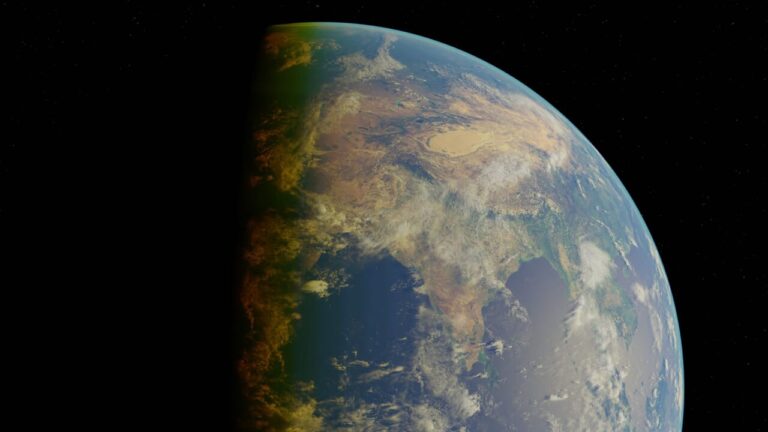
It seems like a retaliation, but one of the most dramatic consequences that global warming could have concerns the so-called Southern Overturning of the Atlantic circulation, or Amoc (Atlantic meridional overturning circulation), a system of oceanic currents on which – among other things – the relatively mild climate of our continent depends. Various research indicates that rising global temperatures could push this great Atlantic ocean circulation to collapse, with potentially catastrophic effects for Europe. And a new study, recently published on Nature Climate Changereveals that the possible risks strictly depend on the choices that the international community will make in the coming years: if we finally started to cut greenhouse gas emissions, and the increase in temperatures therefore occurred sufficiently slowly, ocean circulation could in fact remain stable even with increases of between 4 and 5.5 degrees compared to the pre-industrial era; on the contrary, with current warming rates, the critical threshold could drop dramatically to around 2 degrees, and would therefore be practically upon us by now.
Ocean currents
The Southern Overturn of the Atlantic circulation is often compared to a giant ocean conveyor belt, moving warm surface waters from the tropics towards the North Atlantic. Once they reach the northern regions, the waters give off heat to the atmosphere, cool down, become denser and sink into the abyss, undertaking the journey backwards, towards the south. This process redistributes heat on a planetary scale and is one of the main factors ensuring the mild climate of the European continent.
To understand how the pace of climate change can affect this balance, a group of oceanographers from Utrecht University used a complex climate model to simulate two different scenarios of increases in carbon dioxide in the atmosphere and in average global temperatures. In the first simulation, characterized by a slow increase in greenhouse gas concentrations, the Atlantic circulation showed remarkable resilience, maintaining its structure even in the face of temperature increases above 4 degrees.
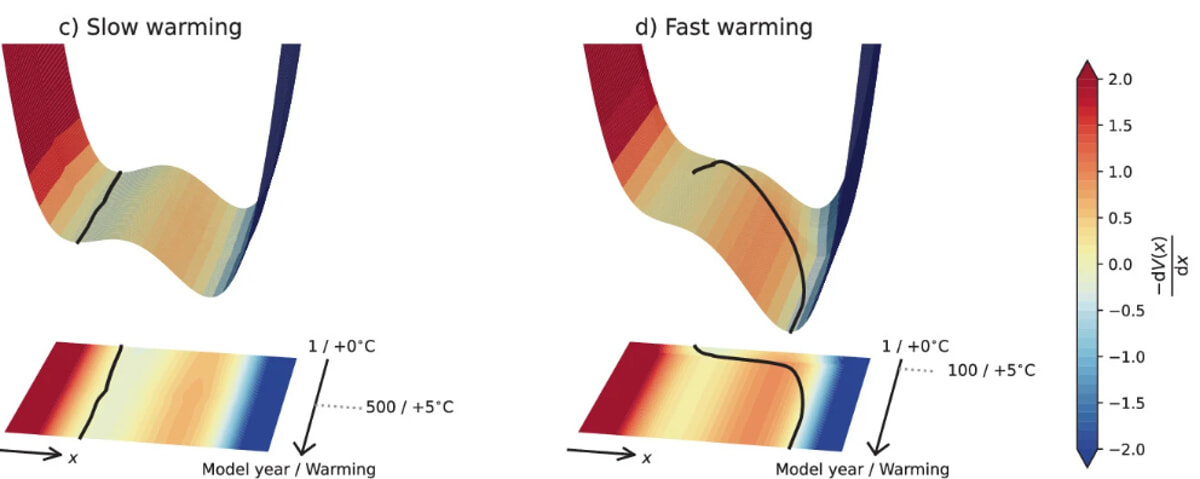
In the second simulation, set to rapid emissions and warming rates, in line with today’s, the system showed signs of collapse already around 2 degrees.
The adaptive capacity of the ocean
According to the researchers, the reasons for the different response that emerges from the simulations lie in the dynamics with which the water masses manage to adapt to external stresses. “Under conditions of slow warming, the entire ocean, from the surface to the deepest layers, has time to gradually reorganize itself and adapt to the changes it encounters,” explains Henk Dijkstra, professor of Dynamic Oceanography at Utrecht University and co-author of the research. “With faster warming, the ocean simply can’t keep up.”
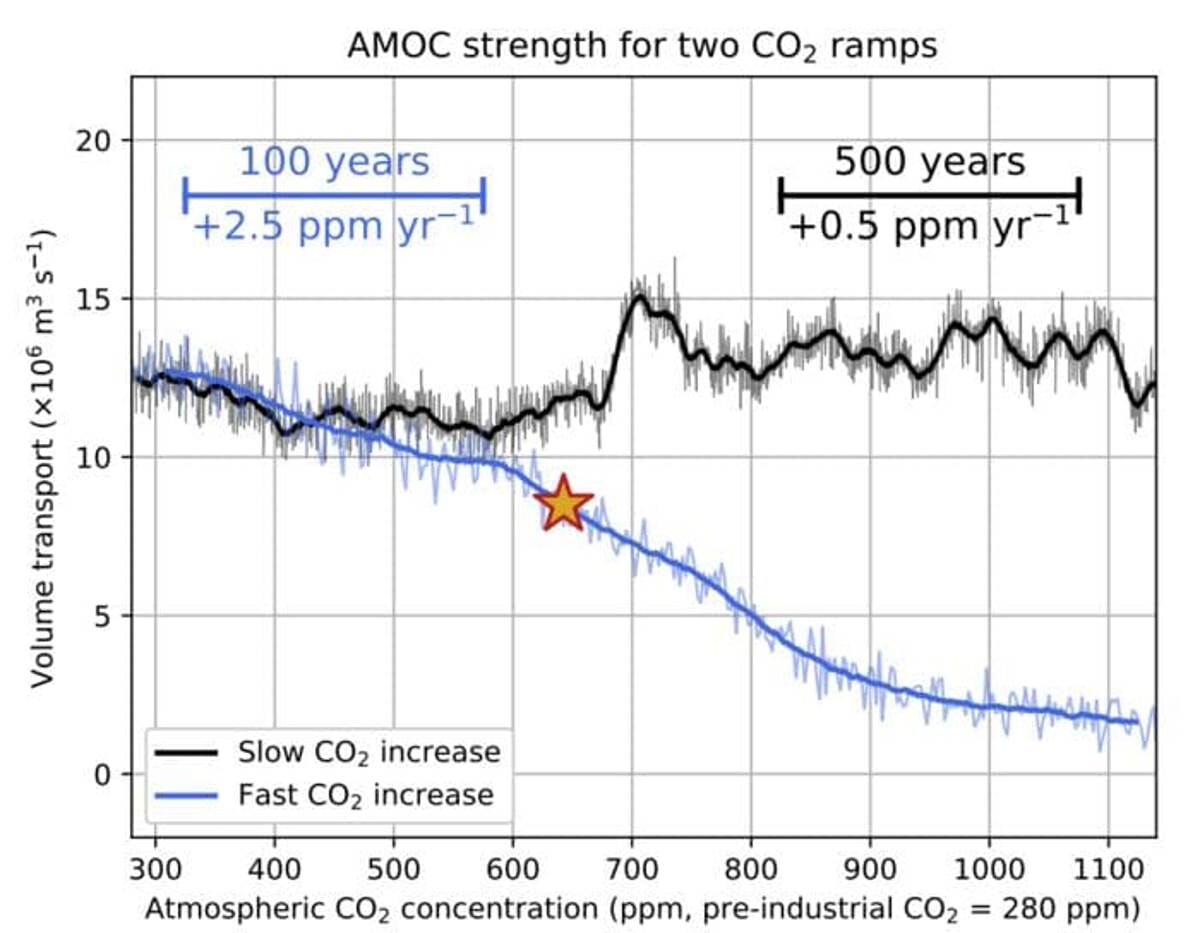
Translating absolute temperature increases into annual rates, the critical rate of warming beyond which the stability of the current is put at serious risk would be around 0.3 degrees per decade. A rhythm that the Earth is already touching today. For this reason, the authors of the study believe that it is essential to renew efforts to quickly reduce greenhouse gas emissions, without prevaricating or moving the first results forward by decades.
Mitigation strategies
The study therefore questions climate mitigation strategies based on the temporary exceeding of temperature limits, the so-called “overshoot” scenarios in which the fact is accepted that today it is impossible to avoid temporarily exceeding the temperature limits reported by the scientific community. Trusting in the possibility of being able to drastically reduce greenhouse gases in the future with new technologies could in fact expose us to the risk of triggering irreversible alterations in ocean circulation before the greenhouse effect is mitigated.
“If you are going into a wall, common sense tells you to swerve to avoid it. And to do so you have to brake, otherwise you end up off the road – underlines René van Westen, co-author of the research – When it comes to global warming, however, the world continues to press the accelerator very hard”.