

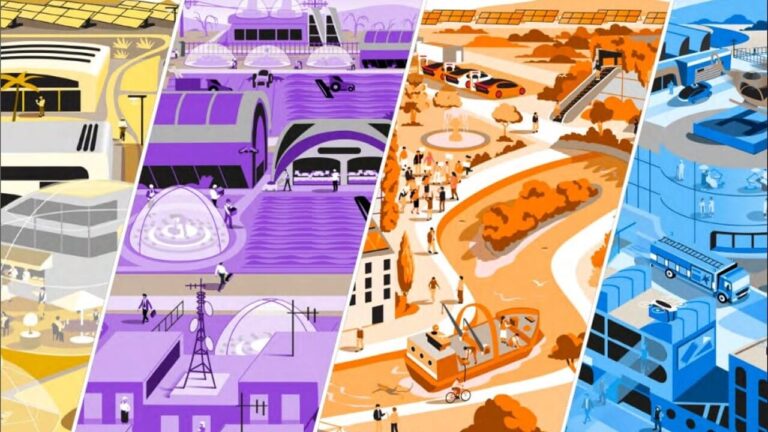
Never before has the world seemed to find itself at a crossroads, caught between climate catastrophes, energy crises, trade wars and traditional conflicts. What path will we take, and what will the planet look like by mid-century? This is what the BCG Henderson Institute think tank, a spin-off of the Boston Consulting Group, one of the three most important strategic consultancy firms in the world, tried to imagine. In their latest report, “Beyond Tomorrow: Four Scenarios for the World of 2050”, American analysts outline four plausible scenarios for the next 25 years, born from the analysis of hundreds of global trends and from the intersection of the 20 macroeconomic, geopolitical, social and environmental indicators, considered most capable of influencing the future. The result are forecasts that should help managers and CEOs prepare to navigate the turmoil of the coming decades, but can also be interesting for us ordinary citizens, offering us a glimpse into some possible futures, or at least, considered as such by the planet’s economic elites.
Abundance driven by artificial intelligence
The first scenario, called “Ai Abundance”, describes a sort of digital utopia. In this future, artificial intelligence drives every aspect of society and, together with the robotic revolution, delivers a world where we work less and live longer, with global healthy life expectancy rising to 70 years. Much has changed, and mostly for the better: the planet’s GDP is constantly growing, and although many have lost their jobs due to robots and artificial intelligence, many nations have implemented welfare and wealth redistribution programs that contain the social damage.
However, the transition is not without obstacles: humans struggle to find a role in a world where most tasks are entrusted to machines, and social stability is maintained in many nations through severe restrictions on the use of social media. Furthermore, to reach this balance, the planet had to go through the so-called “computer wars”, a series of large-scale attacks on energy and health infrastructures that began around 2030, which ended only with the signing of an international treaty in 2035. On the environmental front, temperatures reach 2.2 degrees above pre-industrial averages and many points of no return have been overcome, but thanks to the efficiency of AI, emissions are decreasing and attempts are being made to restore ecosystems.
The return of the blocks
The “Battling Blocs” scenario instead prefigures a return to the logic of the Cold War: a world once again divided into opposing factions and an economy that stagnates, with global GDP growing by just 1.8%. We return to forms of state capitalism where work is perceived as a patriotic duty and individual options are limited. With an aging population and reduced migration, young people work long hours but struggle to find pleasure and meaning in their activities. Stability is maintained through media controls, surveillance and redistributive economic policies. Democratic norms appear to be eroded everywhere: in 2050 only 25% of countries can be classified as liberal democracy, compared to 49% in 2024. Living standards are stagnant, essential goods cost more and global happiness has decreased by 10%. In this context, the temperature rises to 2.1 degrees above pre-industrial levels, with a projection of 3.5 degrees by the end of the century.
Green transition and technological dystopia
There are therefore two alternative and opposite paths. “Climate Coalition” represents the best scenario from an environmental point of view, and although less dynamic than the digital utopia of Ai Abundance, it offers a future in which life on the planet tends to improve compared to today. The idea is that a series of extreme weather events at the end of this decade will convince nations to invest heavily in renewables, limiting temperature rise to 1.8 degrees. In this future, artificial intelligence is a support for humans, not a replacement; the lost jobs are recovered thanks to constant retraining programs. Population pressure remains high, but advances in biotechnology add five years of healthy life compared to today.
In contrast, “Digital Darwinism” is probably the darkest and most dystopian future to emerge from the report. A world in which unregulated innovation and the inability of states to curb tech companies creates a technological elite that dominates advanced countries. A two-speed planet is emerging, where regions rich in computing power extract resources from weaker economies. And where a handful of rich people impose their rules on the majority of humanity, now impoverished. Emissions are out of control and leaders prioritize local adaptation over coordinated decarbonization. In this scenario, extreme poverty rises to 12% of the world’s population.
High impact unexpected events
In addition to the main trends, the report analyzes some events considered unlikely but technically possible that could accelerate or divert these paths. For the scenario of digital abundance, experts cite the possibility of the technological singularity, the moment in which AI surpasses human intelligence by becoming autonomous. In the context of the opposing blocs, the risk is the extension of the conflict into space, with a war for control of orbital infrastructures that would paralyze terrestrial communications. If the world were to unite for the climate, the real breakthrough could come from commercial nuclear fusion, guaranteeing unlimited clean energy. Finally, in digital Darwinism, the integration between biology and information technology through brain-computer interfaces could create a definitive separation between those who can afford cognitive enhancement and those who are excluded from it, transforming economic inequality into a biological disparity.
Few certainties, but there is no going back
Despite the differences between the various paths, the document identifies some fixed points that seem inevitable. In all cases examined, global warming will exceed the limits set by the Paris Agreement, with lasting consequences on ecosystems and biodiversity, which will suffer a net decline in every scenario. Life in 2050 will also be structurally different from today: the way of understanding work, the relationships between citizens and political power and the relationship with the natural environment will change. Although all four scenarios described by the report are all too reminiscent of science fiction, they represent the result of analyzes based on real trends, and could therefore contain at least interesting insights and at least a modicum of reality. The ability of companies to govern technological development and geopolitical tensions will determine which of these paths will prevail, but the return to a past of stability appears, at least according to BCG experts, the least likely option among those on the table.