

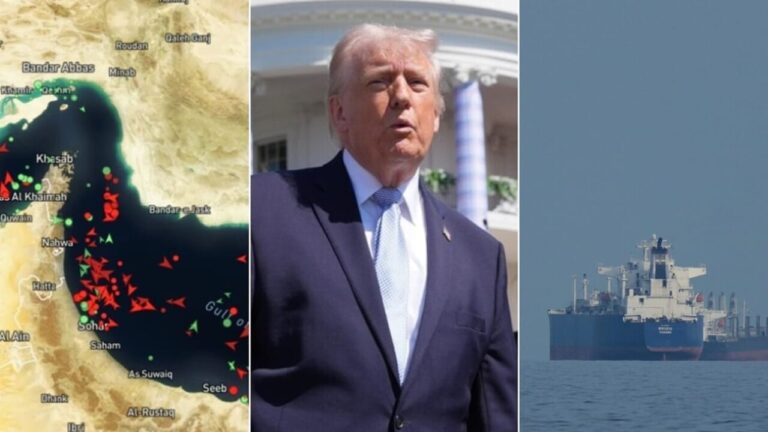
Other than “Project freedom”, the skirmishes resume in Hormuz. Donald Trump’s mission to free the ships stuck in the Strait has not been successful so far and is actually putting the fragile ceasefire signed by the USA and Iran to the test.
The tense situation in Hormuz
The last few hours have been a succession of small-scale attacks which however represent more than a signal. The United Arab Emirates announced that it had intercepted 19 Iranian missiles and drones, reporting an accident at an oil port in the Fujairah region caused by a drone attack.
The United States Central Command (Centcom) then revealed that Iran had launched cruise missiles against US Navy ships and drones against merchant ships, while Seoul’s Foreign Ministry confirmed the fire on the Namu ship operated by the South Korean company Hmm, with Panamanian nationality, but asked for “caution in calling it an attack”.
Shipping companies don’t trust you
Trump’s plan envisaged the commitment of the US Navy and the US Air Force to help ships transit the stretch of sea that flows into the Gulf of Oman, but so far the strait has only been crossed by two merchant ships flying the US flag (a fact denied by Tehran) and by the Alliance Fairfax cargo ship of the Danish company Maersk, but flying the US flag, which would have left the Periscus Gulf escorted by US vehicles.
Hormuz, however, is in fact still a funnel. The oil route remains in check. “The Strait remains extremely dangerous and I expect that most ships will continue to avoid transit until both sides reach a more concrete agreement,” Tim Huxley, president of the shipping company Mandarin Shipping, told CNN.
Angad Banga, CEO of The Caravel Group, the second largest ship management company in the world, also expresses caution. Even if an agreement is reached, he explains, “it may take time for political declarations and military initiatives to translate into safe and workable operating conditions for ships and crews in crowded and contested waters.” Meanwhile, Banga notes, “tens of thousands of civilian seafarers continue to operate under unchosen risk conditions, and global trade depends on them. Their safety and well-being must remain a priority at every stage of the response.”
Simon Kaye of NorthStandard, a giant in the marine insurance sector, is also sceptical. “There are no specific indications on which countries have requested this humanitarian mission – he says – nor on how this can be coordinated with Iran, if it is at all”. This is echoed by Jørn Højgaard, CEO of the Anglo-Eastern ship management company. “To break the deadlock you need both sides, not just one,” Højgaard stresses. “Each side can signal its willingness to allow certain ships to pass, but unless the other actually accepts this consent, the situation at sea does not change.”
Markets are also skeptical of Trump’s plan. And oil is flowing
Shipping companies therefore do not believe in Trump’s plan. Also because, as admitted by the United States, the “Project freedom” mission does not provide for a direct escort, but is limited to offering generic military support to ships venturing into the strait with the use of over 100 land and naval aircraft and 15,000 military personnel.
The fact that Tehran does not agree, and rather sees the US initiative as a provocation, is obviously not a detail. Nor is the fact that the markets welcomed Trump’s words with a certain skepticism, a sign that they no longer trust the president’s proclamations. The result is that after the White House’s announcement, crude oil prices did not record significant declines and on the London market Brent is trading above 110 dollars. The Strait of Hormuz remains blocked. And the energy crisis seriously risks stopping the global economy.