

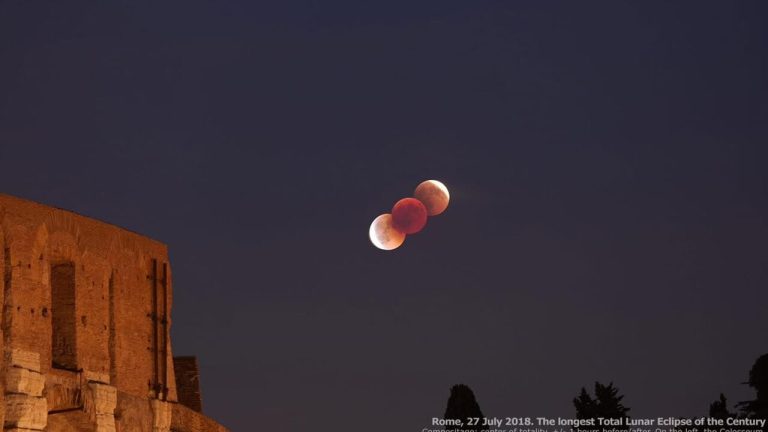
Eyes to the sky on September 7th. In the Italian skies, the magnificent show of the total moon eclipse will return, over three years after the last event, which occurred on May 16, 2022
Total eclipse of the moon, the show on September 7, 2025
An unmissable show, which must be prepared. The observation of the total eclipse of the moon is carried out to the naked eye: the naturalness of this vision is part of the spectacularity of the phenomenon. Obviously, a binoculars or a telescope will offer a much larger image, but little changes for those who do not have any optical tool.
As is known, in just under a month the moon describes an elliptical orbit around the earth, while it moves around the sun, which illuminates both. To have the Luna eclipse, the latter must be hidden from the light of the sun, inside the shadow of the earth; It is evident that the necessary alignment between the three bodies is the sun-luna-luna, with the first and last therefore visible from the earth in opposite directions. This condition, however, geometrically corresponds to the full moon phase, hence the obvious fact that the lunar eclipses occur when the phase of our satellite is, in fact, full.
When the total eclipse of the moon occurs
Evidently, however, the full moon is not enough for the recipe of the eclipse, otherwise we would have one a month (a similar reasoning could be done for the sun of sun): the aforementioned sun-luna alignment is perfect, within very narrow margins, which in fact make the difference between total, partial eclipses and no eclipses.
The lunar orbit plan, in fact, does not coincide with that of the terrestrial orbit (whose projection in the sky defines the curve of the ecliptic, which crosses the zodiac constellations and on which the sun apparently moves), having an inclination of about 5 degrees compared to the latter. Looking at the moon in its motion in the sky, we will see it mostly or under the ecliptic and there will be only two points, called knots, in which it will cross the ecliptic (whose name, not surprisingly, derives from the Greek line of eclipses).
If the full phase occurs when the moon passes close enough to one of the two nodes, then the alignment with the sun was said to be said (it should be reiterated that the sun is by definition on the ecliptic, since this curve is the projection in the sky of the orbit that the earth follows right around it, therefore when the full moon is at the knot, the antithetical alignment is satisfied). And that’s what will happen on September 7th.
The phenomenon of total eclipse proceeds gradually. The moon begins to enter the crumbling cone of the earth from the west, thus showing a slight weakening of the eastern edge of its album. Subsequently, the satellite immerses itself in the shadow cone, which will produce a marked darkening, first marginal, then increasingly extended, of the lunar disc. When the moon is completely inside the shadow cone, the total phase will begin. This will reach its maximum moment, the real Boa round of the phenomenon, after which the eclipse will show specular phases to the initial ones, finishing when the moon will emerge completely from the crumple cone, returning to the full light of the sun.
The moon “changes color”
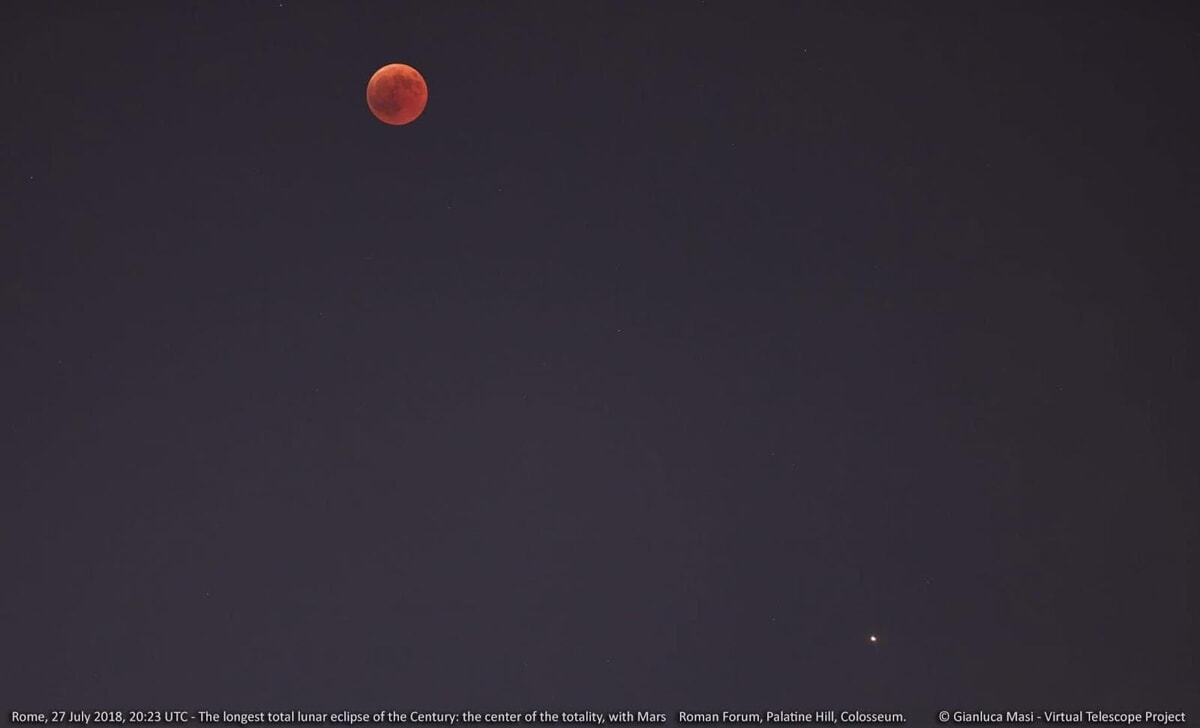
During the totality, but also in the advanced partial phase, the moon acquires a characteristic, elegant bronze color. It derives from the fact that at that moment the terrestrial atmosphere is directing the red portion of the electromagnetic spectrum towards the moon (it is good to note that what for us terrestrials is an eclipse of the moon, from our satellite it would appear as an eclipse of sun: in the total phase, from the moon we would see a reddish halo that is all around the land, or our atmosphere that directs the most red radiation).
During the totality, the eclipses can appear more or less dark: this depends on how centrally the moon immerses itself in the terrestrial shadow cone, as well as on the “transparency” of the atmosphere of our planet, which is affected – for example – of imposing volcanic eruptions. If the alignment between the three actors involved is not perfect, the eclipse will be partial, perhaps even just a penumbra.
The eclipse of September 7, 2025
The total eclipse of the moon of 7 September 2025 will produce itself in the first part of the Italian night, with our satellite in the zodiac constellation of the Aquarium. It is the second total eclipse of the Moon of 2025 (the first, which took place on March 14, was completely invisible from Italy).
The Italian hours of the event (in legal time) are as follows:
- First penumbra contact: 17:28:21
- First Shadow Contact: 18:27:02
- Total start: 19:30:41
- Massimo: 20:12:58
- End of all: 20:52:47
- Leaving the shade: 9:56:26 PM
- Leaving the penumbra: 22:55:00
If on the one hand this will penalize the observation, on the other this circumstance will ensure that the phases of greater appeal of the eclipse will see our satellite enough on the horizon. This will facilitate the vision of the phenomenon in the frame of some urban, naturalistic or monumental elements, which will further enrich the experience, for the benefit especially of those who want to capture some photography of the event.
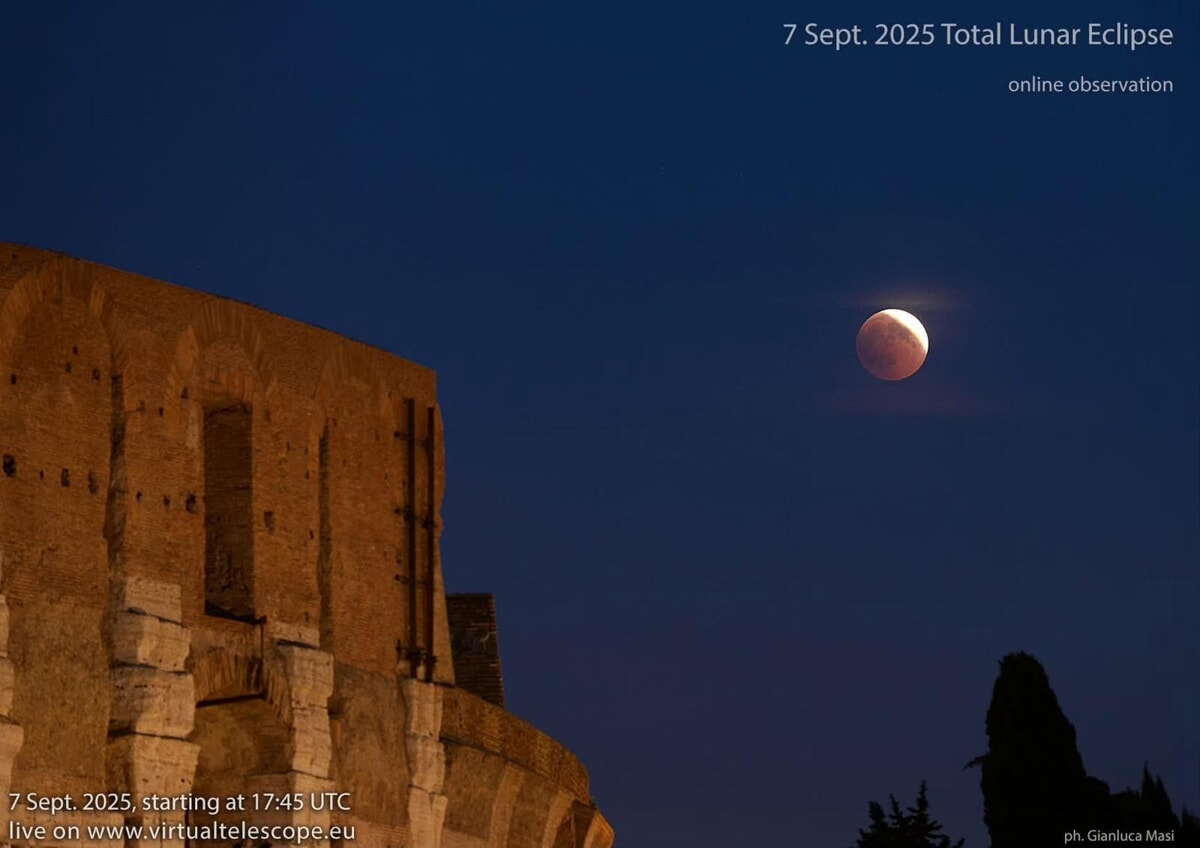
It must be taken into account that when the eclipsed moon will be about to rise, the sun will be just about to set on the opposite side, therefore the sky will still be bright, well inside the civil twilight. This “dilutes” a little the bronze color of the very young total phase, which will also be affected by atmospheric absorption, which “gives up” a little red to the satellite.
Since the highlight will take place with the newly built moon, therefore low to the East, it will be essential to choose a place of observation that does not show significant obstacles in the east direction. Virtual Telescope Project I will show the eclipse on its website live.