

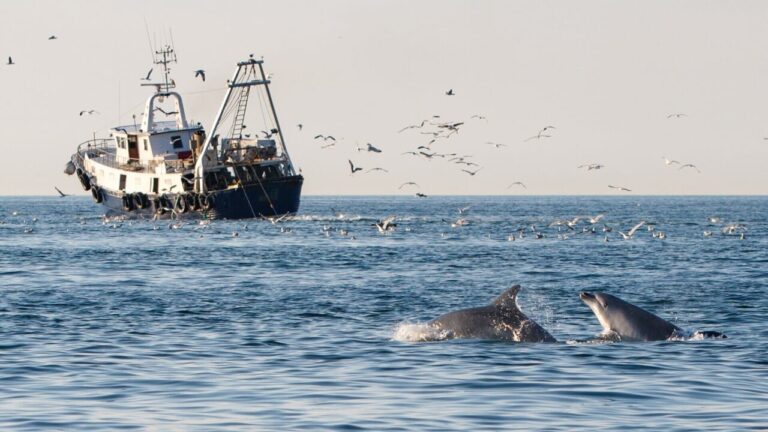
The waters of the Adriatic are increasingly uninhabited. Decades of overfishing and seabed exploitation have reduced numerous fish stocks and profoundly transformed marine ecosystems, forcing large marine predators to move towards fishier waters. In the northern and central sector of the basin, the bottlenose dolphins, or bottlenose dolphins (Tursiops truncatus) is now the only cetacean present regularly, but they too seem to have more and more problems obtaining food, so much so that they now depend on the passage of trawlers to collect waste or steal fish directly from moving nets. A behavior that puts animals at risk, and which is a sign of an increasingly fragile state of health in our seas. The alarm was raised by a study carried out along the coasts of Marche and Veneto by an international research team, and recently published in the journal Frontiers in Mammal Science.
A submerged desert
The Mediterranean Sea is one of the most exploited marine areas in the world for fishing, with levels almost double those considered sustainable by the FAO. And within the Mediterranean, the Adriatic is the area most heavily affected by overfishing, which in our waters is mainly practiced with trawl nets, a destructive fishing system, which causes profound ecological changes in the seabed.
As the authors of the study point out, the Adriatic is historically one of the areas most intensely subjected to trawling in Europe, and now has one of the worst seabed health conditions in the world. What were once complex three-dimensional habitats rich in life have been progressively transformed into desolate plains, on which a fleet operates which on the Italian side alone has around a thousand trawlers. As a result, the ecological communities in our waters have suffered a vertical decline: sharks and rays, for example, have declined by 90% in the space of just sixty years. And predators such as cetaceans have found themselves without prey, in many cases finding themselves forced to seek fishier waters to survive.
Bottlenose dolphins are among the last remaining, but they too have had to adapt, learning to exploit human networks to find food. The study, in which researchers from the NGO Dolphin Biology and Conservation of Cordenons participated, was created precisely to verify how dependent Adriatic dolphins are today on human activities for their survival.
Eight years of research at sea
The monitoring was conducted over eight years by independent research vessels, covering an area of approximately 3,000 square kilometers off the coast of the Veneto region and 2,000 square kilometers off the coast of the Marche region. The scientists carried out 859 visual inspections on different types of fishing vessels during 148 fishing days. During the observations, thousands of photographs were taken of the dorsal fins of the cetaceans, a technique known as photo-identification, which allows us to recognize individual individuals and calculate the frequency with which the same animal returns to follow the boats.
“We estimated that the dolphin populations of the Veneto and Marche combined exceed 1,000 individuals,” explains Silvia Bonizzoni, director of Dolphin Biology and Conservation and co-author of the article. “Between 86 and 90% of bottlenose dolphins, depending on the region, have been photographed one or more times following trawlers. Evidence suggests that the majority of a relatively large dolphin community regularly feeds following trawlers.”
The data collected by the study show clear geographical differences: dolphins were found to be present in the wake of a quarter of the fishing boats inspected in Veneto, while in the Marche the percentage rose to three quarters of the boats inspected. The authors also exclude that this is a limited or occasional phenomenon.
“The long-term, constant and deliberate association with fishing boats suggests a high degree of dependence on that type of fishing,” explains Giovanni Bearzi, first author of the research and president of Dolphin Biology and Conservation. “Although bottlenose dolphins still need to forage independently on days when fishing is not permitted, when fishing boats are at sea they predominantly hunt near nets.”
The dolphins – explain the researchers – are able to perceive trawlers from distances of at least 2.6 kilometres, and deliberately approach them to look for food in their wake. They slip into moving nets to capture trapped fish, extract organisms from the external meshes and consume the waste thrown back into the sea. This is an adaptation similar to that of polar bears and other terrestrial predators who, driven by the scarcity of prey, end up depending on the waste around human settlements.
The dangers and prospects of conservation
When they hunt near fishing boats, dolphins are at constant risk of suffering serious injuries or becoming trapped in nets and drowning. Exposure to engine noise causes permanent damage to their hearing systems and interferes with their communication systems. Furthermore, proximity to ships increases contact with chemical pollutants, while competition alters the social structure of the herds.
The fact that bottlenose dolphins choose to expose themselves to these threats proves that finding enough food in a sea depleted by overfishing is now increasingly difficult: for these animals, taking the risk is probably the only alternative to starvation. And the recent history of the Adriatic should have taught us something: the common dolphin (Delphinus delphis), very common along the Italian coasts until the post-war period, has now almost completely disappeared and is classified as in danger of extinction in the Mediterranean. To avoid the disappearance of large predators and protect sustainable fishing, the authors of the study underline the need to follow up on the proposal made by the European Commission in 2023 to ban trawling at least within marine protected areas, where today – a counterintuitive circumstance to say the least – it is still permitted.
“When the majority of wild marine predators resort to opportunistic foraging around fishing gear, you can be sure that human interference has reached a point of no return,” concludes Randall Reeves, chair of the US Marine Mammal Commission’s Committee of Scientific Advisors and co-author of the study.
Dossier is the exclusive subscription investigative section of The Vermilion. If you want to support our journalistic work and subscribe, visit our shop window by clicking here.