

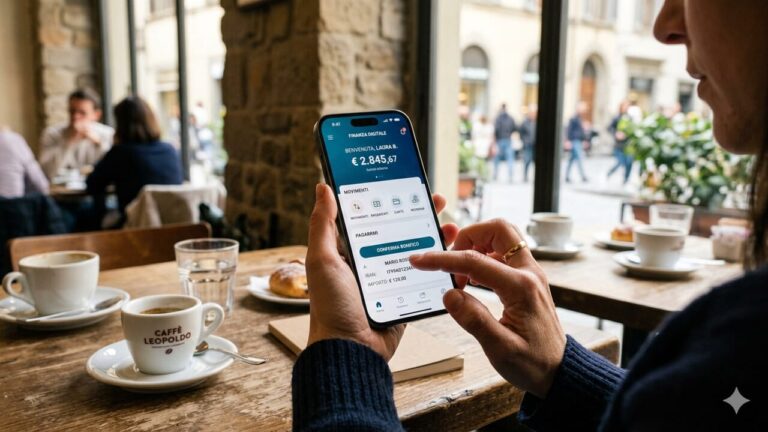
Is it really worth switching to digital-only banks and abandoning the branch?
Traditional banks have closed thousands of branches, pushing customers towards apps. This is certainly nothing new. At the same time, however, digital-only banks – the so-called neobanks such as Revolut or the Italian Isybank and Buddybank – have taken hold and progressively reached maturity. But the question, for many, is still ‘burning’: is it worth closing the old account at the branch to entrust your savings to a bank that only exists as an app on your smartphone?
Physical bank or app?
Today, almost all operations are done independently, think of completing bank transfers or F24s. The difference, therefore, does not lie in the strictly technological aspect – even the ‘historic’ credit institutions have excellent apps -, but in the business model. Digital banks, moreover, are born and grow without the enormous costs of buildings, offices and thousands of employees, and this saving (not always, let it be clear) is directly reflected in the customer’s pockets.
The pros of digital-only accounts
- Zero fee: traditional banks have raised account maintenance costs to compensate for drops in margins. And they impose commissions on the customer, up to 3 euros, on withdrawals at the counters of institutions in different circuits. Digital banks still offer free basic accounts and instant transfers included
- With the adjustment of the European Central Bank (ECB) rates, digital banks are the first to offer (rather) competitive returns on deposit accounts, allowing savings to be made profitable without the often too heavy constraints imposed by ‘physical’ banks
- Seeing is believing: digital banking apps are designed to be simple, agile and easy to use. Managing your budget or changing the pin code of the card associated with your account is immediate and does not require you to sign forms. Zero bureaucracy
- For those traveling abroad, digital banks apply official exchange rates, without the ‘disguised’ commissions of traditional circuits, which usually fluctuate between 2 and 3%.
The cons of digital-only accounts
- If there are no problems whatsoever, the digital bank is perfect. In critical moments, when there is a need for support, however, difficulties arise. If you suffer fraud, have your account blocked due to an algorithm error or have an emergency, speaking to a human operator can become a real odyssey, between AI-based chatbots that promise to solve every problem and endless waits on the phone
- The inability to deposit cash or checks is the most important limitation of digital-only banks. What to do in these circumstances? It is necessary to contact an affiliated tobacconist or often rely on ATMs of other banking circuits, having to pay all the relevant commissions
- If you need a small quick loan, usually up to 5 thousand euros, the digital bank app is better than the physical branch. But to request a mortgage or manage hereditary asset management, the advice of a natural person, who you can turn to ‘face to face’ is still irreplaceable today
- The security perceived by customers is lower. Digital banks are safe, have European licenses and join the Interbank Deposit Protection Fund, but the feeling, for many, is that they do not have a certain base to turn to in times of difficulty or simply to go and protest.