

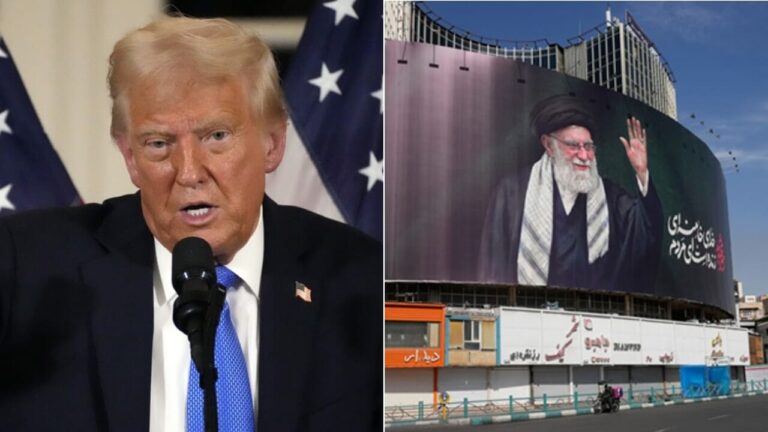
“Garbage”. This is how Donald Trump defined Tehran’s response to the Pentagon’s plan. Iran demands first and foremost the “immediate cessation of the war” and the “restoration of maritime security” in the Persian Gulf and the Strait of Hormuz. Translated: the ayatollahs will sit at the table only when Washington ends the embargo. Iranian Foreign Ministry spokesperson Esmail Baghae said Tehran’s counterproposal was “generous and responsible”, while Trump immediately branded it “unacceptable”.
On this point, the head of the White House is not entirely wrong: so far the Iranians have not made many concessions, indeed none, and even the state media, highlights CNN, underline the position of strength enjoyed by the regime despite the serious economic difficulties faced by the population. Propaganda tries to convince public opinion that the final victory is there, around the corner. With some reason that is well highlighted by Danny Citrinowicz, Middle East expert and senior researcher at the Institute for National Security Studies.
The Middle East expert: “Iran is unlikely to take a step backwards”
“Iran has no intention of surrendering or accepting Washington’s demands, neither now nor in the foreseeable future” writes the analyst in a post on X in which he takes stock of the situation. “It doesn’t matter how many threats Trump may launch threatening the end of civilization” underlines Citrinowicz who believes it is “unlikely that Iran” will take a step back from Tehran, even if the US were to resume raids (as Trump seems intent on doing).
The Pasdaran are ready for all-out resistance, although the economic and social costs are increasingly huge. According to the analyst, at this point Washington has only two options before it: “Give in on key Iranian demands or pursue regime change.” Tertium non datur. In short, Trump should try to go all-in. Or withdraw the troops (and perhaps paint the agreement as a success). “If the administration is not willing to commit the enormous military, political and economic resources required for regime change,” the post reads, “then it likely does not have the power to force Tehran to accept maximalist terms.”
“Trump will have to accept compromises”
Citrinowicz is considered among the most authoritative experts on Iranian dynamics. And on this point he has divergent opinions from those of the US administration. “Neither sanctions, nor blockades, nor other pressure tactics,” he says, will convince the Iranian government “to substantially change its negotiating position. Anyone who claims otherwise is increasingly detached from reality.” Also because, he points out, “Iran and its regional proxies maintain a significant capacity to inflict economic and strategic damage on the Gulf states, particularly in the energy and maritime sectors.”
The gist is simple, the analyst claims: “In Washington there is the illusion that Iran has emerged weakened, isolated and surrounded by military pressure, sanctions and the threat of escalation” while the Islamic Republic “believes it has demonstrated resilience and the ability to resist enormous pressures without surrendering politically”. The regime’s narrative is strengthened, while the United States must accept that “coercion has limits.” Iran, it is highlighted, is not Venezuela. “It is a much larger, more institutionalized, ideologically committed and strategically resilient state, with deep regional networks and much greater tolerance for prolonged confrontations.” For this reason, Washington would do well to accept some compromises.
I hope these messages sink in within the administration:
A. Iran does not believe it lost this confrontation. On the contrary, from Tehran’s perspective, it proved resilience and strategic staying power.
B. Iran has no intention of capitulating or accepting Washington’s… https://t.co/MTMKxAlLIr
— Danny (Dennis) Citrinowicz ,داني سيترينوفيتش (@citrinowicz) May 10, 2026
The total stalemate
The statements of the last few hours portray an almost total stalemate. The deputy commander of the Pasdaran Navy claimed Iranian control over Hormuz, underlining that the hold on the strait has also expanded. For his part, the head of the White House is described as “increasingly angry” and assured the WABC radio station that Iran will “stop uranium enrichment 100%”
The Iranian president, Masoud Pezeshkian, said he was willing to sit at the negotiating table, while making it clear that Iran believes it has emerged victorious from the conflict. “Despite mistrust of the enemy, the Islamic Republic of Iran believes it can negotiate from a position of dignity, wisdom and opportunity,” Pezeshkian said in a statement released by his office. “Tehran – concluded the Iranian president – will have to consolidate in the diplomatic arena everything that the Iranian armed forces have achieved on the battlefield”.