

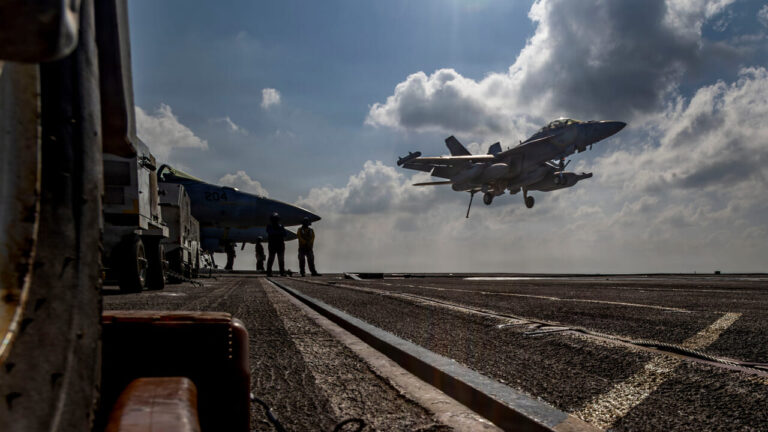
Skirmishes continue between Washington and Tehran after the missile attacks launched by the US army in southern Iran against launch sites and boats which, according to the US central command (Centcom), were attempting to “lay mines”. The Centocom spokesperson spoke of “self-defense attacks” to “protect troops from threats posed by Iranian forces”. But Washington’s operation risks triggering cascading consequences.
Iran reacts with new threats
Iran’s response came quickly. Iran’s Foreign Ministry accused the United States of violating the ceasefire agreement with “aggressive acts” in Iran’s Hormozgan region, saying the action demonstrates the U.S. government’s “malice and hypocrisy” toward Iran. Therefore, he added, Iran will not hesitate to defend itself. Iran’s Revolutionary Guards Corps said it reserves the “legitimate and unequivocal” right to react to any violation of the ceasefire, while Iran’s supreme leader, Mojtaba Khamenei, wrote on his Telegram channel that the Gulf powers will no longer shield US bases and that the United States will no longer find a safe haven in the region.
Lebanon: IDF extends operations beyond the yellow line
Meanwhile, the situation also remains hot in Lebanon, the other front in the Middle Eastern war. In recent days, the Times of Israel reports, the Israel Defense Forces (IDF) have extended ground operations beyond the yellow line, which delimits the designated security zone in some areas of southern Lebanon, as part of an effort to push Hezbollah militants further north and reduce the threat of explosive drone attacks against Israel’s northern communities. According to security sources cited by Israeli newspapers, troops conducted targeted intelligence-based raids both beyond the forward defensive line and north of the Litani River, focusing on areas where Hezbollah maintains infrastructure and operational bases. The Lebanese Ministry of Health reports that the toll from the latest attacks is 28 dead and 104 injured.
Teacher Boroujerdi: “The agreement is within reach”
In reality, however, the negotiating table continues. And it seems to be in good shape. According to Mehrzad Boroujerdi, an Iranian-American university professor at the Missouri University of Science and Technology, the agreement between the United States and Iran could be “within reach”, even if “the final solution on the nuclear dossier has not yet been reached”, but “it will arrive later”.
“Iran will reopen the strait only when it is guaranteed important concessions” explains Boroujerdi. “And he also knows he can close it at any time if developments do not go in the desired direction.” “In my opinion – continues the professor – Washington is more anxious to reach an agreement, while Tehran can afford to wait longer because it wants to be sure that a useless agreement is not reached and that it is not attacked again”.
Keshavarzian: Neither side wants to restart the war
The thesis is also shared by Arang Keshavarzian, professor of Middle Eastern & Islamic Studies at New York University. The United States “does not have good escalation options”, he tells Adnkronos, while Iran “has suffered significant damage and its economy and society are suffering”.
However, highlights the expert reached by Adnkronos, “both sides think they have won or want to be able to display a symbol of victory”. As for the crux of the negotiations, the initial framework agreement appears “built around a gradual reopening of the strait and the end of the blockade against Iran”.
“We still don’t know exactly how the strait will be managed – says Keshavarzian -, whether the current Iranian administration will remain in office, what role countries like Oman will have and what tolls or tariffs will be applied”.