

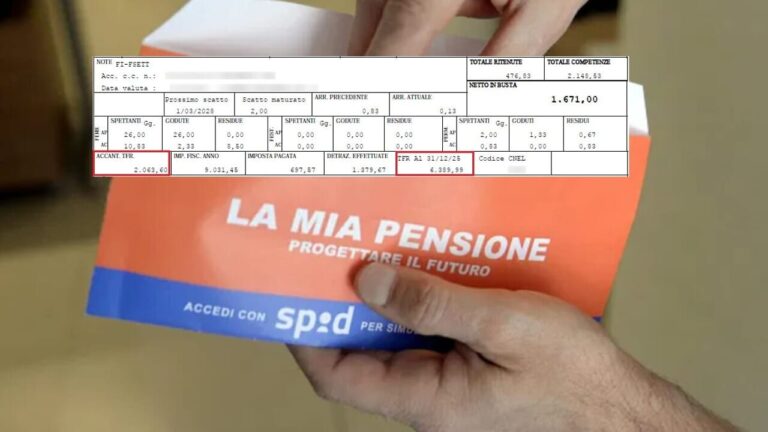
Millions of workers will have to choose what to do with their corporate “treasure”, the severance pay. From 1 July 2026, employees – not all – will have to make a decision and understand where to allocate their severance pay. The choice must be explicit and in some cases may even be irrevocable. Wrong calculations and incorrect considerations could cost thousands of euros. This is why knowing how to move now is crucial for the future.
What happens to severance pay: what’s new from 1 July 2026
The news is described as a measure for new hires, but it does not only concern those entering the job market for the first time. In essence, the terms change: new hires in general in the private sector have 60 days from hiring to communicate an explicit choice on their severance pay. In case of “silence” automatic membership of the complementary pension is triggered. In practice, the accruing severance pay will no longer remain “by default” in the company or in the INPS treasury fund in the foreseen cases, but will flow into the pension fund identified by the collective agreement or company agreements.
From 1 January 2026, other social security rules have also changed. Companies with at least 60 employees (the threshold will drop to 50 from 2028 to 2031 and to 40 from 2032) are obliged to pay the severance pay of new hires into the INPS treasury fund. What changes? Unlike severance pay in the company, funds already deposited with INPS are unavailable, as explains the same social security institution, and therefore they cannot be transferred to a private pension fund, but will be paid at the end of the employment relationship (or requested up to 70% after 8 years).
In general, for all workers who have their TFR in the INPS treasury fund – paid by the categories of companies that have been included since 2007 – this general principle stated by the Ministry of Labor applies: “The worker can always review this choice by allocating the TFR accruing to a freely chosen pension fund”. The possibility of changing choice at any time therefore concerns those who have maintained severance pay in the ordinary regime: the worker can subsequently join the supplementary pension scheme, but without retroactive effect. The severance pay already set aside in the INPS treasury fund remains there and cannot be transferred to a pension fund. Only the severance pay accruing following the new choice can be allocated to the supplementary pension scheme. And this can be done at any time. It is not possible to do the opposite process, i.e. move the severance pay from a pension fund to the INPS fund.
How much is severance pay worth?
Every year the employer sets aside a sum which will be paid to the worker at the end of the employment relationship, unless advance payments are made in the foreseen cases. It is worth approximately 6.91 percent of the useful annual salary. The law calculates the annual quota by dividing the salary by 13.5, on which the foreseen contribution and tax rules then apply.
If it remains in the ordinary regime, the severance pay is revalued every year with a formula established by law: a fixed 1.5 percent plus 75% of inflation, calculated on the basis of the increase in the Istat consumer price index for families of workers and employees.
Example: an employee with 30 thousand euros of useful annual salary sets aside approximately 2,073 euros gross per year. According to the revaluation, with inflation at 2 percent, the legal yield would be 3%. Thus, in this situation and without taking into account changes in salary, periods not worked and taxes, after five years the worker would have accumulated around 11 thousand euros gross; after ten years almost 23,800 euros; after twenty years approximately 55,700 euros; after thirty years just under 99 thousand euros. But now, we can try to understand whether to allocate the severance pay to complementary funds.
The three paths you can take
As mentioned from July 1, 2026, the worker will be faced with a crossroads with three roads. The first is to explicitly choose to keep the severance pay in the ordinary regime: in the company or in the INPS treasury fund for companies subject to that obligation.
The second is to explicitly choose to allocate the severance pay to a form of complementary pension: usually the pension fund provided for by the collective agreement, but in some cases also an open fund or an individual pension plan, if chosen by the worker according to the applicable rules.
The third is not to choose. And this is where the news comes for new hires: silence will result in automatic membership of the supplementary pension scheme. The accruing severance pay will be directed to the pension fund provided for by the collective agreements or contracts, including territorial or company ones. What if there are multiple reference funds? The destination will be the one with the highest number of members in the company, unless otherwise agreed by the company.
What changes between TFR in the company and in a pension fund
Leaving the severance pay in the company follows the “zero surprises” logic. Our money will move according to a simple and predictable pattern, with the parameters seen above: 1.5% fixed annual revaluation plus 75% of inflation. This guarantees stability and growth linked to price trends, but does not allow you to benefit from any higher returns in the long term.
Allocating the severance pay to a pension fund, however, means transforming it into invested pension savings. Returns change, but so do risks. Our sums will grow based on market returns and the chosen investment line, with the possibility of obtaining higher results in the long term, but also with the risk of fluctuations in the short term.
It is then necessary to specify the difference in taxation. The severance pay left in the company or to the INPS treasury fund, when liquidated, is subject to separate taxation and the reference IRPEF rate is applied to the average income of the worker in previous years. The severance pay paid to the pension fund, however, when it becomes a social security benefit, is taxed with a preferential withholding tax, at 15%, which is reduced by 0.30 percentage points for each year following the fifteenth, up to a minimum of 9%. Furthermore, the returns accrued in the fund are taxed at 20%, with a lower rate for the portion invested in government bonds. However, important distinctions remain: the portion of severance pay paid to the fund is not tax deductible, while the additional contributions of the worker and the employer are within the established limits.
TFR in the company or pension fund? To whom it is more convenient
So what should you do? There is no single recipe. For a young person under 30 or a new employee, the pension fund is almost always the winning move, because the long time horizon makes the compound interest run, unlocks the employer’s extra contribution and guarantees a minimum final taxation of 9% by taking advantage of investment lines that are initially more oriented towards equities.
Similarly, for senior roles or those with medium-high incomes, the complementary pension offers better fiscal conditions, reducing the tax on severance pay from 35% and above (expected in the company) to a maximum of 15%, with the advantage of being able to deduct up to 5,300 euros per year in voluntary contributions. On the contrary, leaving the TFR in the company is convenient for those who often change jobs or plan large immediate expenses (such as buying a house without having other savings aside), given that the company liquidation is released in a few weeks at the end of each contract and acts as an immediate economic parachute, avoiding the bureaucratic delays that the funds require for the redemption of the sums.
The 4 most difficult cases
The first is the case of the young but precarious worker. He would have years of work ahead of him, so the pension fund is theoretically suitable. On the other hand, however, he may need immediate liquidity and change jobs often. Here the best choice is not automatic. If the contract offers a negotiation fund with employer contribution, membership may still be useful. If, however, the job is very unstable and the income is low, it may be prudent to pay only the severance pay, avoiding too heavy personal contributions.
Is a supplementary pension still worth it after the increase in interest rates?
The second case is the immigrant worker or in any case those who are not sure of staying in Italy. The supplementary pension remains transferable and redeemable in some cases, but the choice requires attention: it is necessary to understand what happens in the event of return to the country of origin, loss of participation requirements or change of sector. Leaving the severance pay in the ordinary regime may be simpler, but not always more convenient.
The third category includes those who have debts or a low income. Here the pension fund can be useful in the long term, but as long as it does not worsen the financial balance. In these cases it may make sense to allocate the severance pay to the fund only if the personal contribution requested is sustainable or if it is not mandatory.
A 250 billion euro “treasure”: who are the lords of the Italian pension funds
Then there is the case of those who are already registered with a pension fund and change jobs. The new employer must verify the choice already made and inform the worker. If the worker does not indicate within 60 days to which form the severance pay accruing in the new relationship should be allocated, the automatic membership mechanism applies. Those who change companies should therefore immediately check whether it is worth keeping the old fund, transferring the position or joining the fund of the new contract.
The 5 checks to do before signing
First, you must not let the 60 days pass without understanding the consequences. The choice must be communicated in writing to the employer, using the forms provided for the destination of the severance pay and, if joining a pension fund, also the documents of the chosen fund. But before signing anything you should check these 5 points.
- The pension fund envisaged by your collective agreement: it is often a category negotiated fund, with costs on average lower than other individual forms.
- The employer’s contribution: in many contracts, if the worker joins the fund and also pays his own contribution, the employer must add a contribution at his expense. This is one of the main advantages of supplementary pension provision: it does not only concern the severance pay, but also an additional portion that the worker would otherwise not collect.
- The investment: a young person with 35 or 40 years ahead of him can bear a different amount of risk than a worker close to retirement. Regarding the pension fund, it is necessary to understand whether the type of investment envisaged is bond, balanced or equity.
- The need for liquidity: the severance pay in the company and the pension fund have different rules for advances. Ordinary severance pay can usually be advanced after at least eight years with the same employer, within quantitative limits and for specific reasons. In pension funds, advances are possible, but they follow a strict discipline for proven cases of necessity.
- The reversibility of the choice: choosing to leave the severance pay in the company does not exclude switching to supplementary pension provision in the future. You can always change your mind later and allocate your future severance pay to a pension fund. As already explained, however, it is good to remember that the TFR accrued and already transferred to the INPS treasury fund becomes unavailable until a new choice is made.
The news of July 1, 2026 does not impose obligations, but it could make it more expensive not to choose.
Dossier is the investigations section of The Vermilion. If you want to support our journalistic work and subscribe, visit our showcase by clicking here.