

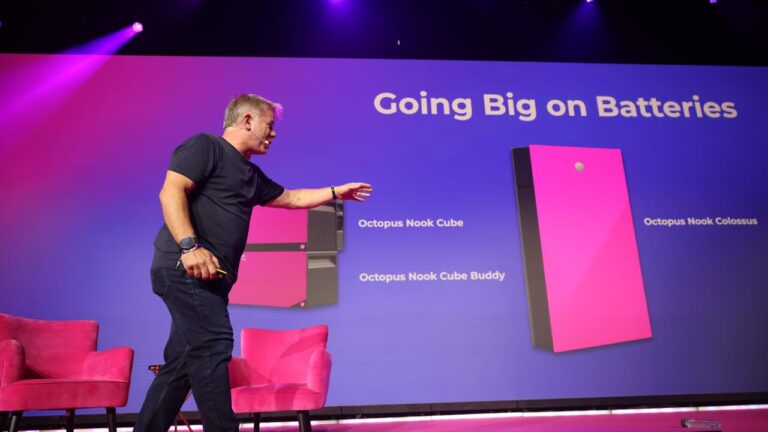
The answer to the problems of high bills for the energy transition may be a battery to be installed at home. At least according to Octopus, which launched “Nook”, a home energy storage device, on the market. These batteries will arrive in Italy in 2027: the promise is to reduce bill costs, also getting paid by the network and overcoming the gas “dictatorship”, which forces us to have high energy prices, keeping us exposed and vulnerable to international shocks as seen with the wars in Ukraine and Iran. “Managing the network with twentieth-century logic is of little use,” the CEO of Octopus Italia, Giorgio Tomassetti, tells Dossier The Vermilion, who explained how Nook works.
What is Nook by Octopus
Nook is a home battery that allows you to accumulate energy. At the moment there are two models, both guaranteed for 12 years: the first is Nook Cube, a device the size of a shoe box, which starts from 2 kilowatt hours of capacity and can be expanded up to 10.5 kilowatt hours. It connects directly to a normal home electrical socket like any household appliance, without requiring structural installations or the intervention of a technician.
For those who own independent homes and have greater consumption needs, there is Nook Colossus, a wall system – which requires professional installation – which starts from 5 kilowatt hours and can be modulated up to a capacity of 30. After installation, the customer does not have to do anything: the artificial intelligence will manage the charge and discharge cycles to maximize savings on the bill, with the monitoring system active via app.
How the battery works that saves on your bill
The battery activates when it’s time to do so. Every day wholesale energy prices rise and fall, even going from 0 euros – when renewables set the price, but we have seen that it is a paradox – to over 100. The reason lies in the functioning of the energy markets and in the Italian mix, which runs on gas more than 40 percent of the time.
The Octopus battery takes advantage of these electricity market fluctuations and time-based tariffs to save users money. “The basic thesis is that a superior mix of renewables works much better with a higher number of batteries – explains Giorgio Tomassetti to Dossier The Vermilion -. Even if today we stopped installing new renewable plants, with more batteries we would still be able to extract much more value from the current grid”.
As? “We charge the battery when the price of energy drops and we discharge it when needed – explains the CEO of Octopus -. This means being remunerated for helping the network without having to do anything as a consumer, going beyond the simple idea of self-consumption”. And there is a difference if you charge the battery while the cost of wholesale energy is close to 0 euros compared to when it reaches peaks of 200: “By doing it automatically many times a day and for the whole month, you reduce the cost of energy.”
Batteries against the waste of renewables: how much you save on your bill
The Octopus battery is active in the UK market and will arrive in Italy from 2027. But how much will you save on your bill? Tomassetti estimates similar savings to their smart charging system for electric cars, a 30 percent discount on the tariff: “With batteries you can expect similar savings, but you can go further. If the grid recognized the value of private individuals in solving balancing problems, it would be cheaper to pay people rather than a gas or coal power plant,” says the CEO of Octopus. And everyone benefits: “In the United Kingdom this mechanism is already active: the network pays Octopus, which in turn pays the customers”.
How many years does a photovoltaic system to install on the roof of your house pay for itself – by Alberto Berlini
“We believe that if people participate in the energy system, everything works better. Managing the electricity grid with the logic of the twentieth century is of little use. With technology, the consumer can do a kind of automatic ‘daily trading’. And it is also cheaper to pay people compared to a gas or coal power plant. So, if the grid makes funds available to us to do this, we are no longer talking about discounts, but actually about getting paid.”
Getting paid with a battery at home: the State also benefits
Having more batteries and storage systems across Italy would reduce the need to rely on gas: this way the energy produced by renewables could be stored when it is really needed. “Italy’s real problem is gas – says Tomassetti – every time gas fluctuates, energy fluctuates. By optimizing the grid through thousands of small domestic batteries, the need to resort to gas power plants at peak moments would be reduced. Thus, we will have less and less need of marginal energy from gas. And if gas were only needed for 10% of the time instead of 40%, the entire system would be more protected from geopolitical oscillations. Otherwise it’s like playing roulette”.
Dear bills, how much Terna and Arera weigh on our expenses – by Cesare Treccarichi
The use of gas is linked to the characteristics of the Italian electricity network which costs us tens of billions of euros every year between maintenance, compensation for Terna and incentives that are not always effective for the power plants that generate energy: “In summer the network goes under stress in the evening, around 9pm, when the air conditioners are still on. If the network abandoned the old protectionist logic, it could pay citizens for every kilowatt saved in those critical moments. This would give a double advantage to the customer: energy at a lower price and remuneration from network”.
Why electricity costs 0, but we pay more and more for it: the paradox of high bills (even in summer) – by Cesare Treccarichi
These network costs end up on your bill. But what would happen if we all had a battery at home, with or without Octopus? Ultimately, according to Tomassetti “we need to work on the cost of energy, but also on the network item in the bill. If we remunerate distributors based on efficiency and not on how much network they build, the scenario changes. It is a market design issue that Europe is trying to address. It is not a question of ‘if’ it will happen, but ‘when’ it will happen. When batteries cost less and less and you can save money, what reason do you have for not installing them?”.
Dossier is the investigations section of The Vermilion. If you want to support our journalistic work and subscribe, visit our showcase by clicking here.