

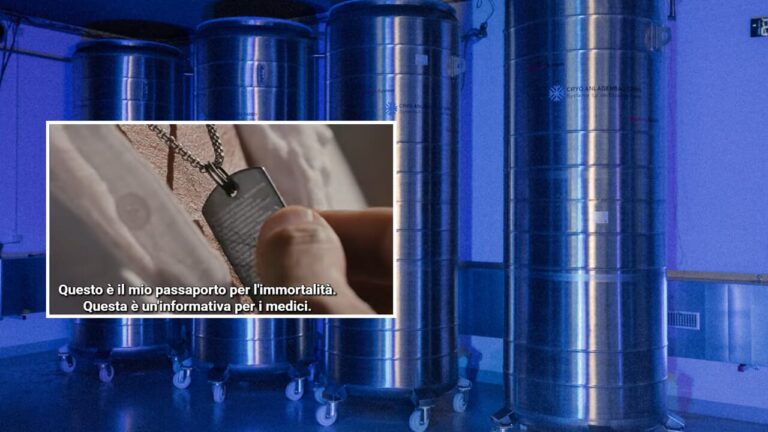
Imagine closing your eyes today and reopening them in 2225. Two centuries passed without aging a day, without perceiving the passage of time. Meanwhile, the diseases that kill us today may have become curable, artificial intelligence may have revolutionized medicine, and humanity may have colonized other planets. Science fiction? For the moment yes. But there are those who are willing to pay 200 thousand euros to bet that one day all this will be possible. In Switzerland there is an underground facility that preserves bodies of legally deceased people at temperatures close to 196 degrees below zero. It is a real plant, managed by the European Biostasis Foundation, with which Tomorrow Bio, a German company specializing in human cryopreservation, collaborates.
Founded in Berlin in 2020 by Emil Kendziorra and Fernando Azevedo Pinheiro, Tomorrow Bio had raised five million euros in funding in May 2025, with the aim of expanding its operational network and supporting research. Membership growth has been rapid. When the British television network BBC visited the company in January 2025, there were almost 700 customers and just three or four people already cryopreserved. In August 2026, the members had exceeded one thousand and the retained patients had become 28, to which were added 14 pets. Among the members – as the Progetto Happiness report says – there are also 51 Italians, which places our country in seventh place in the company’s world ranking, behind Germany, France, the United Kingdom, the United States, Spain and Switzerland.
The bunker to wait for the future
Tomorrow Bio was founded in 2020 by Emil Kendziorra, a German doctor and former oncology researcher. The basic idea: if current medicine can’t save a person, perhaps future medicine can. This is why we need to preserve the body, and especially the brain, before the deterioration becomes irreversible.
The property is located in Rafz, Canton of Zurich. Here patients are stored in cryogenic containers called dewars: thermally insulated tanks that use liquid nitrogen and do not require continuous electrical refrigeration.
The procedure can only start after legally ascertained death. From that moment on, a race against time begins: the absence of blood circulation deprives the brain of oxygen and starts the deterioration of the tissues. Specialized teams intervene with cooling systems and, when possible, mechanical circulation support. Then we proceed to the perfusion of cryoprotective substances.
The technique used is vitrification, different from simple freezing. Freezing a body forms ice crystals that damage cells and tissues. Vitrification tries to avoid this by bringing biological liquids to a glass-like state. The body is then gradually brought to cryogenic temperatures and transferred to containers for long-term storage at a separate facility, the Patient Care Foundation.
Limitations remain. Cryoprotective substances can be toxic. Their distribution in the tissues is not uniform. Cooling still causes damage. And above all: today there is no technique capable of bringing a cryopreserved body back to life. And a fundamental unknown remains: no one can guarantee that a foundation or a financing system can last for two or three centuries.
How much does it cost
Tomorrow Bio claims to have exceeded one thousand members willing to pay an annual fee to ensure the service, even by “guaranteeing” their life insurance policy. The number of people already cryopreserved is in the order of a few dozen: a figure still small, but sufficient to demonstrate that the sector has now overcome the phase of theoretical experiments alone. And the business, meanwhile, grows.
The rates published on the Tomorrow.bio website illustrate how the ordinary membership fee is 50 euros per month, or 500 euros per year. It serves to support the organisation, equipment and availability of specialized teams. But the most important cost comes with the cryopreservation procedure. For those who are already registered, preserving the entire body costs 200 thousand euros, while for the preservation of the brain alone, 75 thousand are enough. Those who request the service without already being a member pay 230 thousand and 115 thousand euros respectively. Payment can be arranged in advance, including through a life insurance policy that guarantees the resources needed at the time of death.
The sum is not just used to pay for conservation. It also includes emergency operations, treatments, transportation and other services provided for in the contract. For long-term custody, a separate structure comes into play, the Patient Care Foundation, within the organizational system involving Tomorrow Bio and the European Biostasis Foundation. The objective is to guarantee continuity of conservation even for very long periods. A project that presupposes not only the technical stability of the plants, but also the economic and organizational capacity to keep them operational for generations.
Italians want to wake up to the future
Among the people interested in cryopreservation there are also Italians. Among those who have already signed the contract is Giuseppe, 54 years old, a tour guide from Gaeta, who always wears a medical medal around his neck with emergency instructions. To overcome the complex Italian bureaucracy that prevents the rapid expatriation of the remains, he used the ploy of the living will and declared that he would donate his body for scientific purposes to the Swiss organization. Elisa, 31 years old, from Rome, has instead decided to enroll not only herself, but also her Bengali cat, Eros, in cryopreservation. “Knowing that this possibility exists gives me peace of mind”
This is the most controversial point of the whole affair. The conservation of cells, embryos and some tissues at very low temperatures is already a consolidated practice in medicine. But preserving a whole human organism and then bringing it back to life is a radically different problem. Vitrification can limit the formation of ice crystals, but does not guarantee the intact preservation of all biological structures. And the brain is the most delicate organ: inside it the organization of the nervous connections on which memory, personality and individual identity depend should also be preserved.
A scientific study published in 2024, Biostasis: A Roadmap for Research in Preservation and Potential Revival of Humansdescribes cryopreservation as a field of research that still presents enormous obstacles, from the quality of preservation to the very possibility of repairing and reactivating a human brain in the future. These obstacles have not been proven to be insurmountable. But it hasn’t even been proven that they can be overcome. Supporters of cryopreservation reason like this: if a person is buried or cremated, the possibility of bringing him back to life through future technologies is definitively lost. If the body is preserved, at least some of the biological information could survive long enough to be recovered. The problem is that, in the current state of knowledge, we do not know whether that information can be preserved completely enough, nor whether a future awakening will ever be possible.
Ultimately, this is what Tomorrow Bio sells: not immortality, but the completely hypothetical possibility of benefiting from a medicine that does not yet exist. For now, behind the walls of the Swiss bunker, there are bodies of dead people, kept in the hope that one day science will be able to do what it cannot do today.