

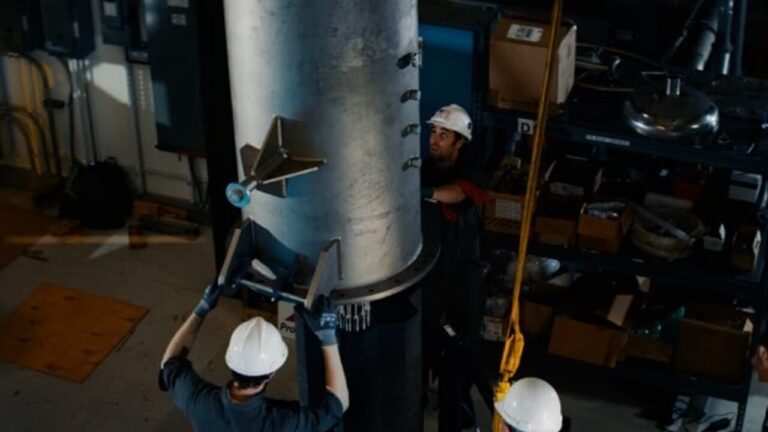
From huge nuclear plants to microreactors capable of being transported on a cargo plane or space module. At the moment we are only in the experimental phase, but in the future the reactors could be in “living room” format. A future not too distant. The American startup Antares announced yesterday, Thursday 4 June, that it has managed to operate its nuclear microreactor prototype autonomously, the first ever for a private company in the USA.
The nuclear microreactor
As also announced on the US Department of Energy website, the Mark-0 experimental model has reached the so-called “criticality”, i.e. the phase in which a self-sustaining nuclear fission chain reaction is triggered. When the reactor reaches this threshold it is able to produce energy continuously and autonomously. The Mark-0 is one of eleven microreactor and Small Modular Reactor (SMR) projects selected by the United States Department of Energy (DOE) as part of the Reactor Pilot Program, an initiative that aims to bring several projects to criticality by July 4th, American Independence Day. Antares was the first company to achieve the goal. The test was conducted at the Idaho National Laboratory (INL), a research and testing center located in Idaho Falls, in the State of Idaho.
“For the first time in more than forty years, a new privately developed non-light water reactor has reached criticality in the United States,” said US Secretary of Energy Chris Wright. “I thank President Trump for his courageous leadership and thank the scientists and entrepreneurs at Antares and Idaho National Laboratory who helped make this moment possible. I look forward to seeing the continued progress of America’s nuclear renaissance.”
How it works
The Antares Mark-0 reactor uses liquid sodium as a coolant at atmospheric pressure, differentiating itself from conventional pressurized water plants and overcoming the risk of steam explosions, the cause of the Chernobyl disaster. Based on technology dating back to the 1950s, this solution is proposed here in a miniaturized version. More details on sodium reactor technology are available on the Antares website. However, sodium requires specific safety measures, since it can ignite in contact with air and explode if it comes into contact with water. Antares plans to put small reactors into operation at US military sites by September 2028.
The success was also celebrated with a video on social media by Jordan Bramble, the CEO of Antares: “We went from concept to criticality in less than twelve months”. In order to be commercialized, the Antares reactor – which currently operates thanks to a special authorization from the DOE – will have to obtain certification from the Nuclear Regulatory Commission (NRC), the federal regulatory authority for the nuclear sector. So far, the only reactor project approved by the NRC is the one developed by the startup NuScale Power.
The “mini” size
Antares did not provide specifications on dimensions, but the real strong point of this reactor is its ultra-compact design, engineered to occupy an overall volume similar to that of a home living room. This miniaturized architecture responds to precise military and aerospace logistical constraints. The system is in fact sized to be easily loaded into the hold of a single C-17 cargo plane. This allows up to five complete units to be transported simultaneously and deployed in record time to the most isolated operating bases or future space outposts.