

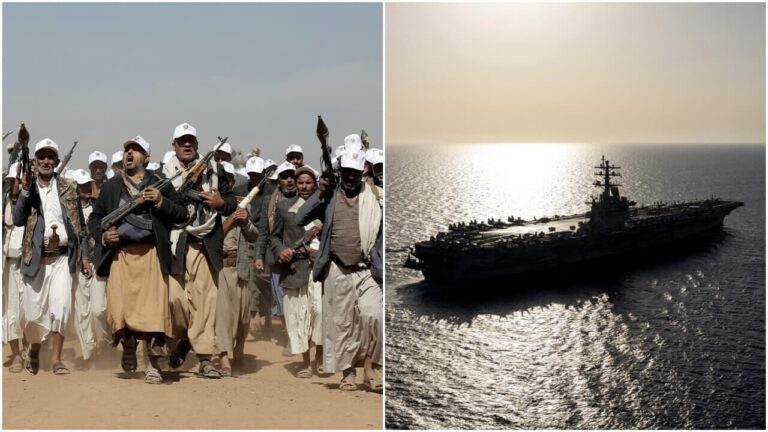
Yemen’s Houthis have announced a maritime embargo against Saudi Arabia, opening a dangerous new front in the war involving Iran and the United States. The blockade, according to military spokesman Yahya Saree, should come into force immediately according to the logic of an eye for an eye and would be a response to what the Shiite movement defines as the Saudi siege of Yemeni ports and airports.
The announcement, however, still leaves many questions unanswered. The Houthis have not explained which ships will be considered Saudi, whether only merchant ships heading to the kingdom’s ports or all vessels carrying Saudi oil will be hit. It was also not made clear whether the blockade will lead to an immediate return to attacks with missiles, drones and explosive boats that have disrupted navigation in the Red Sea since November 2023.
Why Bab el-Mandeb has become fundamental
The risk to energy markets arises from Yemen’s position. The country controlled largely by the Houthis overlooks the Strait of Bab el-Mandeb, the passage a few tens of kilometers wide that connects the Gulf of Aden to the Red Sea and, through the Suez Canal, to the Mediterranean.
Under normal conditions, the main export route for Gulf oil is the Strait of Hormuz. But since the war between the United States, Israel and Iran began on February 28, 2026, traffic through Hormuz has collapsed. Before the conflict, about a fifth of the world’s oil passed through that passage. On Sunday 19 July only four ships managed to cross it, compared to eight the previous day.
To get around the Iranian blockade, Saudi Arabia has therefore moved more than 70 percent of its normal crude oil exports to Yanbu, the large oil terminal overlooking the Red Sea and connected to the eastern fields by the East-West Pipeline.
From Yanbu, oil tankers bound for Europe sail north, crossing Suez. Those destined for Asia must instead go south and pass right in front of the Yemeni coast through Bab el-Mandeb.
In recent weeks, an average of around four million barrels per day have departed from the Saudi port, compared to less than one million in the same period in 2025. Overall, 7.4 million barrels of oil and refined products per day passed through Bab el-Mandeb in June, equal to around 7 percent of global production and almost double the 4.2 million of a year earlier.
The risk of a double closure
The Red Sea has thus become the safety valve of the world oil market. A closure of Bab el-Mandeb, while Hormuz remains all but impassable, would mean simultaneously disrupting the two main routes used to bring oil, gas and refined products out of the Middle East.
The closure of the strait in front of Yemen alone could remove or make it much more difficult to export quantities of oil equivalent to 7 percent of global supply. To these would be added the reduction in flows from the Gulf, already estimated at around 10 percent of world production since the start of the war.
Not all oil would disappear from the market. Some oil tankers may be diverted around the Cape of Good Hope, circumnavigating Africa. But the route would be much longer and more expensive, would tie up ships for additional weeks and increase insurance premiums, ocean freight rates and delivery times. The consequences would quickly affect the prices of fuel, energy and goods transported by sea.
The market reaction was immediate. Brent temporarily topped $91 a barrel, its highest level since June 11, before falling back to around $88 on news of a possible ten-day truce between Washington and Tehran.
Are the Houthis acting on behalf of Iran?
The Houthis are a political, military and religious movement born in northern Yemen in the 1990s. For over a decade they have been fighting against the internationally recognized Yemeni government supported by Saudi Arabia, although a truce reached in 2022 had greatly reduced direct clashes.
The movement is supported by Iran and is included by Tehran in the so-called “Axis of resistance”, together with Hezbollah and the Iraqi Shiite militias. Relations with the Islamic Republic, however, are less hierarchical than those of Hezbollah: the Houthis have their own Yemeni political agenda and reject the definition of simple Iranian proxies.
In the days preceding the announcement, however, sources cited by Reuters had reported that Tehran had asked the Houthis to prepare to close Bab el-Mandeb in the event of new US attacks on Iranian energy infrastructure. Missiles and drones have already been deployed on the heights overlooking Hodeidah and the Gulf of Aden.
What happened with previous attacks
The Houthis have already demonstrated that they can make navigation in the Red Sea unsafe. After Hamas’ attack on Israel on October 7, 2023 and the start of the war in Gaza, the group began targeting ships it believed were linked to Israel.
Over one hundred boats have been attacked or threatened. Companies such as Maersk and Hapag-Lloyd have abandoned the passage through Suez and chosen the circumnavigation of Africa. Despite Western military missions and hundreds of missiles and drones shot down, in 2025 traffic through the Suez Canal was still more than half lower than in 2023.
This time, however, the situation is more serious. During the previous Houthi campaign, Gulf oil could still flow freely through Hormuz. Today that door is almost closed and the entire system is increasingly dependent on the Saudi route to the Red Sea.
For the moment, the Houthis’ announcement remains without precise operational methods. But to block a sea route it is not necessary to sink dozens of oil tankers: a few attacks, or even just a credible threat, may be enough for insurers and shipowners to decide that crossing Bab el-Mandeb is no longer an acceptable risk.