

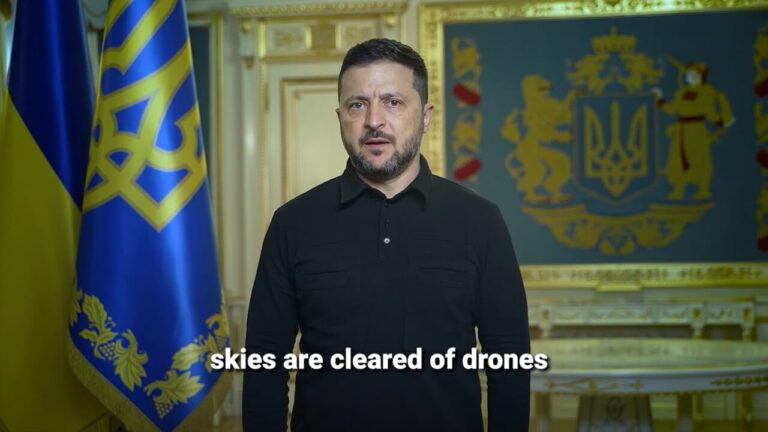
“The safe days in the skies of Russia are over.” Volodymyr Zelensky launches a direct warning and anticipates, in fact, that the intensification of Kiev’s long-range attacks will make the presence of drones over the territory of the Federation increasingly frequent, calling carriers, insurers and international organizations directly into question.
The words come at a time of new escalation of air attacks. On September 1, Russia again struck Kiev and other areas of Ukraine: Russian attacks caused 12 deaths in the capital region, the sixth consecutive day of heavy bombing. At the same time, Kiev has intensified drone operations against targets on Russian territory, including energy infrastructure.
Zelensky in video: “Russian airspace is becoming completely unsafe”
In his evening message, also published in full by the Ukrainian presidency, Zelensky reconstructs the origins of the escalation and warns that the consequences of the war will not remain within the borders of Ukraine.
“It is from Russia that the first missiles and drones came, and they crossed the border of our country from Russian airspace. This escalation cannot and will not remain confined to Ukrainian territory. Today we want to warn every airline using Russian airspace, every insurer and anyone still using Russia’s major airports: Russian airspace is becoming completely unsafe. Ukraine does not threaten civil aviation as such – not a single civil aircraft. There will simply be drones in the skies of Russia on a scale that must be taken into account consideration”.
Ukraine is a country of peace. And we truly respect the fact that our partners want to help bring this war to an end. We support every such effort. When the Americans asked us to pause strikes on Moscow and St. Petersburg on August 25, 26, and 27, we observed that pause. There… pic.twitter.com/wck56fwMUR
— Volodymyr Zelenskyy / Володимир Зеленський (@ZelenskyyUa) September 1, 2026
“Although the Russian authorities are not adequately informing people about this, Russian airspace will effectively close. The war started by Russia is closing its skies. We in Ukraine do not want innocent lives to be lost. That is why we are warning our partners: the safe days in the skies of Russia are over. It is important that this is heard by the ambassadors of the countries represented here in Ukraine, as well as by the ambassadors working in Moscow. Each of them knows exactly what Russia’s war means for the our country and our people, and they must convey this information to their capitals. It is important that airlines currently flying to airports mainly in Moscow, St. Petersburg and other key destinations in Russia are no place for civil aviation.”
EASA already advises against flying over a large part of Russia
There is already a formal alert from the European Union Aviation Safety Agency over Russian airspace. The EASA bulletin on the Russian Federation as a conflict zone is currently active and was extended on 24 July 2026 until 31 January 2027. It covers all Russian airspace west of the 60° East meridian, including Moscow, St. Petersburg, Rostov-on-Don, Yekaterinburg and Samara.
The European agency’s recommendation to interested operators is not to carry out flights in the indicated area, at any altitude. EASA indicates among the risks the activation of Russian anti-aircraft defenses in response to Ukrainian missiles and drones, the possibility of aircraft identification errors and disturbances to satellite navigation systems. The agency also recalls the case of Azerbaijan Airlines Flight 8243 of 25 December 2024 as a demonstration of the risks associated with military operations and airspace management.
Just today, Tuesday 1 September, Rosaviatsiya, the Russian Federal Air Transport Agency, imposed temporary restrictions at several airports. During the night, flights were suspended or limited to Pulkovo, St. Petersburg airport, Kazan, Nizhnekamsk and Bugulma. Similar measures had been adopted in Ulyanovsk, Sochi, Samara, Penza and Saratov.
On the same day, Sheremetyevo, Moscow’s main international airport, also operated authorized flights in coordination with authorities due to temporary airspace restrictions. Vnukovo and Domodedovo then returned to normal operations after the restrictions were lifted.