

Many leave, but there are also those who arrive. Elizabeth and Peter moved to Italy from the UK together with their three daughters. Theirs is one of the many stories of ‘expats’ found on YouTube where the genre of life experiences abroad enjoys some success. There are those who put down roots in the mountains, those who move to Papua and those who end up settling in our area, usually attracted by the artistic and natural beauty, the climate, the gastronomy and the myth of the ‘dolce vita’. If to the qualities that almost everyone recognizes in the Bel Paese we also add a cost of real estate that is still accessible (at least by Western standards) it is clear why there are still some who still choose Italy. Despite its defects which are also known beyond the border: the lack of work, stagnating salaries and a nightmare bureaucracy.
UK vs Italy: a cost of living comparison
On the channel ‘The Meadow House Diary’, Elizabeth says she left England last October with the hope “of being more financially free, saving some money and having an overall better quality of life”. The couple bought an abandoned farmhouse in a rural village in northern Italy with a barn and large land, and decided to refurbish it.
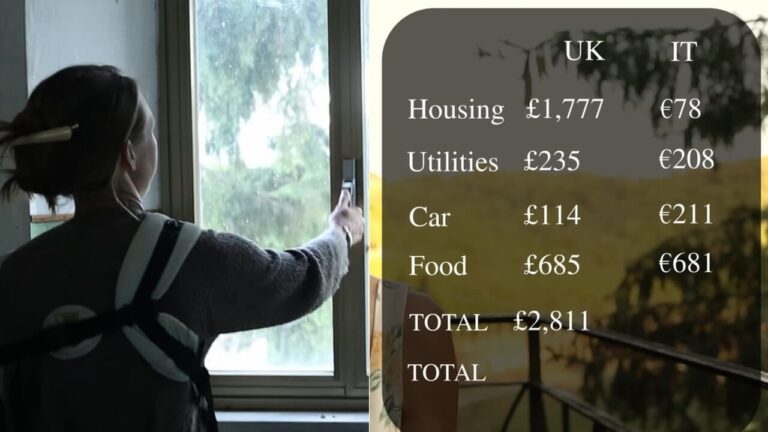
The goal – stated in another video – is to live “off-grid”, that is, to be self-sufficient and produce your own energy. No sooner said than done. The family has been settled in their new home for eight months and now it is already time to take stock. The first item that is put on the table is the cost of accommodation. “In the UK we lived in a bungalow” says Elizabeth in the video, “it had three bedrooms with about 400 square meters of garden around it. It was in Northamptonshire and we paid £1,467 a month on the mortgage for that property.” Approximately 1,712 euros.
23 euros of home insurance (mandatory with the mortgage) and around 340 euros of council tax, i.e. a tax “which is paid for services such as road maintenance and law enforcement”, must then be added to the housing expenses account. In total we are talking about an annual expense of 24,898 euros per year, equal to approximately 2,074 euros per month. A considerable outlay, although as always everything must be related to salaries.
undefined
In Italy the family does not pay any mortgage. Elizabeth explains that freeing herself from that burden “was a huge motivation for choosing this country”. If in the United Kingdom the very high cost of real estate weighed heavily on the family budget, by moving to the UK they were able to buy a property without asking for loans. “Since we don’t have a mortgage, we are not obliged to have home insurance” he explains in the video, although – he adds – “we could take out it in the future”. However, we must take into account the 600 euros per year of IMU and another 330 estimated for the waste tax (“but we are still waiting for the Municipality to tell us the exact figure”). The savings on the house are abysmal, but the absence of the mortgage partly distorts the comparison.
The bills
As for utilities, in the UK the family paid 105 euros a month for electricity (despite the solar panels), 50 for water and 38 euros for heating. And again: 45 euros per month for ultra-fast fiber and another 35 for mobile phones. In Italy the house is heated at no cost thanks to a forest located on the property. Although the water is supplied from a mountain spring, the fixed costs also include 17 euros per month for the filtering system. For the two cell phones the total cost is 16 euros per month, while the internet, provided by Starlink, costs 35 euros.
Considering all utilities, the family is saving around 800 euros a year, a nest egg destined to rise thanks to the photovoltaic panels. “I am confident that by the end of this summer we will be self-sustaining,” Elizabeth says in the video.
In Italy the car is expensive (and shopping is also expensive)
The sore points come with the expenses of maintaining the car, a Volvo V50 that the family already had in England and which was sold and then bought back exactly the same in Italy. In the UK, insurance cost just under 30 euros a month and road tax just 2, while a 50-litre tank cost just over 100 euros. The total cost in the end was estimated at around 1,600 euros per year, whereas in Italy – also thanks to a higher insurance class and the high cost of fuel – it reaches 2,532 euros.
This is followed by expenses for food, dinners out and diapers: around 800 euros a month across the Channel, and 681 euros in Italy. “I’m definitely surprised that we’re spending as much, if not more, on food, even though we shop at Lidl,” says Elizabeth. Which then goes on to list the items in detail. “Feed for chickens costs the same, 11 euros a month. Dog food costs around 40 euros a month. Diapers cost more, and this is definitely something that is much more expensive in Italy: we spend around 40 euros a month for diapers here”, despite “the decision to use washable diapers for our youngest child”.
The final bill
Doing the math, the final saving is still considerable: “In England, just to survive we still needed at least 33,732 pounds just to maintain the status quo, or around 39,000 euros. And in Italy our annual cost is now 12,117 euros.” According to the family’s calculations, the difference is therefore very important, but a large part of the difference is due to the fact that the main expense, that for accommodation, in Italy is equal to zero.
In the comments the couple responds to the objections as follows: “We perfectly understand that the comparison between a house burdened by a mortgage and our house in Italy is not homogeneous. A direct and perfectly comparable comparison”, they explain, “is not really possible – nor was it our goal – since it would involve countless variables and personal choices, such as buying or renting, the amount of the mortgage, the size of the house and the land, the quality-price ratio of the food, the lifestyle, the location and much more. This video it simply compares our family’s monthly expenses based on first-hand experience after 8 months of staying in Italy, nor does it intend to compare the economic systems of the UK and Italy, nor factors such as income taxes, salaries or average cost of living”.
“We are happy to have moved”
What had an (positive) impact on the family budget was above all the possibility of being able to buy a home of their own. Then of course, it goes without saying that there is a wide gap between the two countries on wages, but much has already been said and written on this point. What matters, after all, is that Elizabeth and her family are happy with the choice they made. “I think it was the right decision to move to Italy”, says the woman, “but we had no idea how much lower the cost of living would be here. We had made some rough calculations, but in reality we didn’t know how the council tax worked, we didn’t know how much it would cost us to have a car, but overall living here with the family is turning out to be very, very economical. I’m really happy with the choice, and now – she concludes – I’m going to make pizza alone for the first time”.