

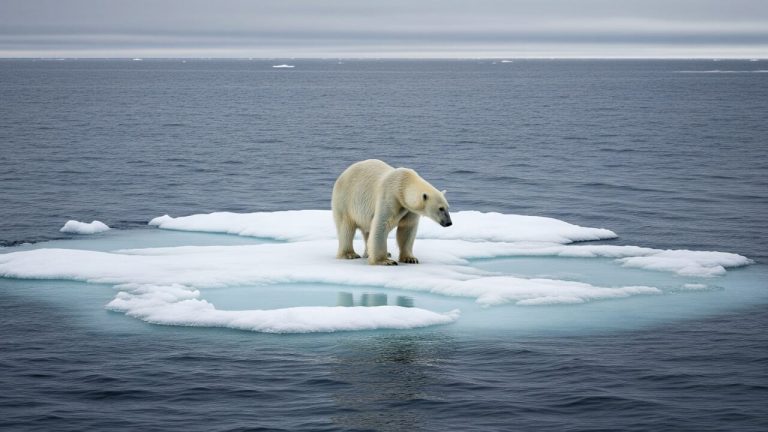
The dissolution of the Arctic Banchisa that covers the waters of the North Pole is one of the most evident signs of global warming. Starting from the late 1970s, in fact, the marine ice of the northern hemisphere have experienced an inexorable decline, and today they cover no more than 70 percent of the occupied area at the beginning of the satellite surveys. In the last 20 years, however, something unexpected seems to have happened: the dissolution of the Arctic Banchisa would seem to have practically arrested.
Is this good news? Not really: it would in fact deal with the effect of natural climatic fluctuations, which has masked the consequences of the increase in temperatures for a couple of decades, and which is soon destined to give way to the retreat of marine ice again.
The discovery comes from a study carried out by researchers from the University of Exeter and Columbia University, which used two different datasets of satellite analysis that detailed the annual dimensions of Arctic sea ice in September, that is, during the minimum extension period, to estimate the decline rate between 1979 and today.
The analyzes confirmed the reduction of the glacial coverage that took place, in absolute terms, between the beginning and the end of the observation period. But focusing on the intermediate periods, what shows the data is a slowdown in the dissolution of marine ice, which intervened since 2005. In the first decade of this interval, the reduction of the glacial coverage would amount to about 0.35 million square kilometers, while in the second it would still have fallen up to 0.29 million square kilometers. Decline rates extremely reduced compared to those seen in the previous decades, which in statistical terms – punctualize the authors of the study – are indistinguishable from zero.
They increase greenhouse gases and temperature, but not ice
To verify the possible causes of the phenomenon, the researchers have resorted to thousands of climatic simulations, obtaining a rather unequivocal response: in recent decades the concentrations of greenhouse gas in the atmosphere have continued to increase, and the Arctic temperatures have risen to a greater rhythm than those of almost any other corner of the planet; The explanation, therefore, is that some natural, and transient climatic phenomenon has counterbalanced their effects, protecting arctic ice from dissolution.
“It may seem surprising, given that the extension of Arctic ice today is at least 33 percent lower than that they had at the beginning of the satellite surveys, 50 years ago,” underlines Mark England, climatologist of the University of Exeter who participated in the research. “Yet it is absolutely consistent with the results of the simulations obtained from the climatic models, in all likelihood the result of a natural climatic variability that has overlapped the long -term trends linked to human activities. It is however a temporary break, and soon the decline of Arctic sea ice is destined to resume, and recover the lost ground”.
In short, the reduction of the Arctic Banchisa Arctic will start again, and a rhythm that could also be double compared to that seen in the decades preceding 2005. With what effects, it is difficult to say: someone in 2013 had estimated that the Arctic sea ice would disappear completely by 2020; Clearly it did not happen, and this should suggest how difficult it is to make accurate predictions in a complex field such as the climate study.
What happens if the Arctic ice melts
Speaking of the consequences, however, we can have some more certainty. Summers without Banchisa Arctic would mean a upheaval for the entire polar ecosystem, and would have the effect of further accelerating global warming. They would also risk further destabilizing the glacial cap of Greenland, whose dissolution – unlike what happens in the case of marine ice – would determine a catastrophic raising of seas and oceans, from the devastating consequences for millions of people all over the world.
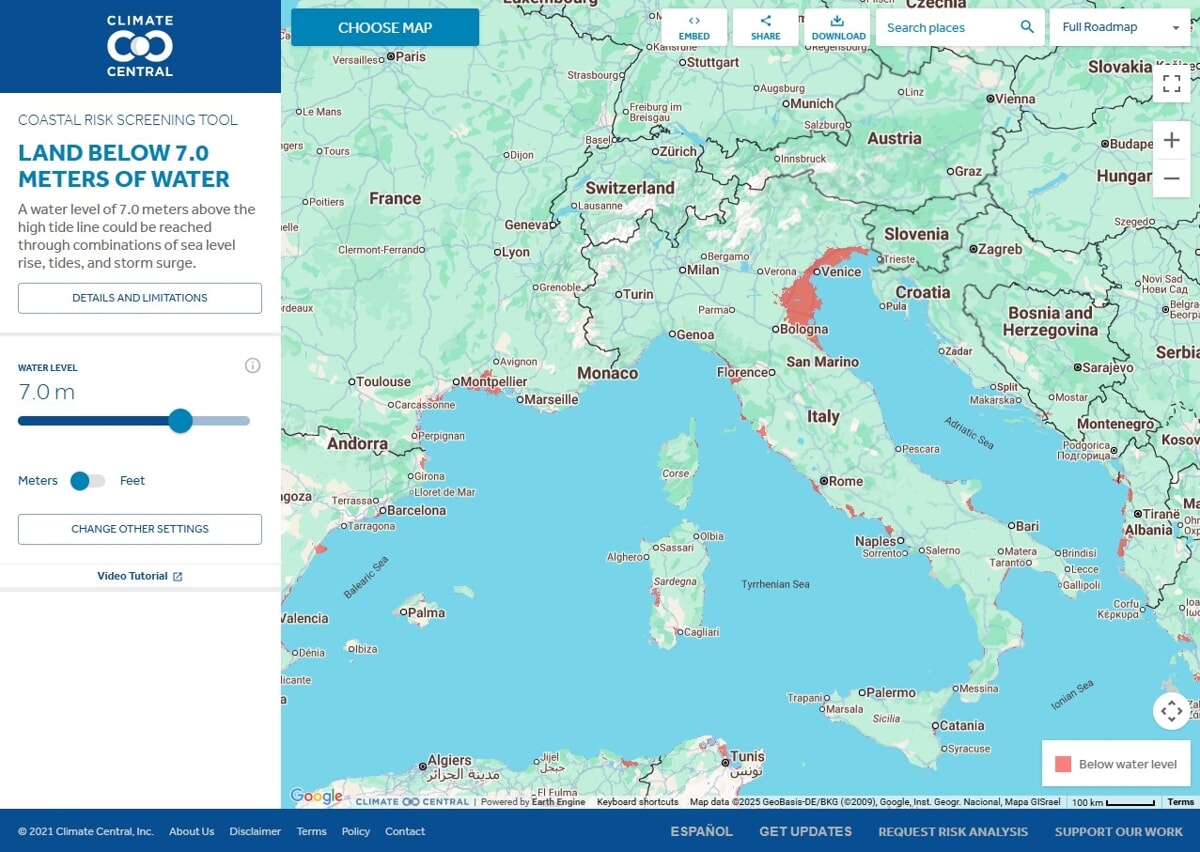
It has been calculated that if all the water kept in the glaciers of Greenland poured into the ocean, the levels of the seas would rise globally about seven meters. A circumstance that would have direct consequences on the Italian coasts: large areas of Veneto, Emilia Romagna, Lazio and Tuscany would end up being submerged by the waters. Cities such as Venice, Ravenna, Ferrara, Pisa and Livorno would disappear completely. And many others would be periodically reached by storms and anomalous waves.