

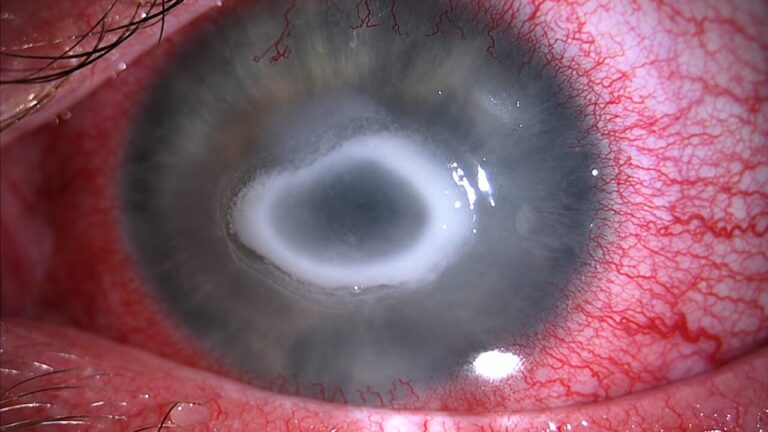
Social media can sometimes create the impression that an emergency is underway, when in fact we are faced with a known, rare and preventable risk with some precise hygiene rules. This is the case of Acanthamoeba, a genus of microscopic amoebae which, under certain circumstances, can infect and damage the cornea, causing a pathology called Acanthamoeba keratitis.
The infection is rare, but can be very serious: without timely diagnosis and treatment it can leave permanent scars, compromise vision and, in the most serious cases, make a cornea transplant necessary. The risk mainly concerns those who wear contact lenses, although it can affect, more rarely, people who do not use them, in particular when there are abrasions or previous traumas to the cornea.
This does not mean that every splash of tap water or every dip in the pool constitutes an immediate danger. Acanthamoeba is widespread in the environment and can be present in soil, dust, natural waters, swimming pools and even domestic water. Coming into contact with the microorganism is therefore relatively common; developing a corneal infection is rare.
The role of algorithms
By frequenting Instagram, Facebook or TikTok, you may see, in a few days, numerous videos dedicated to the so-called “eye-eating amoeba”. However, the repetition of the contents does not prove that an epidemic is underway.
When we interact with a video, recommendation systems can offer us other similar content, increasing the visibility of the same topic in our feed. In this way a rare phenomenon can appear much more frequent than it is in the general population.
It is one of the mechanisms that can contribute to the formation of so-called information bubbles, even if the relationship between algorithms, individual selection of content, disinformation and polarization is complex and cannot be traced back to a single cause. Some studies show that algorithms significantly change what users see; others do not find such clear effects on their opinions.
In the case of Acanthamoeba, the central point is therefore to distinguish between the rarity of the infection and the severity of its possible consequences. We are not faced with a danger that looms over anyone who uses tap water, but nor is it a risk that should be ignored for those who wear contact lenses.
How the infection occurs
Acanthamoeba is a free-living unicellular microorganism found in many parts of the world. It has an active form and a more resistant cystic form, which makes the infection particularly difficult to eliminate once it has penetrated the cornea. Keratitis develops when the amoeba manages to overcome the outermost layer of the cornea, generally through a small abrasion or other alteration of the corneal epithelium. The simple contact of the eye with water, therefore, does not automatically cause the disease.
Contact lenses are the main risk factor because they can cause small lesions, stick more closely to the surface of the eye when they come into contact with water, and trap microorganisms against the cornea. The danger increases when you swim, shower, or enter a hot tub while wearing your lenses, or when they are rinsed or stored in tap water.
Once the infection begins, early diagnosis is key. The therapy is not based on common antibiotics, which act against bacteria, but on specific topical drugs against amoeba. Treatment can last several months. In more severe cases or when significant scars remain, a cornea transplant may be necessary.
How to protect your eyes when using lenses
The first rule is to avoid contact between the lenses and any type of water. Lenses should be removed before showering, swimming, entering a hot tub, or diving in the ocean or lake. To see well while swimming, the safest solution is to use graduated goggles.
If lenses accidentally come into contact with water, they should be removed as soon as possible. The dailies must be thrown away; reusable ones must be cleaned and disinfected for the time indicated by the manufacturer before being worn again.
The solution in the lens case must be completely replaced each time it is used. It is not necessary to add new liquid to that left over from the previous day, because this practice reduces the effectiveness of the disinfection. It is also important to distinguish the saline solution from the disinfectant solution: the saline solution can be used to rinse some types of lenses, but it does not kill microorganisms and must not be used alone to preserve them.
Before handling lenses, wash your hands thoroughly with soap and water and dry them completely with a clean, lint-free cloth. Touching lenses with wet hands can transfer water and microorganisms to their surfaces.
The lens case also requires precise maintenance. It must be scrubbed and rinsed with disinfectant solution, never with tap water, left to dry upside down and replaced at least every three months or according to the manufacturer’s instructions.
The lenses must not be used beyond their intended duration or worn for a number of hours greater than that indicated by the specialist. Sleeping with lenses increases the risk of infections: even those authorized for prolonged use should be used during sleep only on the recommendation of the ophthalmologist or optometrist.
Finally, the symptoms should not be underestimated. Pain, persistent redness, strong sensitivity to light, tearing, sensation of having a foreign body and reduced vision require immediate removal of the lens and timely specialist evaluation. The symptoms of Acanthamoeba keratitis can in fact resemble those of more common eye infections, making early diagnosis more difficult.
How to protect your eyes during the summer
But Acanthamoeba is not the only microorganism that attacks the health of our eyes. To reduce the risk of keratitis, conjunctivitis and eye irritation during hot weather, experts recommend first not touching or rubbing your eyes with dirty hands and not sharing towels, wipes, cosmetics or eye drops. At the seaside and in the swimming pool it is preferable to use well-fitting goggles, avoiding as much as possible keeping your eyes open underwater: chlorine disinfects swimming pools, but the irritating substances that form when it reacts with sweat, cosmetics and other impurities can cause burning and redness. Contact lens users should remove them before swimming, showering, or entering a hot tub, because water can distort the lenses, cause them to stick to the cornea, and trap microorganisms against the surface of the eye. Alternatively, graduated glasses can be used; relying only on daily lenses under glasses does not completely eliminate the risk.
Out of the water it is useful to protect yourself from ultraviolet rays with sunglasses equipped with certified filters, avoid using lenses beyond the prescribed times and, in case of dryness, only use artificial tears compatible with the lenses and recommended by a professional. Lenses should never be rinsed with tap water or stored in simple saline solution, which does not have a disinfectant action. In the presence of persistent redness, pain, strong sensitivity to light, secretions or reduced vision, you must immediately remove the lenses and quickly contact an ophthalmologist: intense pain, photophobia and visual impairment are not symptoms that can be automatically attributed to chlorine or trivial conjunctivitis.
Dossier is the exclusive subscription investigative section of The Vermilion. If you want to support our journalistic work and subscribe, Click here.