

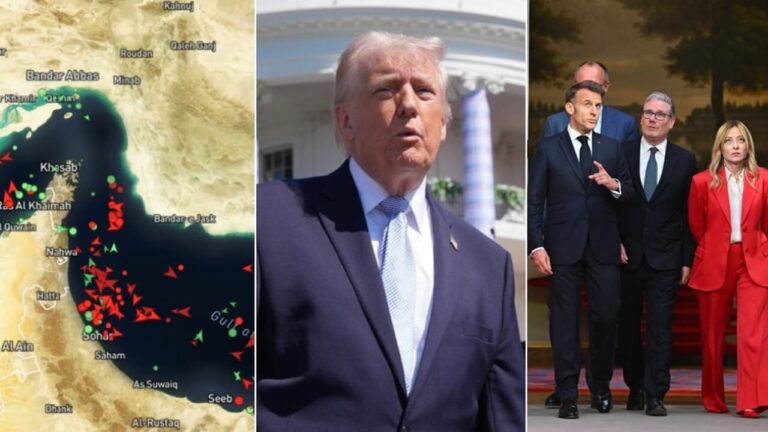
The news comes while the summit of the ‘willing’ is still underway. The Strait of Hormuz has been reopened. At least in part. Oil tankers can return to shuttling between the Gulf and the West. The markets breathe a sigh of relief. The European heads of government, too. Hoping that the truce holds.
The green light for commercial ships will last until the end of the ceasefire between Israel and Lebanon (expiring on April 25). Tehran’s Foreign Minister, Abbas Araghchi, said that the passage will be “completely open”, but the pass will need the green light from the Pasdaran.
In line with the ceasefire in Lebanon, the passage for all commercial vessels through Strait of Hormuz is declared completely open for the remaining period of ceasefire, on the coordinated route as already announced by Ports and Maritime Organization of the Islamic Rep. of Iran.
— Seyed Abbas Araghchi (@araghchi) April 17, 2026
“The transit of military ships through the Strait of Hormuz remains prohibited,” Iranian state TV announced. “Only civilian ships can transit along the designated routes, subject to authorization from the Navy of the Islamic Revolutionary Guard Corps. Civil ships must transit exclusively along the route designated by the Iranian port and maritime organization”, clarified the broadcaster again. Hormuz therefore reopens, but traffic will be limited and in any case Tehran will have the final say on which ships can pass.
Trump: “A fantastic day.” But warn NATO
Trump rejoices: “A fantastic day for the world” he writes in Truth, underlining however that the US will keep the blockade of Iranian ports in place “until an agreement is reached”. And then: “Iran has agreed never to close the Strait of Hormuz again. It will no longer be used as a weapon against the world!”.
Happy with the agreement reached, but furious with the allies. The president of the United States thunders on social media: “Now that the situation in the Strait of Hormuz is over, I received a call from NATO. They asked me if we needed help. I told them to stay away, unless they just want to load their ships with oil. When they were needed they were useless.”
Also on Truth, the head of the White House assures that “the agreement is not linked in any way to Lebanon”. He then adds that Iran and the United States are already removing mines from the Strait of Hormuz to allow navigation.
The (alleged) nuclear deal
Trump also spoke of a nuclear agreement which, however, seems to have already been denied by sources close to Tehran. Asked whether Iran agreed to stop enriching uranium, Trump replied: “Yes.” Then he added: “Yes. They accepted everything. “Are you surprised?”
The US president then confirmed to Reuters that he will work with Iran to “recover the enriched uranium and bring it to the US”. “We will recover the uranium at our leisure,” continued the Head of the White House. However, speaking to the Qatari newspaper Al-Araby Al-Jadeed, an Iranian source defined the information provided by Trump as “completely false”. According to the source, negotiations are underway with the United States on “controversial” issues, but there is no clear way out given the “excessive” American demands. Not only that. As reported by the Fars agency, an Iranian source warned the White House: “If the US blockade continues, it will be considered a violation of the ceasefire and the Strait of Hormuz will remain closed.”
Villa (Ispi) “Better than nothing, but no return to normality”
But it’s better not to have too many illusions. “No return to pre-war normality” warns Matteo Villa of ISPI (Institute for International Political Studies). “Tehran will decide who can pass and how many (15 ships a day, there were 140 before the war) and will impose the transit rules.” “The ships blocked in the Gulf – explains Villa again on
⛔️🚢 Hormuz: a quick, disarming calculation.
The ships stranded in the Gulf contain 6 days’ worth of pre-war export oil, and 7 days’ worth of LNG. If they all come out in the next 10 days it will be better than nothing, but they won’t even be able to begin to make up the deficit… pic.twitter.com/nHKeKxAYx2
— Matteo Villa (@emmevilla) April 17, 2026
The summit of the willing caught off guard by events
In the meantime, we were saying, the summit of the ‘willing’ convened in Paris by French President Emmanuel Macron and British Prime Minister Keir Starmer was taking place at the Elysée. Objective: reopen the Strait. Which however, at the end of the summit, had already been partially reopened. Among the leaders present were Prime Minister Giorgia Meloni and German Chancellor Friedrich Merz, as well as many heads of state and government via video link.
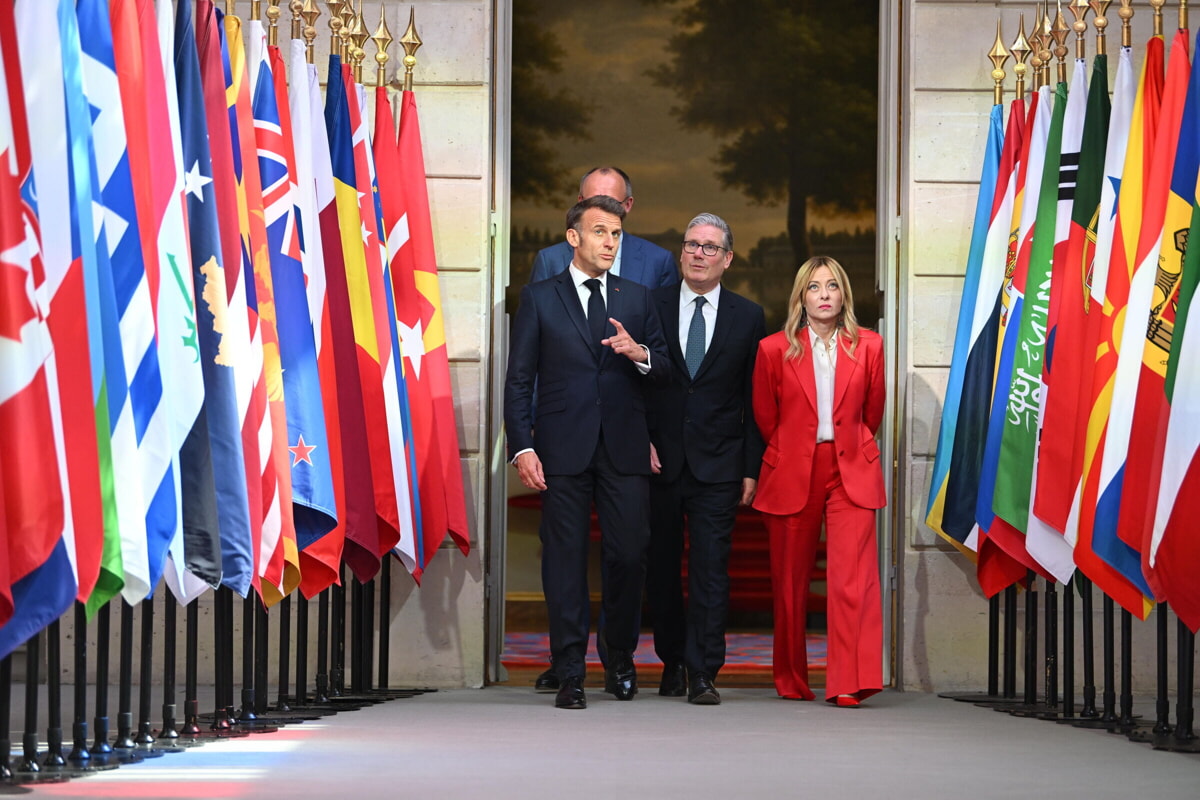
British Prime Minister Keir Starmer told a press conference that Britain and France were ready to lead an international mission to ensure freedom of navigation in the Strait of Hormuz. But at this point, at least this is the hope, the mission risks being useless.
While European leaders announced their intentions to guarantee freedom of navigation, Trump caught everyone off guard by explaining that he was already working to demine the stretch of sea. In any case, there was no shortage of ritual appeals. Macron asked “all parties” for the “full, immediate, unconditional reopening of the Strait of Hormuz. We demand the restoration of the pre-war conditions of free passage and full respect for maritime law”, he added.
Meloni didn’t hold back. “Italy offers its willingness to make its naval units available on the basis of parliamentary authorization according to our constitutional rules” the prime minister said in a press conference. “It is a commitment in line with the Aspides and Atalanta missions.”
undefined
“Freedom of navigation in the Strait of Hormuz is an absolutely central issue for Italy, for Europe, for the international community as a whole” added the prime minister. “It is about affirming a key principle of international law, a principle that applies to Hormuz and clearly to any other step on which global supply chains depend.” But Europe arrives late. Trump is already removing the mines.
The price of oil is plummeting
Meanwhile, the price of oil is collapsing. At the time of writing, Brent is trading at 89 dollars a barrel on the London market (down 10%), while on the West Texas Intermediate in New York the drop is even steeper (-12%). European gas futures on the Amsterdam stock exchange are also reacting to the news from the Middle East: the Ttf index is plummeting to 38.4 euros per megawatt hour (-9.5%), marking the lowest price since the end of February.
Giorgetti: “The situation is not resolved”
“Every day the scenario changes, so it means that uncertainty – which is the dominant feature of the discussions of these days – today turns to the good, but this does not mean that the situation is resolved” said Economy Minister Giorgetti commenting on the news arriving from the Middle East
“Markets are rational, but also irrational” added the Treasury holder. “They think on the immediate and on expectations. So we need to see the long-term trends, not simply the daily up and down. These days any statement, any situation, can bring prices up and down. And I think we must have the rationality and cool-headedness to evaluate the long-term dynamics. And the long-term dynamics as regards Italy and the Italian stock market is favorable. And we hope it continues like this.”