

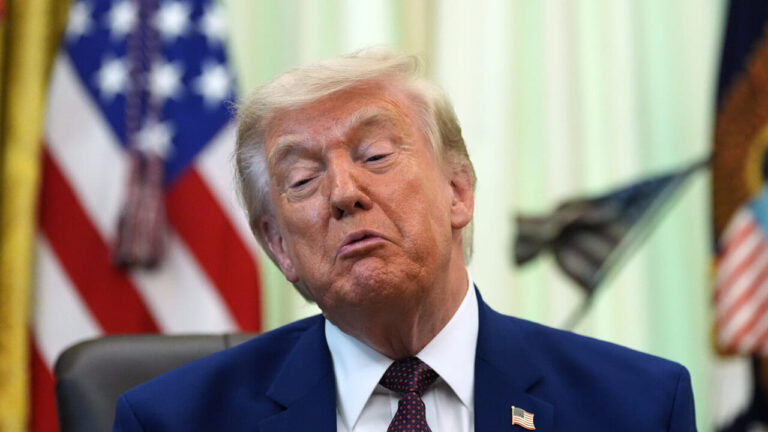
The US House of Representatives has passed a resolution ordering President Donald Trump to withdraw US forces from the conflict with Iran or obtain congressional approval to continue the war. The measure passed with 215 votes in favor and 208 against, and is now being sent to the Senate. Even if a “no” comes from the upper house, the tycoon may not be forced to stop the war. Meanwhile, an agreement with Iran is getting closer.
The vote in the House
The vote in the US House represents first of all a significant political blow for the tycoon. For the first time, perhaps, the internal Republican opposition has demonstrated that support for Trump is not so solid after all. If several parts of the Maga world have already distanced themselves from the president of the United States, his party has not done the same. The vote, in fact, had already been postponed because the party was aware that it did not have sufficient numbers to reject the measure. The predictions came true: four Republicans voted in favor of the resolution. They are Tom Barrett of Michigan, Brian Fitzpatrick of Pennsylvania, Warren Davidson of Ohio and Thomas Massie of Kentucky.
Trump’s veto
However, it would appear that even if the proposal were approved by the US Senate, this would not be enough. Trump and his closest aides have rejected any attempt by Congress to limit his war powers, calling it unconstitutional. The question goes from political to legal.
In the past, Congress has used joint resolutions to express its position on an issue without requiring presidential approval. However, the Supreme Court ruled in 1983 that for congressional actions to have binding legal effect, they must follow the normal legislative process, including submitting the measure to the president for signature and enactment.
This would mean that any attempt to make the directive to withdraw US forces from Iran binding would require Trump’s signature. Or the favorable vote of two thirds of both chambers to cancel his possible veto.
The Israel-Lebanon truce and the agreement with Iran
While US politics agonize over the issue, in the Middle East the geopolitical situation takes another unexpected turn. Given the precedents of a few days ago or the mutual attacks of June 3rd. Israel and Lebanon have announced that they have agreed to renew the ceasefire and establish Lebanese safe zones that will exclude Hezbollah. This was announced by the US State Department which also spoke about the imminent new round of talks in the week of June 22nd.
On the Iranian front, the tycoon announced that “the talks could end over the weekend, we are very close to signing”. President Donald Trump assured that Tehran “has already accepted that it will not have nuclear weapons.” Furthermore, the tycoon confided that “he would like to meet” the Supreme Leader Mojtaba Khamenei.