

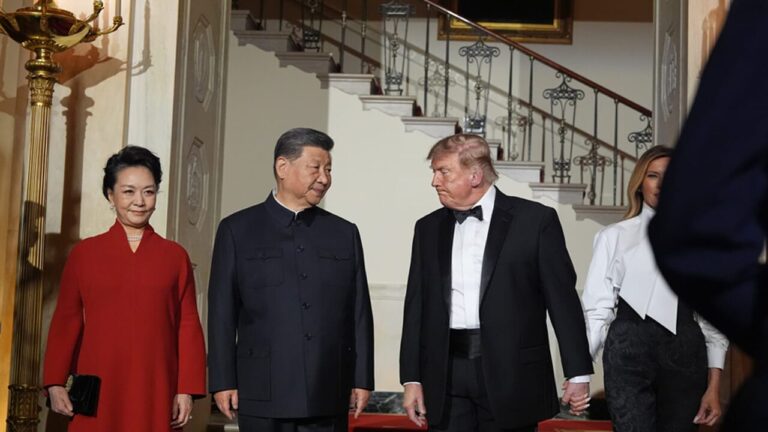
Red carpet, soldiers in full uniform of the various US corps and overflights of B-2s and F-22 Raptors, then the state dinner with the great protagonists of technology and Wall Street. Thus American President Donald Trump and first lady Melania welcomed Chinese President Xi Jinping and his wife Peng Liyuan in a polished White House. The impression is that the glories are directly proportional to the divergences that weigh on bilateral relations and which we want to minimize at all costs.
Friendly enemies
In every speech that saw them side by side, the two world leaders gave speeches in the spirit of the “personal relationship and friendship” established over the years. Trump praised the “tremendous progress” made with Xi and made clear that decisions made together “can foster peace and prosperity for decades to come.”
Xi, in response, said he was ready to collaborate because the two nations “would benefit from cooperation and lose in the event of a clash”. The two countries must “coexist and cooperate” as major global powers.
The relationship between Trump and Xi is marked by contradictions. Ostentatious friendship yes, but Trump is pushing to end the war in Iran, while China buys oil from Tehran and exports components used for drones and missiles that hit the American military. The US and China are engaged in a race against each other for supremacy in artificial intelligence and have long disagreed on trade issues. US fears about the growth of Chinese nuclear power are also growing with estimates that Beijing is on track to have over 1,000 nuclear warheads by 2030.
President Trump and the President of China Deliver Remarks at a State Dinner https://t.co/hoS9KBIjK9
— The White House (@WhiteHouse) September 24, 2026
And the tensions, going beyond smiles and elegant clothes, re-emerge. China, CCTV reported citing Xi’s words in the bilateral meeting, hopes that the US will maintain the correct posture of “opposition to Taiwan’s independence” and handle the Taipei issue “with prudence”. For Xi, the issue of reunification with the democratic island should not be postponed to the next generations. The USA, he added, “lay solid foundations for Sino-American strategic cooperation and the development of bilateral relations”. Xi, in other words, illustrated the mandarin position for “coexistence” between superpowers, while one of the objectives of the two leaders is the construction of a more predictable relationship and, potentially, combined with the conclusion of some agreements.
The state dinner
One of the most iconic moments is undoubtedly the state dinner with over a hundred guests representing Big Tech, Wall Street and Washington institutions, starting with the entire Trump administration. At the main table, with Donald and Melania Trump and the Chinese presidential couple, also Elon Musk (Space X), Tim Cook (Apple) and Jensen Huang (Nvidia). Also on the list of those present is Lisa Su, number one of the chip giant AMD: Su and Huang are not only cousins, but also two successful Taiwanese. And again Jeff Bezos (Amazon), Michael Dell (Dell) and Sundar Pichai (Google), Jane Fraser (Citigroup), Mark Zuckerberg (Meta), David Solomon (Goldman Sachs), Stephen Schwarzman (Blackstone), Jamie Dimon (JpMorgan), Cristiano Amon (Qualcomm), Albert Bourla (Pfizer), Larry Fink (Blackrock) and David Ellison (Paramount Skydance).
The absence of Chinese companies is noteworthy. When Trump went to Beijing in May, he brought with him a large delegation from top-level Corporate America. Many of China’s major internet and automotive companies are on US sanctions lists due to their ties to the Chinese military, so including them would have posed a challenge for US officials.
President Donald J. Trump at the State Dinner. 🇺🇸🇨🇳
“The hospitality of the Chinese people was on full display during my visit to Beijing earlier this year — and tonight, we hope to show you the same honor as you return to Washington for the first time in over a decade.” pic.twitter.com/RrA58t9mNG
— The White House (@WhiteHouse) September 25, 2026