

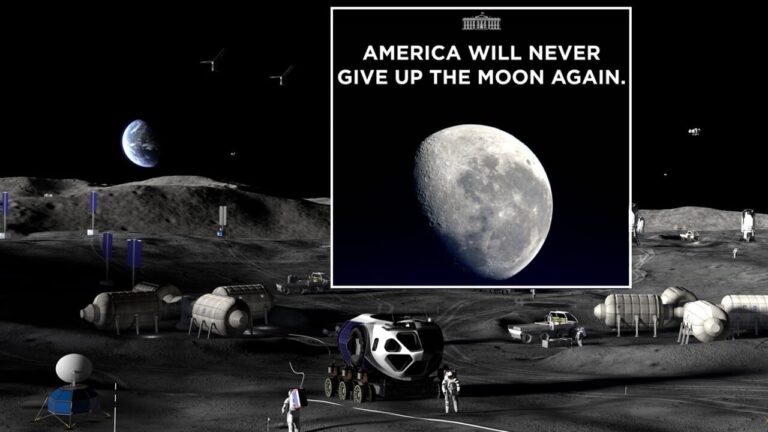
Trump’s America continues to amaze opponents and allies, both on Earth and in Space. With an announcement made during the “Ignition” event, which was held in NASA’s Washington headquarters, the US space agency has in fact certified a radical change in its lunar exploration projects, suspending indefinitely the Lunar Gateway project – the space station in lunar orbit being developed in partnership with ESA and other international space agencies – to focus everything on two objectives: bringing American astronauts back to the surface of the satellite by the end of Trump’s presidency (and therefore in 2028), and the construction of a base on the lunar surface quickly, to beat Chinese rivals who plan to complete their International Lunar Research Station by 2035.
As has happened more and more recently in recent months, the USA does not appear to have consulted its international partners before unilaterally deciding on the new change of course. A drastic change in programs that will directly affect agencies such as ESA and the numerous European and Italian companies that have already been working for some time on the construction of modules and equipment for the now defunct Lunar Gateway.
Thales Alenia had already created the inhabited Halo module, already shipped to the USA, which was supposed to represent the basic nucleus of the orbiting station. Furthermore, the Turin company of the Leonardo group should also have created the exit module for the astronauts.
The abandonment of the project of an orbiting space station should – in the words of the administration of the American agency, Jared Isaacman – free up the resources necessary to build a surface base on the south pole of the satellite: 20 billion dollars that NASA will invest over the next seven years, with around thirty launches already scheduled to beat its Chinese rivals to the punch.
A base of 20 billion dollars
The construction of the lunar base, which involves an investment of 20 billion dollars over seven years, is divided into three phases. Phase 1 (2026-2028) will concern the intensification of robotic missions aimed at consolidating reliability in journeys to reach the Moon and studying, through technological demonstrations, solutions aimed at improving logistics operations and services for the future base. Phase 2 (2029-2031) will see the start of construction work on the base, which includes the creation of the infrastructure necessary for the stay of astronauts, for the landing of cargo modules and to provide adequate support for two manned missions each year. Finally, in phase 3 (from 2032 onwards) the infrastructures intended to guarantee a continuous human presence will come into play. Among them is Mph (Multi-Purpose Habitat), a multi-purpose housing module: it is a project of the Italian Space Agency in collaboration with NASA, developed by Thales Alenia Space Italia, and constitutes an important strategic asset of our country within the Artemis programme.
To build the base, existing projects will be used – with some modifications – such as Gateway, the space outpost designed to orbit the Moon and to play a double role: laboratory for scientific experiments in deep space and support structure for the lunar missions of the Artemis programme. Finally, innovative technologies such as MoonFall, a drone capable of moving from one point to another on the lunar surface, will also be introduced.
Beyond the Moon, Mars
In addition to the plans for the Moon, during yesterday’s event NASA announced two other important news. The first is a new strategy for low Earth orbit, which plans to keep the International Space Station in service for a while longer, and to use it as a support point for new modules that should also be built and launched in the coming years by private companies. Once tested in orbit, the new modules will then be detached from the old ISS, to transform into a new commercial station, of which NASA – like ESA and the other interested space agencies – would become a simple customer.
NASA is advancing nuclear power and propulsion in space to accomplish President Trump’s national space objectives.
With SR-1 Freedom, launching in 2028, we will demonstrate nuclear electric propulsion and deliver SkyFall helicopters to Mars.
In collaboration with @Energythese… pic.twitter.com/gkGLs7xiVu
— NASA (@NASA) March 24, 2026
The second novelty concerns a new form of propulsion, still never used in space travel: nuclear propulsion. In fact, NASA intends to launch the first interplanetary space vehicle with nuclear electric propulsion by 2028: it will be called Space Reactor-1 Freedom and will bring a fleet of helicopter drones similar to Ingenuity to Mars, to demonstrate the possibilities of this new engine and increase the exploration capabilities of the Martian surface.
“Nuclear electric propulsion offers an extraordinary ability to transport mass efficiently into deep space – explains NASA in a note – and allows high-power missions beyond Jupiter, where solar panels are not effective”.