

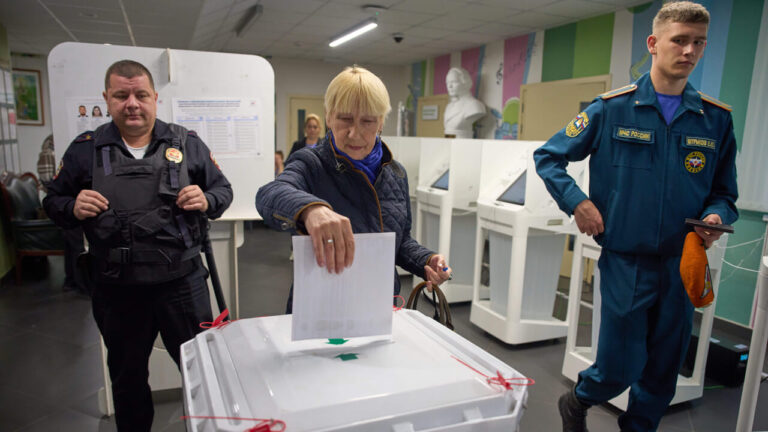
Polls open in Russia where until September 20th over one hundred million citizens are called to renew the 450 deputies of the Duma, the lower house of Parliament. It is the first parliamentary election since the large-scale invasion of Ukraine in February 2022. But to understand how elections work in Vladimir Putin’s Russia we must forget for a moment the Western idea that the vote serves above all to establish who will govern. In Moscow it serves above all to demonstrate that whoever governs has the country’s consensus.
United Russia, the party that supports Putin, starts from a position of almost absolute dominance: in the 2021 elections it had obtained more than two thirds of the seats in the Duma. Alongside the governing party, communists, nationalists from the LDP, Just Russia and New People continue to exist, formations that maintain political differences between themselves but which have frequently voted together with United Russia on the main decisions of the Kremlin.
Putin himself attributed a meaning to the vote that goes far beyond the composition of the Duma: he presented participation as a demonstration of national unity and support for the soldiers engaged in Ukraine.
An imperfect democracy
The electoral formula, on paper, is perfectly recognizable. Half of the 450 deputies are chosen in single-member constituencies, the other 225 with proportional representation through party lists. The problem comes before inserting the ballot into the ballot box.
On August 10, the Russian Supreme Court excluded Yabloko, a historic liberal party and the only officially registered party openly opposed to the war in Ukraine, from the national competition. The decision came after an appeal by the nationalist party Rodina, which accused Yabloko, among other things, of having received undeclared electoral support from abroad.
Boris Nadezhdin, who had tried to run on an anti-war platform, was placed on the register of “foreign agents” and left the country. In Russia, “discrediting” the military or spreading what authorities consider to be false information about the military can also result in heavy criminal sentences.
The result is a particular model of pluralism: many things can be discussed, as long as some are not seriously questioned.
Voting in occupied Ukraine
The vote for the Duma also includes, for the first time since the 2022 invasion, the areas of the Ukrainian regions of Donetsk, Luhansk, Zaporizhzhia and Kherson controlled by Russian forces, as well as Crimea, annexed by Moscow in 2014. The EU has already declared that it will not recognize the results of the elections organized in the occupied Ukrainian territories as legitimate.
According to Ukrainian authorities and human rights organizations cited by the Associated Press, in some occupied areas election officials accompanied by armed personnel also pressured the population to participate in the vote.
Elections without observers
In more than twenty years of power, Putin has progressively shifted elections from what happens inside the ballot box to what happens before they get there: which parties can participate, which candidates can run, which opinions can be expressed without risking criminal consequences, and who can externally monitor the fairness of the process. In fact, it will be the third consecutive Russian national consultation that OSCE observers will not be able to monitor, the same thing happened for the 2024 presidential elections while in 2021 the conditions set by the Kremlin prevented the international mission from being sent.
This is perhaps the most effective feature of the system built by the Kremlin. There is no need to cancel the elections. Just reduce, one piece at a time, everything that could make them truly unpredictable.