

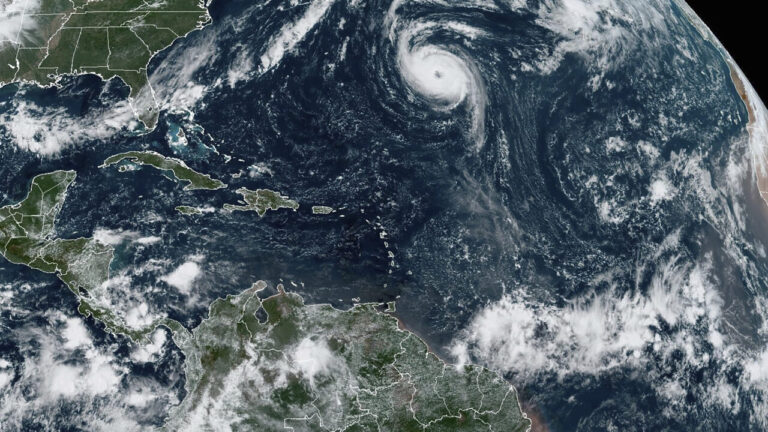
Amoc is at risk of collapse. This acronym, unknown to many, stands for Atlantic meridional overturning circulation, a fundamental current for the global climate system, characterized by a northward flow of warm saline water in the surface layers of the Atlantic, and a southward flow of cold water at depth.
Amoc and risk of collapse
According to new research, the probability of a collapse is higher than previously thought. This current is part of the Atlantic thermohaline circulation, a global system of ocean currents also called “conveyor belt” a fundamental component for the climate of the entire globe, which was already at its weakest point in the last 1,600 years due to the climate crisis. As reported by the Guardian, scientists have called the scenario “very worrying”, with a possible collapse having catastrophic consequences for Europe, Africa and the Americas. Climate models that reveal a slowdown in Amoc are now considered more realistic and reliable and, according to experts, the point of no return seems increasingly closer.
The new models
Experts use complex computer models to try to predict the future climate, but the problem lies in the range of results, often very divergent: from scenarios with no slowdown up to 2100, models that suggest a 65% deceleration. The new research, published in Science Advances, combines real ocean observations and models, reducing the margin of uncertainty and providing an alarming result to say the least: the estimated slowdown would be between 42% and 58% by the end of the century. The scientists obtained this data using “ridge regression”, a statistical method that analyzes the salinity of the Atlantic with extreme precision.
The impact on the global climate
A level which, according to experts, will culminate with the collapse of the entire system. As mentioned, the Amoc current transports tropical water heated by the Sun towards Europe and the Arctic, where it cools and sinks, forming a deep return current. In the event of a crisis, the belt of tropical rainfall on which millions of people depend to grow their food would plunge Western Europe into extremely harsh winters and summer droughts, with sea levels rising by 50-100 cm in the Atlantic area.
The concern of the experts
A hypothesis defined as “very worrying” by Dr. Valentin Portmann, the expert at the Inria Center de recherche Bordeaux Sud-Ouest in France, who led the research: “We found that Amoc will decrease more than expected compared to the average of all climate models. This means that Amoc is closer to a point of no return.” Fears also confirmed by Professor Stefan Rahmstorf, of the Potsdam Institute for Climate Impact Research in Germany: “This is an important and very worrying result. It shows that the ‘pessimistic’ models, which predict a strong weakening of the Amoc by 2100, are, unfortunately, the most realistic ones, as they agree better with the observational data. I am increasingly worried that we could exceed the point of no return.”
A scenario to avoid
A collapse that must be avoided at all costs, as underlined by Rahmstorf, who has been studying this phenomenon for 35 years: “I already supported this when we thought the probability of an Amoc shutdown was perhaps 5%, and even then we said that the risk was too high, given the enormous impacts. Now it seems that it is higher than 50%. The most dramatic and drastic climate changes that we have seen in the last 100 thousand years of Earth’s history occurred when Amoc transitioned to a different.”
The Amoc current is slowing due to global warming in the Arctic. The warmer air prevents the ocean from cooling and sinking, this blocks the recirculation of the water, which becomes less salty due to rain, further lightening. This triggers a vicious circle that risks turning off the engine of the Atlantic climate. Not only that, as climatologist Stefan Rahmstorf points out, the models do not yet fully calculate the melting of Greenland’s ice, a “variable” that could accelerate the process already underway, with climate impacts that are currently unpredictable.