

Every year, each of us Italians throws away on average almost 2 kg of small waste electrical and electronic equipment (WEEE) And 0.12 kg of Battery Waste among undifferentiated municipal waste, rather than placing it in dedicated collection channels. If these quantities were intercepted, the collection rate of small WEEE could increase from the current one 17% al 37%while that of portable batteries could go from 25% al 52%(1) (the targets set by the European Union are respectively equal to 65% for WEEE et al 45% for exhausted portable batteries).
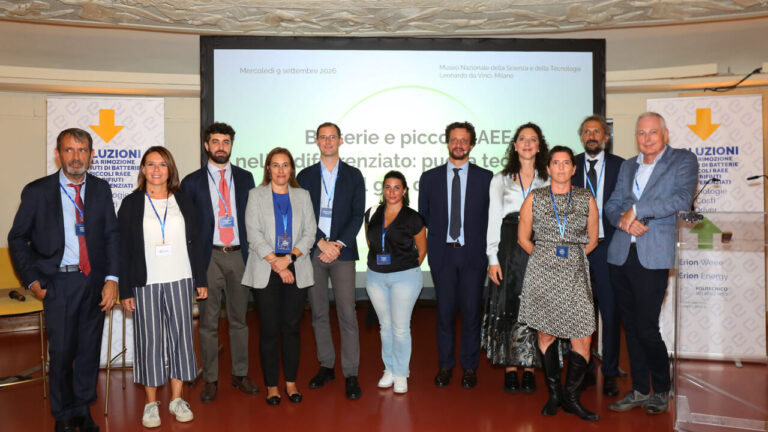
Starting from this premise Erion Energy, Erion WEEE and the Department of Mechanics of the Polytechnic of Milan they carried out the study “Solutions for the removal of battery waste and small WEEE from unsorted waste: technologies, costs and drivers”presented yesterday at the Leonardo da Vinci National Museum of Science and Technology in Milan during the event “Batteries and small WEEE in unsorted waste: can technology close the collection gap?”.
The removal of this waste from the unsorted waste flow would allow achieving a dual objective: recovering critical raw materials, which would otherwise be incinerated or lost in landfill, and improving the safety of the plants, since the lithium batteries present in Residual Municipal Waste (RUR) can cause fires during treatment operations.
To verify the feasibility of the intervention, the study took the implant as a reference case Ecology Viterboone of the most important players in the RUR treatment of Central Italy, simulating the integration of technological solutions based on systems bag opening, X-ray scanner, robot for automatic identification and separation. The analysis confirms that the removal of spent batteries and small WEEE from the unsorted stream is technically feasible, but requires significant investments.
The introduction of the necessary technologies in the Mechanical-Biological Treatment (TMB) plants of RUR would in fact require an investment of between 1.5 and 2.9 million euros for each plantdepending on the level of automation adopted. Assuming its implementation on the main ones 60 TMB plants (which cover 80% of the RUR flow generated annually in Italy), the overall investment would be between 65 and 114 million euros.
Although this figure is all in all contained in relation to the overall economic dimension of the urban waste sector in our country, this type of investment presents a structural problem: it does not generate sufficient revenues to independently cover the depreciation and consequently is not profitable in itself in the current tariff framework of RUR management.
The study highlighted what external policy tools can be implemented to make the introduction of technologies for the interception and separation of battery waste and small WEEE in TMB plants sustainable.
A first tool could be represented by direct public incentives (national/regional tenders or non-repayable contributions) to encourage the installation of new technologies; the incentivized investment, however, brings with it a misalignment of incentives between the financier and the operator, since the latter can be led to install the equipment to access the financing, without however having a real strategic interest in its continuous operation: the risk is therefore that of creating spot systems that function only nominally.
More effective would be the introduction of a regulatory obligationwhich involves the interception of spent batteries and small WEEE in all TMB plants; in this way the investment would be progressively incorporated into the economic-financial plans of the plants and in the tenders for the assignment of the service, guaranteeing homogeneous conditions among the operators, avoiding competitive distortions and encouraging a widespread diffusion of the technologies throughout the national territory.
«The technologies available today make it possible to intercept a non-negligible part of waste batteries and small WEEE even after their incorrect disposal among unsorted waste by citizens. – he states Laura Castelli, General Director of Erion Energy – However, these systems must be considered a complementary solution and not a replacement for dedicated collection. The priority remains promoting correct behavior on the part of citizens and making collection points increasingly widespread and accessible.»
«The study highlights once again how the world of waste needs a strategic vision and policy tools consistent with this strategic vision.», declares Giorgio Arienti, General Director of Erion WEEE. «The “free market” alone does not go in the right direction: adequate regulatory tools can allow the country to make important steps forward in the recycling of critical raw materials».
«The growing presence of batteries in unsorted waste imposes a new challenge: developing technologies capable of recognizing and separating them automatically, transforming an environmental problem into an opportunity for recovery and valorization», underlines Marcello Colledani, Professor at the Polytechnic University of Milan – Department of Mechanics. «The solution combines sensors based on X-ray and optical technology, artificial intelligence and robotic systems, paving the way for a more efficient, sustainable and advanced industrial application in battery recovery.»
The following speakers attended the event: Laura CastelliGeneral Manager of Erion Energy, Marcello ColledaniProfessor at the Polytechnic University of Milan – Department of Mechanics, Laura Mascherettifrom the Strategic Development and Innovation team of Erion Compliance Organization, Susana FerreiraWaste Management Director of Electrão (Portugal), Jan VlakManaging Director of Stichting Open (Netherlands), Martina VottaTechnical Director of Ecologia Viterbo, Guglielmo SepeErion Energy Board of Directors and Public Policy Manager of Amazon, Carlo SamoriSole representative for the WEEE program industry in Confindustria.