

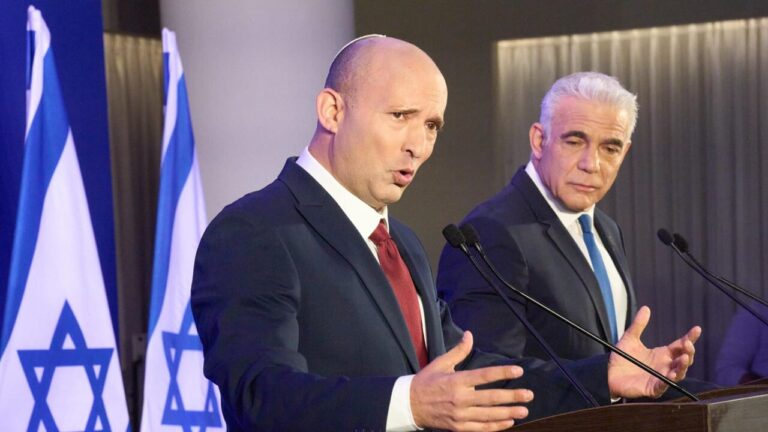
The challenge to Benjamin Netanyahu is taking shape around an alliance that until a few years ago would have seemed unlikely. Naftali Bennett and Yair Lapid get back together and choose to merge their respective political forces into a single entity, baptized Beyahad (“Together), with an explicit objective: to put an end to the political era of the Likud leader.
The operation has a strong symbolic and strategic value. The two former prime ministers – protagonists in 2021 of the only real interruption to Netanyahu’s hegemony in the last fifteen years – are now attempting to recompose the anti-Netanyahu camp by overcoming ideological divisions and personal rivalries. “Our unity is a message”, declared Bennett, openly claiming the differences with Lapid but transforming them into a strength: a transversal alliance, capable of speaking to a large and fragmented electorate.
“Israel needs to breathe”
The birth of Beyahad marks, in the intentions of its promoters, the end of the internal struggles of the so-called reformist bloc. The merger between Yesh Atid and the Bennett 2026 party aims to concentrate resources and consensus in view of the 2026 elections. Lapid insisted on the need for a change of direction: Israel, he said, “needs unity like air to breathe”. A message that also echoes in the political strategy: bringing together the center and the moderate right under a shared leadership, explicitly asking centrist voters to converge on Bennett.
The precedent of 2021 and the new conditions
Bennett and Lapid aren’t starting from scratch. In 2021 they managed to build a heterogeneous coalition which, despite a fragile majority, managed to oust Netanyahu from power after twelve consecutive years. That experience, however, lasted just 18 months, worn out by internal divisions over crucial dossiers, first and foremost the Israeli-Palestinian conflict.
That coalition represented an unprecedented political experiment, including for the first time an Arab formation. Today, however, the scenario has changed profoundly. Bennett clarified that the new project “will rely only on Zionist parties”, explicitly excluding any dependence on Arab parties – a choice that signals a more marked shift towards national and identity positions.
Arab parties out, security and reforms: the political program
The new Bennett-Lapid axis presents itself with a platform that combines institutional reformism and security firmness. Among the most relevant points is the introduction of an eight-year limit on the prime minister’s mandate; promotion of compulsory conscription also for the ultra-Orthodox; creation of a state commission of inquiry into the Hamas attacks of 7 October 2023; strengthening of national identity and refusal of territorial concessions. On a military and geopolitical level, the two leaders share a hard line: support for operations against Iran and allied groups such as Hamas and Hezbollah, with criticism of Netanyahu not for excessive force but for insufficient strategic incisiveness.
What the polls say
The most recent findings photograph a moving picture. A survey published by the newspaper Maariv reports Benjamin Netanyahu’s Likud in decline compared to previous months, paired on 24 seats with the formation led by Naftali Bennett, ready to return after remaining on the margins of active politics after the 2022 vote.
Lapid’s centrist Yesh Atid party is credited with around 12 seats, while other opposition forces – including the Democrats (heirs of the Labor Party) and Avigdor Lieberman with Israel Beytenu – would have around 9 seats each. The formation led by Benny Gantz would instead gain around 7 seats.
Overall, this bloc could reach the threshold of 61 seats in the Knesset, enough to govern. Netanyahu’s current coalition – which includes the nationalist parties of Itamar Ben-Gvir and Bezalel Smotrich as well as religious groups – would stop at around 49 seats. The Arab parties, excluded from any government alliance, would obtain around 5 seats each.
In this context, the joint Bennett-Lapid list aims to catalyze the anti-Netanyahu vote and create a pull effect. But with still a few months to go until the vote (expected between September and October 2026, without a date set yet) and in a Middle East context strongly marked by the outcome of the war with Iran, every forecast remains extremely fluid.
Polls indicate a weakening of the government bloc after the war in Gaza and regional tensions, but do not yet certify a stable alternative. Security management – Netanyahu’s traditional strong point – has been called into question after the events of 2023, opening up spaces for the opposition. Netanyahu, for his part, remains an adversary capable of politically surviving crises and defeats. He missed no opportunity to attack the new political alliance, recalling the experience of 2021 and insinuating that such an experiment is destined to repeat itself and fail.
Who is Naftali Bennett, symbol of the liberal and Zionist right
Naftali Bennett, 54, is a former special forces commander who became a successful tech entrepreneur before entering politics. An exponent of the nationalist right, he held various ministerial positions, including Defence, Education and Economy. In 2021 he became prime minister leading a heterogeneous coalition, standing out for a pragmatic but strongly identity-based approach. Today he presents himself as the leader of a “liberal and Zionist” right, an alternative to Netanyahu.
Yair Lapid, from host to centrist leader: focuses on the reforms requested by the secular electorate
Yair Lapid, 62, comes from a media career as a journalist and television host. Founder of the centrist Yesh Atid party, he was finance minister and then prime minister in 2022, taking over from Bennett in the rotation. It represents the secular and urban middle-class electorate, with an agenda focused on fiscal fairness, institutional reforms and reducing privileges for ultra-Orthodox groups.
The return of the Bennett-Lapid tandem marks a new chapter in Israeli politics yet to be played out. An alliance that was created to overcome deep divisions, but which at the same time reflects a changed country, more polarized and marked by years of conflict.