

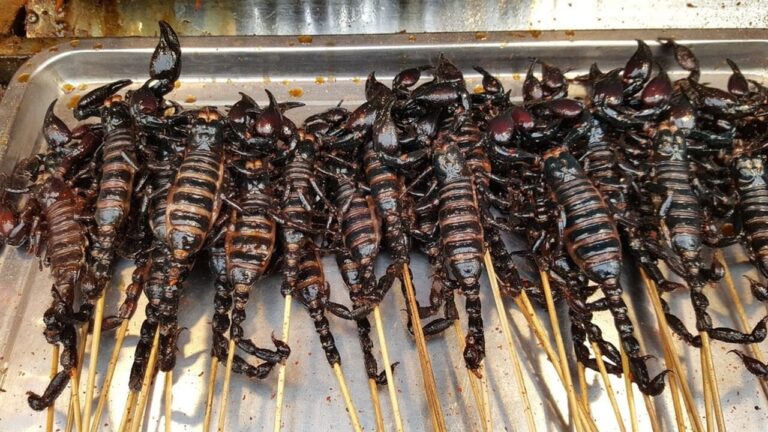
For years now, organizations such as the FAO have been promoting insects as a sustainable source of protein for an overpopulated world forced to deal with the consequences of climate change. The choice on paper is completely rational: breeding insects is easy, economical, requires much less water resources and space than traditional farming, and with over 1,600 species of edible insects in the world, there would certainly be no shortage of choice. Yet attempts to promote entomophagy continue to clash with consumer distrust, especially in the West: insects at the table generate disgust in many, too many people, for the market to really take off. Where does such a deep-rooted aversion originate? A study recently published on tells the story Science Advances by two researchers from the University of Barcelona, who investigated the ecological, historical and evolutionary dynamics that have shaped the relationship between Europeans and the inhabitants of North Asia and insects, since prehistoric times.
The map of ancient Tartar
To reconstruct the history of entomophagy in Eurasia, Spanish researchers examined 745 dental calculus samples belonging to ancient, anatomically modern humans, the oldest of which date back over 33,000 years. For research of this type, tartar is equivalent to an authentic time machine, because it preserves microscopic traces of the DNA of the species consumed regularly in the diet. The results of genomic analyzes confirmed that hunter-gatherers and early farmers in northern Eurasia did not systematically integrate insects into their diet, limiting themselves to sporadic or completely accidental consumption.
The most solid proof of the lack of insects on the tables of our Eurasian ancestors was therefore found in the genes linked to the production of acid chitinase (Chia) and chitobiase (Ctbs), enzymes responsible for breaking down chitin, the complex molecule that makes up the armor of insects. In fact, molecular analysis has revealed that the populations of northern Eurasia have mutations that have accumulated over the last 9,000 years, coinciding with the advent of agriculture, which have drastically reduced the effectiveness of these enzymes.
In contrast, the study highlighted how genetic variants that allow high chitinase expression remained stable and active in populations permanently residing in tropical areas. The most plausible explanation, the two researchers write, is ecological: in regions near the equator insects are available all year round in high quantities, and tend to be larger in size; this makes it easier to rely on insects as a source of protein and calories. In temperate climates, on the contrary, the effort required to collect large quantities of insects has made the energy balance less convenient, discouraging food consumption.
An ecological transition
The ancestors of Homo sapiens regularly consumed insects, a trait still present today in our closest relatives, such as gorillas and chimpanzees. The progressive abandonment of entomophagy in northern latitudes is therefore linked, in all likelihood, to the small size of insects and their absence in cold seasons, which have made them a less advantageous source of protein compared to large birds and mammals.
This reduced selective pressure has “turned off” the enzymatic machinery of our stomach, making it more difficult for modern Europeans to digest insects compared to populations living closer to the tropics. However, the authors of the study point out that modern industrial transformation processes are able to isolate the nutritional components and eliminate chitin before consumption. And they underline how greater attention to these aspects of digestibility could help promote the spread of insect meat also in Western markets. Provided – obviously – that we overcome the cultural aversion that still surrounds entomophagy in our latitudes.