

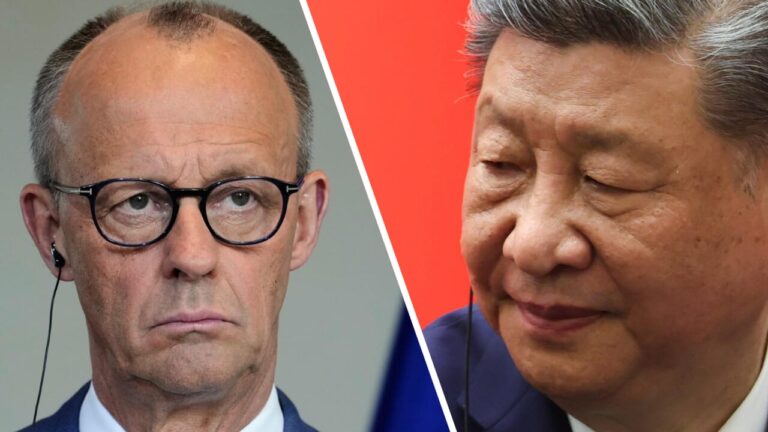
Germany, the main engine of economic growth of the old continent, has long been considered the great sick man of Europe. Downward GDP estimates and industrial crises are merely the symptoms of a pathology that comes from far away, precisely from China. In just over two decades, Beijing has managed to replace the main German assets by replacing them with the local manufacturing fabric. It exports more and imports less and less, all under the distracted eye of a Europe that is complacent in getting rid of sectors with low added value. It’s a shame that the Dragon is establishing itself on the world market even in those sectors, such as automotive, chemistry and aeronautics, which were the pride of Germany.
Here is the anatomy of the fall of Berlin proposed by two scholars from the Center for European Reform.
The situation in Germany
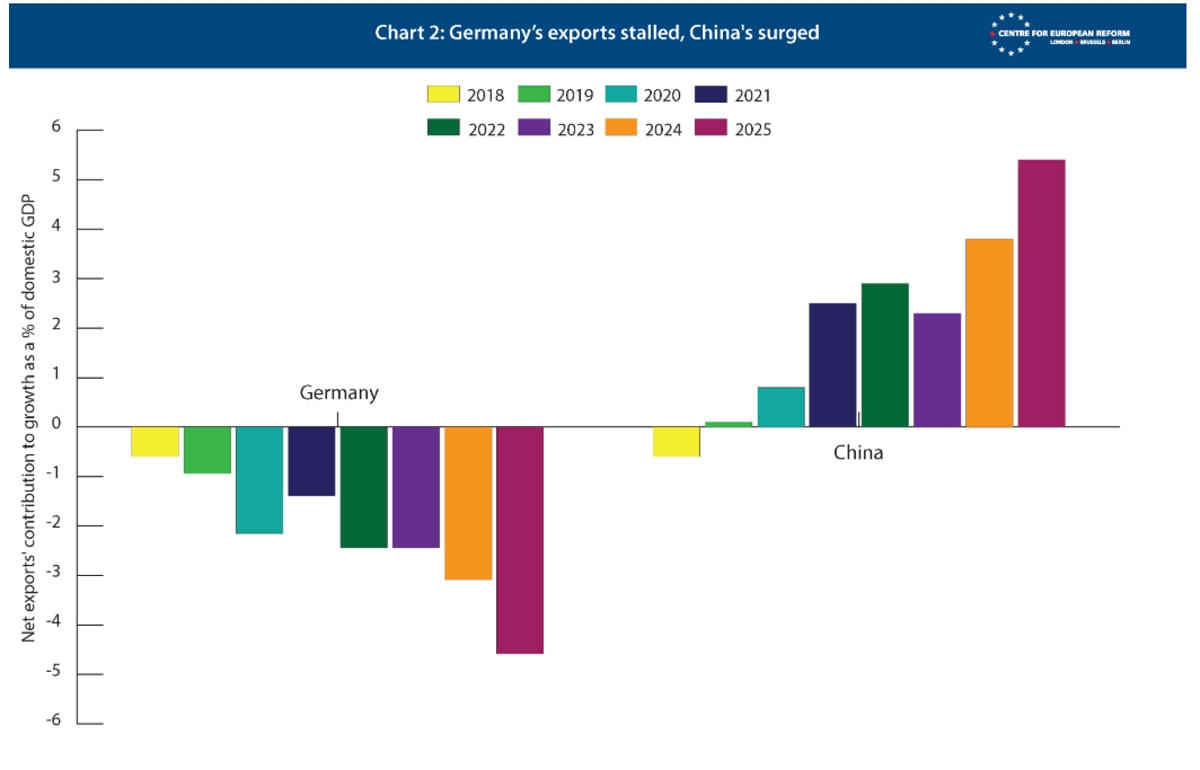
According to Sander Tordoir and Brad Stetser, authors of the study, Germany finds itself in a unique macroeconomic situation in its history: industrial production has been declining for six years, while private consumption has never recovered from the pandemic shock. And now Berlin would be in the midst of a second shock caused by China, after the one that arrived with its entry into the World Trade Organization in 2001.
In Germany the political debate is desperate for culprits. We look at the increases in energy prices and the EU bureaucracy: “Neither of the two explanations is entirely satisfactory”, say the authors of the study. Which cite an analysis of Bloomberg of 2024 according to which approximately 40 percent of the decline in German GDP is attributable to the decline in exports, another 40 percent to high energy prices and the remaining 20 percent to domestic demand, bureaucracy and other factors.
The causes
Since the pandemic, Chinese export volumes have increased by more than 40 percent while imports have barely grown. Beijing is replacing German producers with local ones and those from other countries. A policy in line with China’s new five-year plan.
The phenomenon, the report highlights, is fueled by three structural distortions:
- Excessive saving and weak consumption. China’s high savings rate and weak domestic demand depress consumption;
- Aggressive industrial policy. In priority sectors such as semiconductors, machinery, automobiles and aeronautics, the Chinese government provides direct subsidies, free land, low-cost machinery and state-guaranteed loans. The International Monetary Fund estimates that these subsidies are worth 4.4 percent of China’s GDP, about $800 billion a year;
- Undervalued exchange rate. “A country with a large current account surplus would normally see its currency appreciate as it repatriates foreign exchange earnings into the domestic currency,” the authors write. Instead, the Chinese currency depreciated as China’s central bank cut rates to offset the declining real estate market and drove the currency lower. The IMF estimates that the renminbi, the Chinese currency, may be undervalued by 16 percent, but the real undervaluation could reach 30 percent.
The two shocks
The first Chinese shock, that of 2001, pushed Beijing’s manufacturing surplus to just under 1% of global GDP. Over the past three or four years, a second significant surge, dubbed “China Shock 2.0,” added nearly another percentage point.
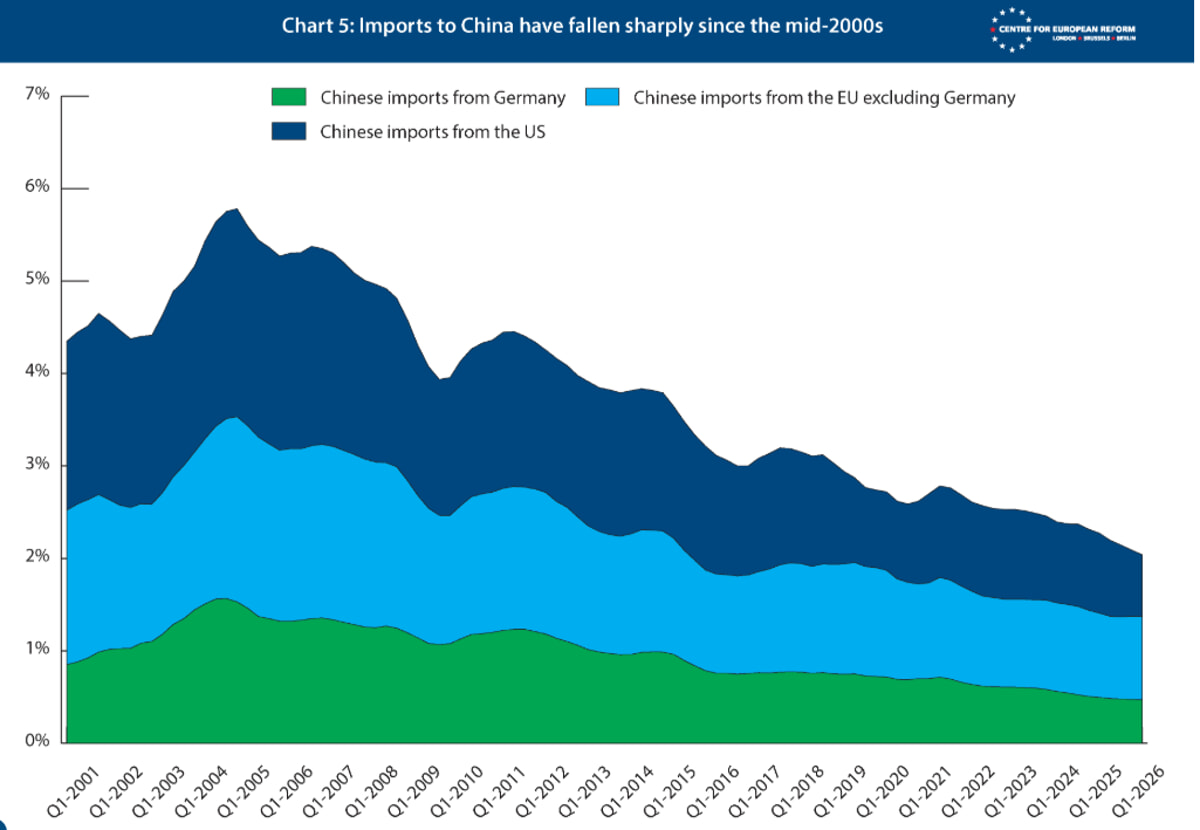
In the early 2000s the surplus did not concern strategic dependence, but sectors such as the production of toys, furniture or basic electronic components. It was thought, the scholars reconstruct, that the lost sectors were not central and that the “savings” obtained from cheaper imports and technological modernization could compensate for the local damage. But things are no longer like this, China is establishing itself in sectors with high added value.
The damage suffered
According to Jürgen Matthes of the Institut der deutschen Wirtschaft, a private German economic research institute, at the height of China’s export boom in 2021, around 1.1 million German jobs were directly or indirectly dependent on final demand in China. That is, almost 2.5 percent of total employed people. Since then, German exports to China have fallen by more than 40 percent. This implies a loss of over 400 thousand jobs in Germany linked to exports to China.
China is gaining increasing importance in the sectors that represent the productive heart of the German economy: automotive, machinery, specialized chemicals, electrical equipment, aircraft production. A project in line with the Chinese strategy of “10 thousand small giants”, a network of small and medium-sized enterprises that aims to replace imports from abroad.
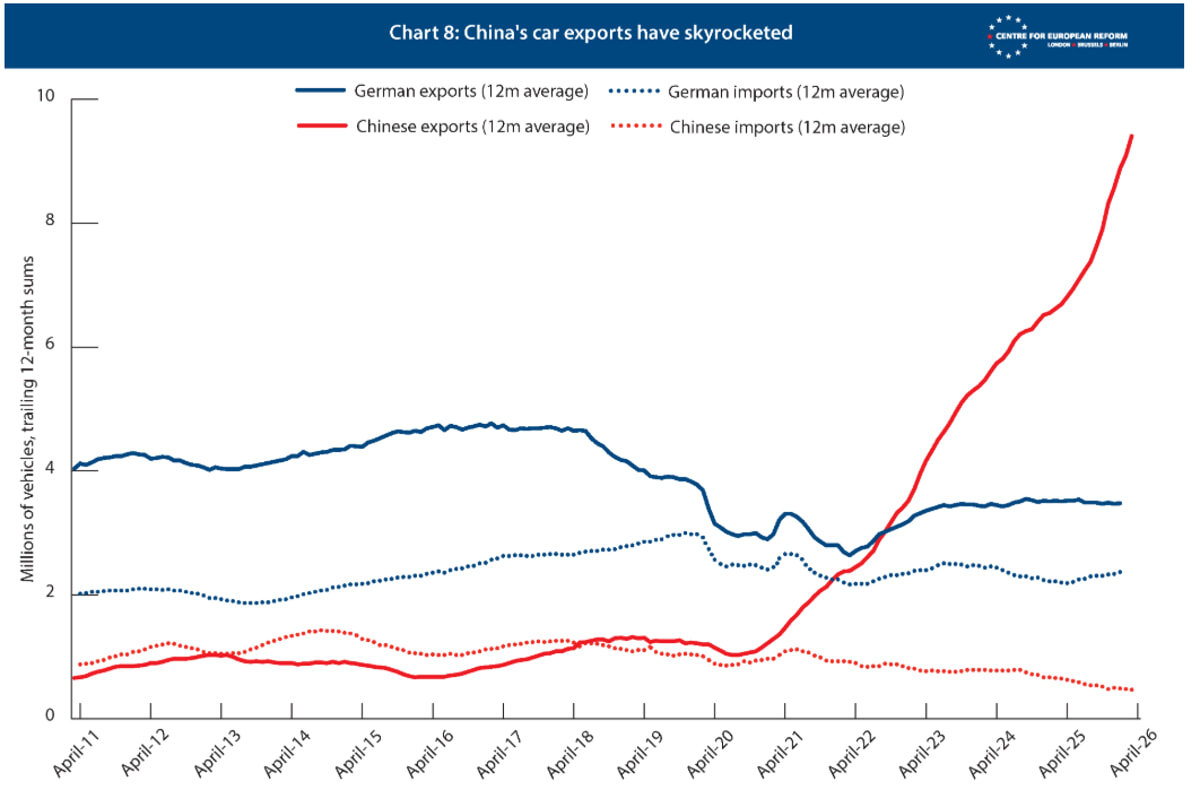
As for the automotive sector, Beijing has factories capable of producing 55 million cars a year, equivalent to around 65 percent of global demand. The United States has defended itself with 100 percent tariffs and regulations banning Chinese connected vehicle technology. German aircraft exports to China have fallen by 50 percent from their peak, as Airbus shifted its production for the Chinese market to the land of the Dragon.
No support from Washington
Until Trump’s arrival, the US market had offered an important counterweight to the Chinese shock: European car exports to North America had almost doubled between 2019 and 2024, from 25 to 50 billion dollars.
The tycoon has reduced federal support for charging infrastructure and imposed new duties on European car imports. No support from Washington to its European ally in a picture that, according to Goldman Sachs, is becoming increasingly gloomy. The investment bank estimates that the surge in Chinese exports could reduce German growth by around 0.2-0.3 percentage points per year until 2029. The most exposed states, in addition to Germany, would be those in Central and Eastern Europe.
How to respond
How to react to this “medical record”? The report drawn up by Sander Tordoir and Brad Setser suggests some lines of action. The authors suggest strengthening European trade defenses with a measure equivalent to Section 301 of the US Trade Act of 1974. The provision allows Washington to investigate and respond to a wide range of foreign practices deemed unreasonable or discriminatory. Meanwhile, the Commission could invest even more in the “buy European” policy in response to Chinese protectionism.
Only by building alternative supply sources can Europe be ready for a possible Chinese retaliation on the supply chains of critical minerals.