

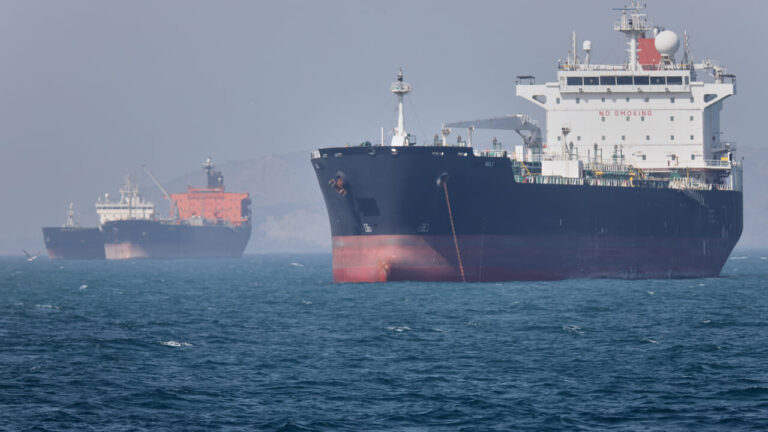
Since the first days of the conflict, the closure of the Strait of Hormuz has been the “key” exploited by Iran to put pressure on the United States, which is decidedly superior in the military field. As confirmed by Trump himself in recent days, the end of the blockade that has deprived the global economy of a fifth of its oil needs is closely linked to the agreement to be signed with Tehran. There would already be an “in principle” agreement, at least according to the latest rumours, but the real problem, once peace has been made official, could be another.
The bottleneck
In fact, by reopening the Strait of Hormuz after months, the risk is that of unleashing a real logistical nightmare. To see circulation return to normal, as well as a reduction in prices to pre-war levels, we will have to wait. And the process will be anything but simple. The first problem, as highlighted in a CNN analysis, will be the “bottleneck” effect. A blockage that will take time to dissolve, given that oil tankers move at the same speed as a bicycle. According to Matt Smith, oil analyst at Kpler, there are at least 166 oil tankers stuck in the Persian Gulf, carrying around 170 million barrels of crude oil. Once these boats have been “freed”, the empty ones will in turn be able to cross the Strait to refuel and leave again.
Inventories and the resumption of production
This will be the beginning of the new phase, which involves the disposal of the deposits. Empty tankers will begin emptying overflowing warehouses, where producers had stockpiled crude oil they had previously failed to sell. The positive note is that refineries have managed inventories intelligently, avoiding filling warehouses to the maximum limit. This strategic choice will allow the plants and distribution to restart more quickly. Despite this, the presence of crude oil reserves that are still higher than average will slow down the return of oil extraction to its maximum production capacity.
A slow process
Subsequently, if peace is lasting, production will also be able to resume. Many oil wells in the Middle East have been shut down due to war, and restarting them is not the same as flipping a switch. This is a complex and delicate process, which in some cases can last several weeks. Crude oil extraction will have to restart progressively to avoid structural failure of the deposits.
A start that is too abrupt would in fact risk damaging the wells, forcing companies to carry out expensive repairs or new drilling. To put the plants back into operation it will be necessary to rebalance the flows of water and gas injected into the subsoil, an extremely complex technical operation. Since the wells in this region are very large and close to each other, the resumption of activities will require perfect coordination between the different companies and governments involved. The objective is to ensure that the pressure of the gases and liquids introduced remains completely constant and balanced within the entire extraction network.
Repairs and prices
The next step will be to repair refineries and gas plants damaged by bombing, with some infrastructure likely to require years of work before returning to operation. Slow processes, such as those expected to bring fuel prices back to pre-war levels. Since mid-March the price of crude oil has never stabilized below $94 a barrel. According to analysts at JPMorgan, if the Strait of Hormuz is reopened in early June, the average price of oil could remain at $97 a barrel until the end of the year.
Too many “ifs”
A plausible scenario, but at the moment hypothetical. The signing of an agreement between the USA and Iran could mark the end of hostilities, but the world economy will have to deal with a gear that has been stuck for too long. Before oil returns to regular circulation and before a truce on the price front, we will have to wait for diplomacy to overcome the most difficult obstacle: the one with the tide of iron, mines and paperwork blocking the most strategic channel on the planet. The agreement on the table could start the recovery, but at the moment the road is still entirely hanging on a very long series of “ifs”.