

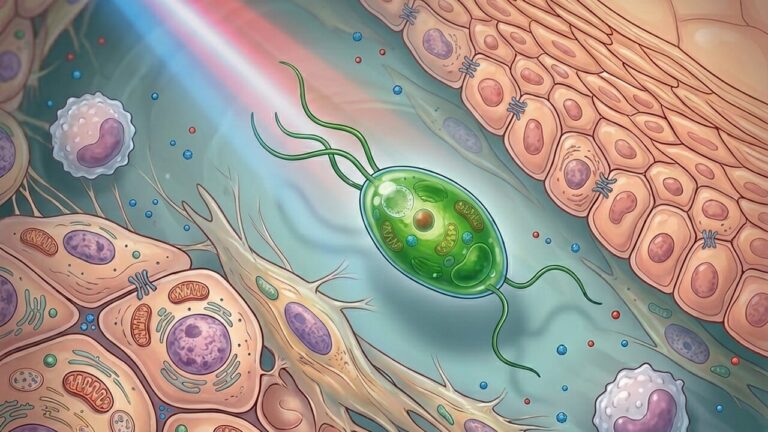
Nanobots and nanites are ever closer to leaving the pages of science fiction books and becoming an everyday reality in medicine. A team of researchers from the University of California San Diego has in fact developed a method based on the use of red and blue light to control the movements of swarms of biohybrid microrobots, paving the way for the use of these microscopic robots for the targeted treatment of wounds and lesions, and for the administration of drugs with very high precision. The invention was recently described in a study published in Science Advances.
The structure of biohybrid microrobots
The microscopic robots developed by American researchers are composed of two main components. The first is biological: the unicellular green alga Chlamydomonas reinhardtii, an organism that in nature moves in aquatic environments using two tentacle-like structures, called flagella. This algae has a natural sensitivity to light, which it uses to move towards light stimuli or away from them depending on the wavelength encountered.
The second component is synthetic, and is made up of Plga nanoparticles, a biodegradable plastic. These structures act as tiny “backpacks”, which can be loaded with drugs and other molecules, and are connected to the algae by electrostatic attraction: the plastic carriers have a positive charge, while the cell surface of the algae has a negative charge.
Controlling movement through light
By exploiting the biological characteristics of the algae, the authors of the study have developed a remote control mechanism. Exposure to different wavelengths, in particular red and blue light, allows the action of millions of cells to be coordinated. Chlamydomonas reinhardtii simultaneously. By attracting or repelling microrobots through a series of openings in geometric masks that determine their shape, the system is able to make the swarm aggregate, separate or change configuration. In their experiments, the scientists managed to make the swarm take on specific geometric shapes, including star- or gear-shaped configurations, demonstrating the reversibility and flexibility of the aggregation process.
To verify the effectiveness of the system in a simulated biological context, the technology was tested on a lesion reproduced within an artificial skin model. The process in this case involves the support of artificial intelligence: a software autonomously analyzes the contours and morphology of the open wound and calculates the exact light projection required. The light beams guide the swarm of biohybrid microrobots to the damaged site, where the positively charged nanoparticles release the active ingredient directly onto the target tissues. This approach reduces the dispersion of the drug and concentrates the therapeutic effect exclusively where necessary, minimizing the intervention on the surrounding healthy areas.
The research team now intends to optimize the system to enable the management of increasingly complex medical treatments on open wounds and in live settings. In addition to the biomedical field, the characteristics of these biohybrid swarms also suggest their use in different scenarios, such as environmental remediation operations in aquatic micro-environments. “Swarms of biohybrid microrobots can dynamically change their morphology, size and position,” the researchers point out. “The reversible nature of the generated swarms and their remarkable versatility and reconfigurability hold great promise for a myriad of possible microrobotic applications.”