

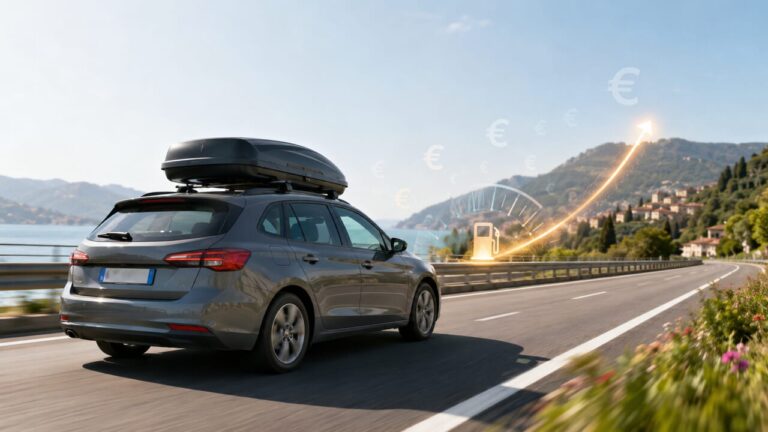
You choose the new car by comparing consumption, range and costs per kilometre. Hybrid and electric engines and increasingly efficient systems are being evaluated. Then, however, simply leaving an empty box on the roof for months or traveling with flat tires is enough to nullify at least part of the savings.
They are small daily behaviors that work like a “hidden taximeter”: they do not produce an immediately visible expense, but slowly increase the cost of each trip. The bill can reach several hundred euros a year, especially for those who travel many kilometers on the motorway.
Because the roof box increases consumption
At high speeds, an important part of the energy used by the car is used to overcome air resistance. The aerodynamic force does not increase linearly with speed, but increases approximately with its square. The power needed to counter it grows even more rapidly.
This is why the automotive industry invests in the design of increasingly aerodynamic bodywork. However, a box mounted on the roof alters the air flows around the car, increases the exposed surface area and worsens the overall aerodynamics. According to tests carried out by the German automobile club ADAC, at 130 kilometers per hour a box can increase consumption by around 18 percent on average. At lower speeds the effect is reduced, but still remains significant: at 80 kilometers per hour the increase observed was around 11 percent.
If for example, we take a petrol car that travels 15 kilometers per liter and travels 15 thousand kilometers a year. The overall consumption is approximately one thousand litres. With a petrol price of 1.80 euros per litre, the annual expense is around 1,800 euros. If all 15 thousand kilometers were driven at motorway speed with a roof box, an 18 percent increase in consumption would result in an additional expense of 324 euros.
What changes with an electric car
On electric cars the effect of the box is mainly noticeable in the form of a reduction in autonomy. On the highway, boxes and other loads on the roof can increase energy consumption by approximately 10 to 25 percent, depending on the vehicle, speed and shape of the accessory.
Pay attention, however, to the difference between increased consumption and loss of autonomy. If energy consumption increases by 25 percent, the range does not automatically decrease by the same percentage. A car that consumes 20 kilowatt hours per 100 kilometers, for example, would increase to 25 kilowatt hours with a 25 percent increase. With the same battery, autonomy would be reduced by 20 percent. The penalty can become particularly costly during long journeys, when the lower range forces you to make multiple stops at high-power charging stations. In some cases, pay-as-you-go fast charging can exceed 80 cents per kilowatt hour.
How much impact do flat tires have?
The other hidden cost is tire pressure. A flat tire deforms more during rotation. Part of the energy is thus lost in the form of heat, increasing rolling resistance. Traveling with all tires at approximately 0.5 bar below the pressure indicated by the manufacturer can increase consumption by approximately 1.5-2.5 percent. The actual value depends on the car model, tire, speed and road conditions.
On an annual expense of 1,800 euros for fuel, the increase can translate into approximately 27-45 euros more. A figure lower than that caused by a roof box, but obtained simply by forgetting a check that takes a few minutes. Furthermore, insufficient pressure can also alter tread wear and increase stress on the sidewalls.
The effect depends on how long you travel in those conditions, the load, the speed and the type of tyre. Some technical estimates indicate that a lower pressure of about half a bar could reduce tread life by 10-15 percent. Added to this are aspects related to safety: tires with incorrect pressure can worsen stability, increase braking distances and overheat more easily.
Windows open or air conditioning?
Another recurring doubt concerns the air conditioning. At low speeds, when conditions permit, opening the windows can consume less fuel than using the air conditioning. On the motorway the situation changes. Open windows generate turbulence and increase aerodynamic drag. At high speeds, this effect can become more detrimental than the energy required to operate the air conditioning compressor.
There is no universal threshold valid for all cars. The result depends on the shape of the bodywork, the external temperature, the humidity and the efficiency of the system. The practical rule is to use the windows at low speeds and prefer the air conditioning, without setting excessively low temperatures, during motorway journeys.
Dossier is the investigations section of The Vermilion. If you want to support our journalistic work and subscribe, visit our showcase by clicking here.