

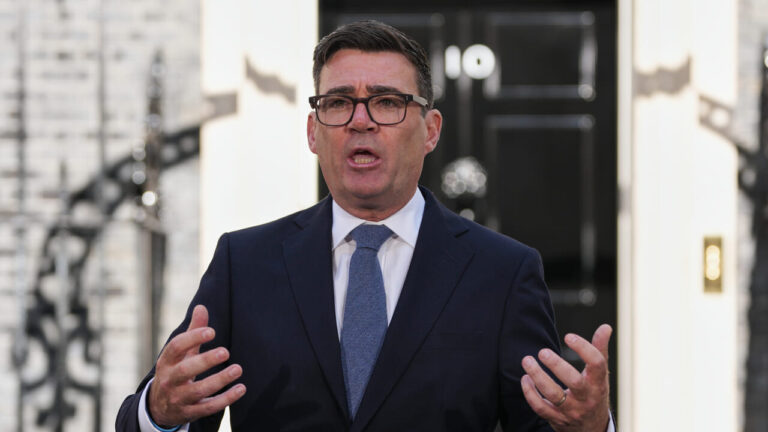
Great Britain has a new prime minister: Andy Burnham. The leader of the Labor Party, who takes the place of the resigning Keir Starmer, has received from King Charles III the task of forming a new government. “We have not been effective enough – he declared in the speech he delivered upon his arrival at Downing Street -. We will be so in the future. We will bring the biggest changes of the last 40 years, a new political model, a new economic model, after the negative turn of the 1980s. We will reindustrialise the country”.
The new prime minister
Burnham, greeted with long applause, then spoke about his long-term plan, as well as some measures to implement as soon as possible. The first measures that the new prime minister has announced that he wants to take are those to no longer have people forced to sleep on the streets, as well as wanting to “give respite” to citizens crushed by the cost of living. Burnham also said he wants to put people at the center of his work: “I want to help young people enter the world of work, changing the education system and offering more support, particularly for mental health; we will respect our budget rules and commitments made in defense and with our international partners. We will help people to live well, building a State capable of better prevention, investing in people’s success rather than paying for their failure”.
The King of the North
But who is Andy Burnham? Born Andrew Murray Burnham, the new British Prime Minister was born in Aintree, in the Liverpool metropolitan area, on 7 January 1970 and is 56 years old. Married and father of three children, he is also known by the nickname “king of the North” after his successful work as mayor of Manchester. Taking office in Downing Street, the prime minister evoked a new economic model for the country, centered on a change in domestic politics and profound decentralisation. Burnham has openly criticized the past decades characterized by neoliberal recipes, in which politics was centralized and the economy privatized disproportionately, contrasting them with objectives guided by hope, unity and common determination to change. A political “manifesto” that differs greatly from the line previously held by Starmer.
Burnham’s plan
His program includes several concrete measures, always keeping a strict eye on public finances. Burnham intends to bring large service companies back under state control, starting with the receivership of Thames Water, the country’s main and indebted water company. In parallel, to respond to the housing emergency, the largest social housing plan since the post-war period will be launched, giving municipalities the power to expropriate private rented homes left in total disrepair by their owners. In addition to the creation of a government branch called Downing Street North, designed to encourage devolution, the prime minister intends to reopen the project for high-speed rail extended to trains on the Birmingham-Manchester route, which had been canceled by the previous executive.
The economic program
On the economic front, Burnham has promised a 20% cut in business taxes for independent pubs and concert halls, funded by raising taxes on department stores and automated fulfillment centers used by e-commerce giants such as Amazon. For young people between 16 and 18 years old, the plan provides for the introduction of guaranteed work placements to enhance alternative professional paths to university.
The program strictly excludes a hypothetical return of the United Kingdom to the European Union or a farewell to Brexit, concentrating efforts on the internal working class. Finally, regarding the conflict between Russia and Ukraine, Burnham anticipated a conversation already today with Volodymyr Zelensky to reassure him of Great Britain’s constant and resolute support for Ukraine: “There will be no changes. I will be with him 100%, exactly as Keir Starmer was”.