

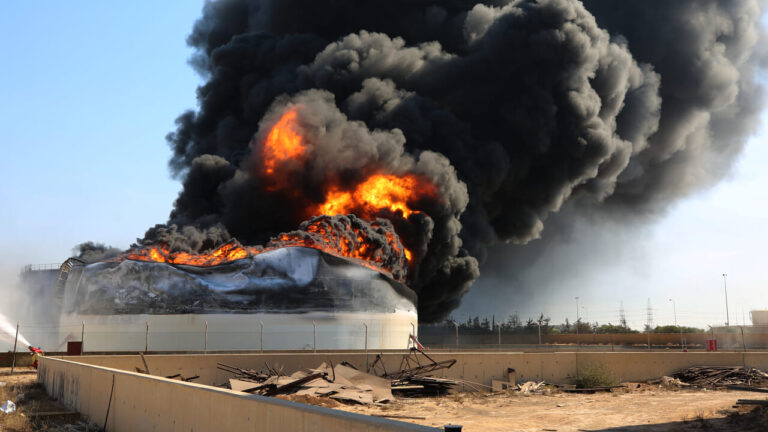
Libya has entered a particularly delicate phase. A large-scale civil war between Tripoli and Haftar has not started again, at least for now, but a new military escalation in the West, protests against the government, an institutional crisis and negotiations are overlapping that could reshape power in the country which – as the crow flies – is closer than the distance that separates Rome from Milan. A new series of drone attacks has in fact hit Zawiya, about fifty kilometers west of Tripoli, targeting refineries, fuel depots and electrical plants. And what is happening on the other side of the Mediterranean concerns us directly.
Not only for immigration, the dossier that most often brings Libya to the Italian front pages. What is at stake is above all energy. Libya is today Italy’s main supplier of crude oil and covers almost 20 percent of our imports, while Eni is the largest international operator in the country and is investing billions to bring larger quantities of gas back to Italy through the Greenstream, the underwater pipe that arrives in Gela, Sicily.
The immediate danger arises rather from the showdown within western Libya, precisely in the area where some of the fundamental infrastructures for Italian energy interests are located.
The attacks on the oil city
Zawiya is one of the focal points of the Libyan economy. The largest refinery still operational in the country is located here, with a capacity of around 120 thousand barrels per day. The plant is also connected to the giant Sharara oil field, which can produce around 300,000 barrels per day.
In recent days, drones loaded with explosives have repeatedly hit the energy complex. A tank containing around 4.5 million liters of petrol collapsed after being engulfed in flames. The fires were subsequently put out and, according to the technicians cited by Reutersthe refinery suffered no direct damage. However, the Libyan National Oil Corporation has warned that it could lead to a complete suspension of activities and a declaration of force majeure if the attacks were to continue.
The tension, however, is part of the clash between the government of Abdulhamid Dbeibah and the armed groups that maintain strong territorial control in the west, particularly in the Zawiya area. A demonstration of how fragile Tripoli’s attempt to transform the militias into a truly state-controlled chain of command still is.
For Italy the first risk is oil
To understand why all this interests Rome we must start from an often overlooked fact. On oil, Italy’s exposure to Libya is much greater than on gas. According to data cited by Reuters in May, Libya became Italy’s largest supplier of crude oil, with a share close to a fifth of overall imports.
For now we are not faced with a general interruption of exports. Indeed, Libyan oil production had reached 1.44 million barrels per day in June, the highest level since 2013, approaching levels prior to the collapse of the state following the fall of Gaddafi. It is precisely this recovery that is now under threat. Libya’s recent history teaches how quickly a political crisis can turn into an oil crisis. In 2024 the battle for control of the Central Bank had led to well closures and a cut in exports by more than half.
A prolonged blockade would have possible repercussions on crude oil prices and, consequently, on fuel prices.
The Libyan gas that Meloni wants to bring back to Italy
On gas the situation is different. Greenstream connects the Mellitah complex, on the Libyan coast, directly with Gela. It is one of the infrastructures that allow Italy to receive methane from North Africa without passing through the LNG maritime routes. Today, however, the pipeline is working far below its potential.
In 2025, Libya exported only around one billion cubic meters of gas to Italy, down from 1.4 billion in 2024. The flow was slowed down by the increase in Libyan internal consumption, infrastructure problems and political instability. The new crisis therefore comes as Italy is trying to do exactly the opposite of what has happened in recent years: fill the Greenstream again.
On 7 May Giorgia Meloni received Dbeibah at Palazzo Chigi. Investments in the energy sector were explicitly at the center of the conversation. A few days earlier, a Copasir delegation had also discussed in Tripoli the need to increase Libyan production to increase exports to Italy.
Eni’s billion-dollar investments
The industrial protagonist of this strategy is Eni, present in Libya since 1959 and today the country’s main international operator. Already in 2025, CEO Claudio Descalzi had announced over 8 billion euros of investments in Libya over four years, as part of a broader plan on North Africa and the Mediterranean which is also intertwined with the government’s Mattei Plan.
At the end of June, Eni and the National Oil Corporation started the Sabratha Compression Project, which allows the recovery of approximately 800 million cubic meters of additional gas per year from the Bahr Essalam offshore field. That gas is primarily used by Libyan power plants, but can also support exports to Italy through Greenstream.
The Bouri Gas Utilization project and, above all, Structures A&E, the development of two new offshore fields intended to feed both the Libyan market and exports, are also underway. Overall, Eni indicates investments of approximately 10 billion dollars in the three projects underway in the country. In March Eni also announced two new discoveries, Bess 2 and Bess 3, with resources preliminarily estimated at over one trillion cubic feet of gas. Their proximity to the Bahr Essalam plants should allow them to be connected more quickly to existing infrastructure and, also in this case, part of the gas is destined for export to Italy.
However, a few weeks ago, popular protests against the continuous blackouts affecting the North African country showed how vulnerable this infrastructure is in its “gate” of Mellitah, the station that pumps gas bound for Italy.
Meloni and the difficult balance between Dbeibah and Haftar
‘It is ultimately a political problem. Italy cannot afford to simply choose one of the two Libyan camps. The internationally recognized government is that of Abdulhamid Dbeibah in Tripoli, Rome’s main interlocutor on energy and immigration. But Khalifa Haftar and his military apparatus control Cyrenaica, a good part of the south and above all some of the main oil fields and terminals. For this reason, in recent years Italy has also kept channels open with the East. In 2025, the Minister of the Interior Matteo Piantedosi had attempted, together with a European delegation, to reach Benghazi to also discuss migratory flows; the mission ended with a diplomatic incident and the expulsion of the delegation due to a dispute over the protocol, but it clearly showed the European and Italian willingness to talk to both centers of power.
This balance becomes even more delicate today because a possible national agreement is under discussion that could at least formally reunite the two blocs. A plan mediated by Pakistan and supported by the United States envisages a 36-month transition with Dbeibah still prime minister and Saddam Haftar, son of Khalifa and number two in the eastern army, at the helm of the Presidential Council. The project is still under discussion and there is no guarantee that it will be built. For Italy, an agreement that stabilized the country would be economically valuable. It would mean reducing the risk of well closures, protecting Eni’s investments and increasing the chances of truly using the Greenstream’s capacity. But there is also the flip side of the coin: a pact between Dbeibah and the Haftars would not automatically erase the dozens of local militias and centers of power. Indeed, the attacks in Zawiya show how violent the reaction can be from those who fear losing territory, money and influence.