

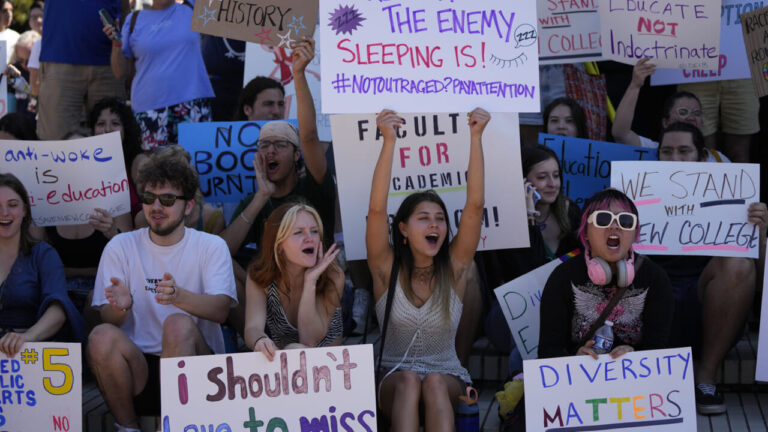
“Woke” as a consequence of performative activism (and what are the effects)
“Woke doesn’t exist in Italy!”, this is the chorus that arose on social media after Giuseppe Conte, as leader of a progressive political force, publicly distanced himself from it. But what is meant by “woke culture”? Many seem not to have understood this. There are those who abuse this expression to discredit any progressive battle for civil rights, such as radical conservatives, and those who totally deny the existence of the problem.
The term “woke”
Yet the term “woke” makes sense to exist, since it identifies the growing ideological and dogmatic approach that many people are taking towards progressive battles. If we wanted to translate the “woke” attitude into something more understandable in the Italian language, I believe that the most correct expression to use is “hypermoralist”, a neologism also recognized by Treccani in 2018, which is attributed to a person “who tends to judge with excessive moral scruple, who intransigently relies on morality”.
A digital subculture
But why do we talk about “woke culture”? The reason is that it is not an attitude that arises individually, but rather arises from a well-defined context and closely linked to social networks. In fact, it is no coincidence that this type of attitude has exploded in recent years, especially among younger people, and that it has taken root much more online than in real politics. In fact, “woke” can be defined as a digital subculture which (at least for the moment) has remained confined mainly to the field of digital activism and, in particular, to that of so-called “performative activism”. This expression refers to an approach to the battle for social rights which has as its primary aim that of bringing advantages to one’s person: visibility, consensus and relational or economic capital. In fact, for many today, activism is a real full-time job, and essentially consists of becoming a content creator.
Performative activism
The problem of performative activism lies precisely in the conflict of interests that is generated between the social battle, which has collective relevance, and one’s professional objectives, which risk becoming priorities even with respect to the very values one wants to represent. But what exactly is the connection between woke culture and performative activism? No one really seems to have grasped this point, yet the mechanism is quite intuitive. Those who are professional activists will have to publish reflections and news regarding their area of activism with a certain frequency. However, often not having an academic background, and having to guarantee a certain consistency in publication, the fear of these content creators is that of becoming redundant and banal over time, also in relation to what their colleagues write. In order to stand out from the crowd, combat the rapid addiction generated by social content and attract attention, the performative activist will therefore be incentivized to take his positions to the extreme and use increasingly aggressive and provocative slogans, strongly rewarded by the algorithms. We therefore move from a moderate progressive approach to an increasingly radical approach, but this is not enough to structure an ideological polarization.
Without contradiction
The additional element needed is represented by the validation of the group and the establishment of a closed community: a space where the contradictory is effectively absent and where some speculative assumptions become indisputable dogmas, under penalty of exclusion from the community itself. These groups then also take on a strong hostility towards anyone who expresses different views, implementing coordinated behaviors of digital aggression, which materialize in shitstorms and media pillorying. A drift that no longer has anything to do with the progressive demands from which it originated. Indeed, performative activism and the consequent hypermoral culture that arises from it risk becoming the main obstacle to progressive battles: with their extremes they end up ridiculing the causes for which they say they are fighting and open themselves up to attacks from detractors. Because every ideological polarization inevitably tends to fuel equal and opposite extremism.