

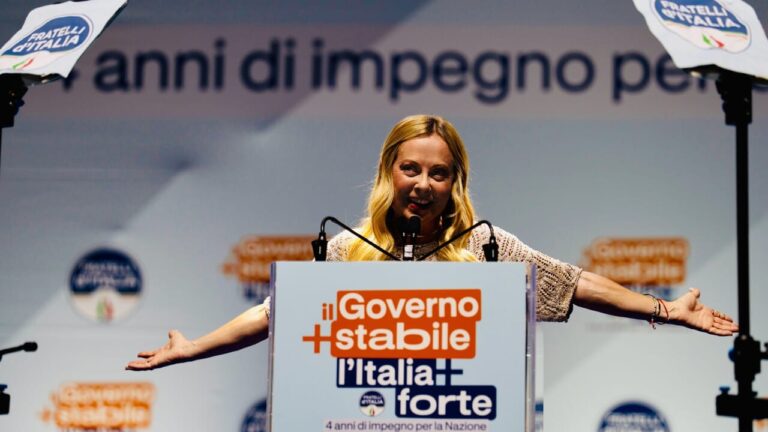
On the cost of fuel “we must now take more targeted measures, because we cannot continue to spend money on those who don’t need it and come to get petrol from France”. From the stage in Bari, where the Fratelli d’Italia event was held yesterday, Prime Minister Giorgia Meloni made it clear that the government must change course regarding the high price of petrol.
The decree passed yesterday provides for the extension of the 17 cent cut in excise duties on diesel for another 5 days. Then, from 10 September, the general discount will be accompanied or more likely replaced by measures aimed at specific categories. But on this point some tension transpires among the majority. If Meloni wants to avoid that the resources end up benefiting cross-border workers or those with high incomes, Salvini looks with annoyance at a possible bonus based only on the ISEE which would penalize employees and the middle class in favor of the usual “smart ones”.
The limits of the ISEE and the tug of war in the majority
The doubts raised by the Northern League secretary regarding the ISEE mechanism are not new in the centre-right. According to critics, the ISEE tool strongly penalizes employees and middle-class families, risking giving an advantage to those with undeclared incomes. For the League, the commuter from the North or the middle class must not be cut off just because he exceeds the threshold of 15,000 or 20,000 euros. Not only that. Salvini also looks at VAT numbers and self-employed workers, while the prime minister emphasizes equity.
This is not an insurmountable contradiction, but a classic political tug-of-war. To find a synthesis, the majority is turning to tools that have already been tested. Among the options under study, there would be specific aid for the road haulage sector and a contribution for employees to be paid through the company with fringe benefits. The model, Adnkronos reports, is a similar measure already launched in 2022 by the Draghi government, which had introduced the possibility for private companies to assign fuel vouchers to their employees which did not contribute to the formation of taxable income.
The hypotheses in the field: fringe benefits and a bonus linked to income
Political mediation will therefore be played out on how to divide the aid. As already highlighted, the agreement will probably involve raising the tax-free threshold for fuel vouchers for employees. In this way, companies will be able to provide tax-free petrol vouchers up to higher amounts without ISEE constraints, protecting the middle class audience supported by the League.
On the other hand, Meloni’s words from the stage in Bari also leave open the possibility of allocating part of the resources using the income criterion. To intercept the truly poor groups without creating new bureaucratic infrastructures, the intervention could for example take place by crediting an ad hoc sum for fuel on the ‘Dedicated to you’ card. Finally, a third way is to reserve targeted resources for specific categories such as hauliers (but it is not certain that the audience will not expand) through tax credits on fuel purchase invoices.