

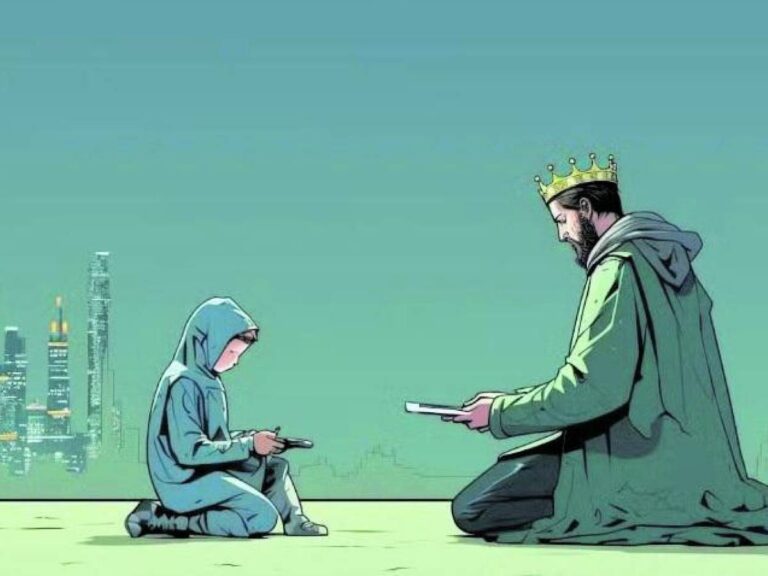
There is a word that you will hear very often both in the economic and political fields: it is “rifaudalization”. Term that describes some mutations that risk putting democracy in difficulty as we know it. Let’s try to understand why. That the world order, and also the internal situation of some western states, is subjected to a period of brutal tension is evident, and not only to political analysts. Within a few years, after the pandemic, the outbreaks of war have developed repeatedly. So much to make people speak – Pope Francis in the first place – of “World War in pieces”. But it is not only the events itself that explain that storms of discomfort so palpable within the western society (other companies have much less margins of freedom to express it the discomfort).
To strengthen the impression of insecurity is the fact that many of the interpretative categories we use seem to be quickly aged, as if they had no longer taken on reality.
When we talked about the market in the 90s, for example, it was given for awarded that they acted there a plethora of independent actors, in an atmosphere of competition and with a distribution of profits which, however unequal, inevitably dripping downwards would have finished, without a foul, to make the entire company richer. In the political field it was convinced that the western model of democracy would lead to a “legalist” world order where possibly, to the UN, the problem would have been harming the excessive decision -making margin of the USA and perhaps China.
Now, however, in the financial field a small number of companies check most of the companies listed on the main price lists. The totality of the exchanges that take place on the network is conveyed by an equally small number of digital platforms. In the political field, the “slip” is no less striking. Nation states not only have become aggressive, but are no longer the only custodians of the force. Just think of Russia where a private force such as the Wagner mercenary company first was fundamental to save the situation in Ukraine, then it became almost the summit of the Moscow army and finally risked transforming itself into a force able to subvert Putin’s power. Or on the other side of the front, such as the technological support of Elon Musk’s Starlink was decisive for Ukraine as much as and more than the aid of some European nations. Or how much a private society like Palantir, medievally in the name, is fundamental for western intelligence. These are just some of the examples of the phenomenon known among polytologists such as “rifaudalization”, a mechanism that leads to the erosion of modern institutions from the inside, progressively altering the logic that governs the accumulation of both wealth and power. The alarm towards this phenomenon is not new. He had been launched since the 1920s by the intellectuals of German agreement taken from Jürgen Habermas who feared the loss of grip on the reality of what we call civil society (which has always had its bourgeoisieth average force). But if those fears, born in front of dictatorships that privileged the personal vassallatic subjection to authoritarian leaders, seemed to have been stored with the great economic boom of the post -war period, are now recurring in new and more cleared forms.
To realize it is a good starting point the essay by Massimo De Carolis Refoundalization. The mutation that is disintegrating western democracies (Feltrinelli, pages 202, Euro 17). The panorama outlined by De Carolis, who taught political philosophy, is not that of an apocalypse with dark colors or of a sort of return to the income that might like some lover of the Middle Ages next venturi to the Mad Max. His is a serious work, full of examples, on the ontology of the present.
The new feudalism appears through mechanisms, according to De Carolis, that the birth of the model of western democracy, during the Enlightenment, has highlighted but never eliminated. Let’s start with an economic context.
According to the liberal scheme, the market offers the prototype of equal relations, opposed to the feudal model where what matters to prosper is loyalty. Everyone preached the first model in recent decades. But nobody prevented the great corporations and digital corporations from taking over the environment in which exchanges take place (bags and the net). There is no company that does not have to go through the Network for the Big Five of the hi-tech (Meta, Apple, Microsoft, Alphabet/Google and Amazon) and there are very few that financially may not be influenced, cascade, by the choices of the Big Three (Black Rock, Vanguard and State Street).
These new protagonists of the market play a role of gatekeeper: they are the “custodians of the threshold” outside which it is less and less conceivable that both production and exchange can take place. If we were in the Middle Ages we could say that they live on the rights of “Banno and Forabanno” on their immaterial territory. However, their unaware, or aware vassal goes, will pay. It goes without saying that this extraterritorial power, even without demonizing it, also crumbles the ability of actions of individual states. In Nepal a very corrupt parliament went on fire only when the government dared to demand to put her hands on the digital territories. Just to give an example.
There have been whose coins can no longer compete with the encrypted immaterial. Like when in the Middle Ages it was fought for the rights to beat money … there were like Honduras or Transnistria that have lost control of a nice piece of their territory in favor of multinationals as if these territories are self -employed …
And then there are more stripping effects in a policy that passes through social networks the identity crumbles and what matters is to be a follower of someone (who sounds better than vassal but is not so different).
Once there were political identities now leader who embody an empty signifier. For many, according to De Carolis, “the collective identity coincides with being peronists, Trumpians or friends of Beppe Grillo. In short, it is only the affiliation that unites them and distinguish them from the rest of the population”.