

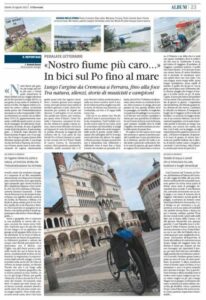
“Our bigger river, longer, more beautiful, more expensive …”. Now almost seventy years ago Mario Soldati On his television journey for Rai he told the magic of the Po. His people, his story, traditions, work and food. An intimate and intense link between man and nature, a close friendship before industrialization traced an unsurpassed furrow and the river became an enemy to defend himself from. The Po is there, apparently meek, and on the other side a world of countryside, cultivation, small villages, streets, houses, well -kept gardens, small swimming pools, parked cars … to divide them, after floods that have left their mark, now there is an embankment, which time and fear have made become higher and higher.
It is a long way that from Pavia to Piacenza, from Cremona to Ferrara, aims for the sea Crossing three regions, crossing worlds and stories that look like images and sequences of a neorealist film, crossing a low where the time seems to have stopped, where each square, each bell tower every circle remembers the disputes and spite between Peppone and Don Camillo: “For me the Po begins in Piacenza – he wrote Giovanni Guareschi -. The fact that from Piacenza up is always the same river, does not mean anything: even via Emilia, from Piacenza to Milan, is basically the same road; But the Via Emilia is the one that goes from Piacenza to Rimini. You cannot make a comparison between a river and a road because the roads belong to history and the rivers to geography … ».
History and geography that come together in a ride in the middle of the “waters”on slopes that go to the infinite, interrupted here and there only from the flight of a folaga or a seagull that reaches wings explained by the nearby Adriatic coasts. We go to the Delta crossing a pelvis of four hundred square kilometers and furrowed by the five main river branches that intertwine with Mincio, with Oglio, with other rivers and more a thousand other channels that are the masters here, conditioning the climate, the crops, the vegetation, the survival of animals, rains and droughts. It pedals in the story that gives the idea of reliving a time gone, a small world that is not a place on the map but a geographical hypothesis that moves together with its “smilezi”, up and down along the river, for that “slice” of land that is between the Po and the rest of the world.
A real humanity where there is room for everyone, good, less good, normal, strange, devils and even saints that such are even without perhaps knowing it. Where many squares are now empty, where the bars are managed almost all by Chinese boys, where “our” young people are less and less, where the elderly are sitting at the tables and play cards, where they blaspheme to put the quotes in the speeches. And on the embankment there is a world that pedals for work, for tourism, for sport, towards the future. Like Daniele and Francesco, street players who, guitar on his shoulder and stereo on, go to Brindisi and Greece to learn the notes of the Sirtaki or pedal, touching the legend of cycling that was. So you pass by San Nicolò Po and stop in front of the sign that recalls that it was the birthplace of Learco War, The “human locomotive”, a powerful physical, formidable passist, humble bricklayer who at 27 became a professional cyclist and in his short career found a way to wear the first pink jersey of history, to win a Sanremo, a Lombardy, a tour and 31 stages in the pink race.
Fly away in an instant San Nicolò, Because the sea is still far away, all to be conquered. See the rough asphalt that flows under your wheels, you feel the breach scrounts, you melt under a warm sun that makes the few, humid gusts unbearable and you understand that on the poison of the Po, time flows slower than elsewhere. A banks and the river next to it. Always next to you who never abandon you. Kilometers and kilometers towards the sea up to Porto Levante who looks like a piece of Ireland, where the Po and the Adriatic embrace, where they live a hundred souls, where you are fishing and navigates, where to go from one bank to another you need a passage, a boat, a ferry, something that floats and on which to load the bikes so as not to return to pedal backwards for about fifteen kilometers with the wind in the face in the face in Romea, that asphalt “monster” where civilization is ingolved and which seems to be a century away from the quiet of this mouth.
An embankment and bikes above with the wheels that advance and often get lost Because the signs are not there, because the roads are divided, because it is also easy and pleasant in nothing. Under the wheels, the plain, the infinite spaces, three regions that intertwine and touch, the Polesine and a delta that is at times a metaphysical space where reality is what you want. Finally. The most intimate sense of traveling, pedaling, traveling and pedaling together is the one you care inside. You keep it for you for a strange form of ancient shyness that allows you to keep a space sacred where you do not want visits. With a map, without too many selfies, without too much smartphone, without trumpets. That’s what you do for you. Your joy, your fatigue, your kilometers, climbs, descents, rain that follows you, chases you and also puts you some anxiety. It happens. The most intimate sense of pedaling is your story, your present that changes day by day. The expectation that transforms, which becomes something else, becomes what you want. Speeds and distances change. The places that travel by bike makes more familiar are chased.
The holiday is the journey itself, with its tiring flowwith unexpected deviations, with unexpected stops because you meet a village, a trattoria, a glimpse that deserves a photo. With the sun, with the rain, with the unexpected because it happens (and how if it happens …) to pierce and repair, to get the hands of fat, to have to deal with some bolt that is attached, to have to put their hand to bruv and screwdriver. And so Ferrara, a city of enchantment, seems closer than it is. So Cremona from Torrazzo to the Duomo, from the Baptistery to the Palazzo del Comune, to the Loggia dei Militi, to its medieval architectures that can be enjoyed closely on the pedals without fears of prohibitions, without parking anxieties, stopping where you want.
And so Mantua That, arriving at sunset with a gray sky and a wind sideways that makes you travel very quickly swollen clouds of rain, it presents itself from afar as Mont Saint Michel in Normandy. And so Rovigo a little Venetian and a little Austrian with his statue of Garibaldi who should have ended up in Rome but here he remained “exiled” because the hero of the two worlds puts his feet on the brackets made with the shape of the crown and this does not like the young monarchy much. And so Polesella where we stop for the “fried river” served on a boat anchored to Riva or Fratta Polesine with her Palladio villas that you meet almost by chance, making a crossroads, finding you suddenly in the face of the beauty of timeless constructions.
Magic of traveling slow Which becomes the way to discover what does not imagine, to take up time, to stay out of chaos, traffic, discharges that poison your lungs and brain. Pedal often puts a lot of things in place, of daily mess, of thoughts. And then the trouble and fatigue disappear as a magic, you go to sensation and you don’t even try to stop time. You cannot stop time and then you pedal as you want and how you can, maybe a little less faster maybe a little longer. Maybe not in a group, in a stubborn direction and contrary but without performing, without making the boats. Strength and patience. A bit like the river flowing next to it. Slow, patient, imposing and unstoppable …