

US President Donald Trump would be willing to impose new tariffs. The tycoon, after the rejection by the US Supreme Court, could open a new trade war with the excuse of wanting to sanction Russia and those who still import oil or gas from Moscow. Among the top states or groups of states there is also the European Union which in June 2026 ranked fourth among buyers of Russian fossil fuels. The Kremlin, however, is seeing its refining capacity shrink month after month due to Ukrainian drone attacks. To supply distributors it would purchase fuel obtained from refining its exported crude oil abroad.
Zelensky is leaving Putin high and dry: “Refining capacity down by 20-40 percent, buy petrol from Minsk”
Lindsey Graham’s bill
An agreement would have been reached in the US Congress, not yet voted on, on the bill promoted by Senator Lindsey Graham, who died due to an illness on 11 July 2026. In reality, the deputies would have reached an agreement on a text that modifies the more “rigid” proposal presented in April 2025 by Graham. The new version of the measure allows the president to impose duties of up to 100 percent, compared to 500 percent in the original proposal, on the top five third-party buyers of Russian oil and natural gas.
The day before his death, Graham announced that he had obtained Trump’s consent. Now it would only be a matter of time before the text is approved. However, according to reports Reutersthe measure provides an exception for countries that import less than 15 percent of Russia’s natural gas exports and that are taking significant measures to reduce this activity. A detail that could exempt Japan, France, Hungary and Belgium.
In addition to tariffs, Graham’s bill proposes to impose sanctions on Russian officials, the shadow fleet of oil tankers that are not dependent on Western shipping services, the central bank of the Russian Federation and major state energy projects. Among these, some located in the Russian Arctic regions: Yamal Lng and Arctic Lng 1, 2 and 3.
The Russian paradox
Among the main importers of Russian fossil fuels is India. According to data from the Crea research center (Centre for research on energy and clean air), in June 2026 New Delhi was the second largest buyer of Russian fossil fuels, importing hydrocarbons with a total value of 5.5 billion euros. Crude oil accounted for 83 percent of Indian purchases, for a total of 4.5 billion euros. Petroleum products (488 million euros) and coal (444 million euros) made up the remaining part of monthly imports.
Paradoxically, Russia itself would be supplied from India in order to be able to distribute enough fuel in its distributors. This is because, for the Financial TimesUkrainian drone attacks reportedly reduced domestic refining capacity by about 40 percent. And in the next few days an oil tanker with 42 thousand tons of petrol on board, coming from the Indian refinery of Vadinar, is expected to reach the Beloye More oil terminal, in the Murmansk oblast. According to data from the analysis company Kpler, more than 90 percent of the crude oil processed in Vadinar in 2026 came from Russia. This would mean that Putin is forced to buy abroad the refined products that third countries obtain by processing the oil that Moscow sells them.
What does the EU risk?
Russia’s revenues from fossil fuel exports in June 2026 fell by only 1 percent month-on-month, Crea reports. Every day, Moscow earned 734 million euros per day, although export volumes increased by 7 percent. Imports of Russian LNG into the EU fell by just 5 percent month-on-month, but remained 14 percent higher than June 2025 levels. In June it ranked fourth among buyers of Russian fossil fuels, accounting for almost 11 percent (1.9 billion euros) of Russia’s export earnings from the top five importers. In first place is China (with a share of 41 percent), then India, Turkey and behind the EU is Saudi Arabia.
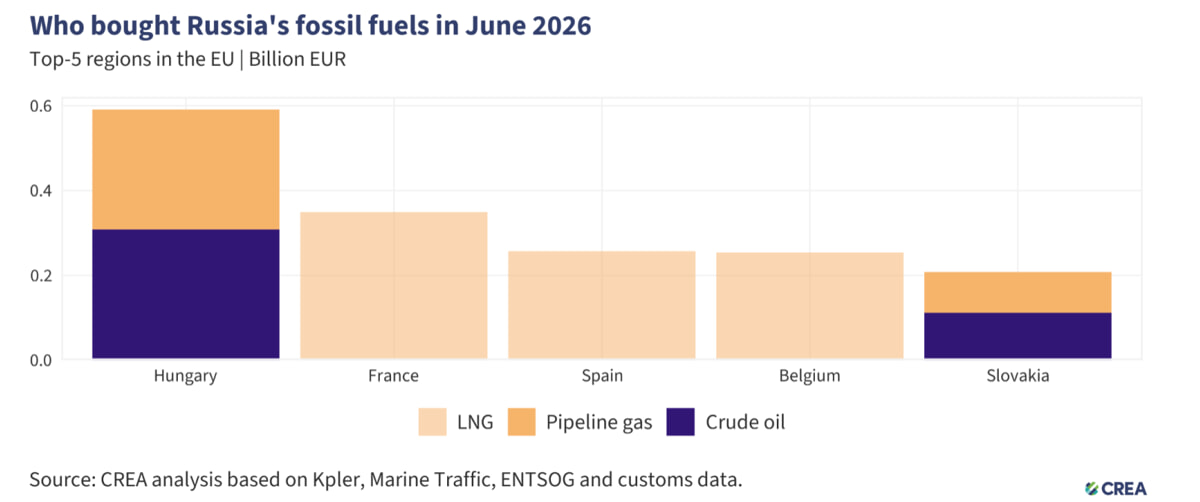
If we isolate only the Russian LNG data, the European Union represents almost half (49 percent) of Russia’s total exports, followed by China (23 percent) and Japan (18 percent). Hungary was the largest EU-wide buyer of Russian fossil fuels as of June 2026. It imported a value of 591 million euros. It is followed by France (349 million euros). Spain is third, receiving 258 million euros of Russian fossil fuels, all LNG. Then there is Belgium with 254 million euros of LNG. Slovakia closes the top 5 with an almost homogeneous mix of crude oil and gas worth 208 million euros.
On 16 June 2026, MEPs definitively approved the Turnberry agreements signed by the President of the European Commission Ursula von der Leyen in the summer of 2025. The agreement provides for tariffs of 15 percent on most European goods imported into the United States. On July 24, however, the 10 percent global tariffs imposed by the US on the basis of Section 122 of the Trade Act of 1974 will expire. Europe is therefore on alert, but the new wave of tariffs should not concern the countries of the Old Continent.