

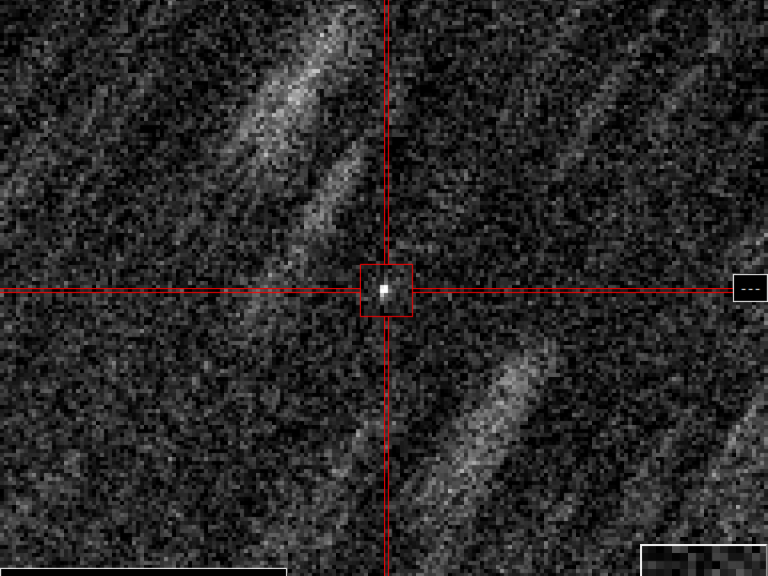
The astrophysicists of the Polo Gal Hassin of Isnello in the province of Palermo, in the Madonie, discovered a asteroida Near-Earth Asteroid (Nea), which has an external orbit to the terrestrial one but inside the orbit of Mars. The 2025 QK3 asteroid, the official name, describes an orbit around the sun in 435 days, inclined by 24 degrees compared to the terrestrial one. The revelation takes place 224 years after the last great Sicilian discovery. It was 1801 and the astronomer Giuseppe Piazzi discovered “Ceres Ferdinandea”, the first asteroid discovered “Among the stars”, a homage that made the astronomer to Sicily and his sovereign Ferdinand III. Now the story repeats itself. Sicilian astrophysics used the large Wide-Field Mufara Telescope telescope installed on Monte Mufara (at 1865 meters on Piano Battaglia. The surveys that defined the discovery were made on the nights of 21 and 22 August 2025.
The story
For two days 2025 QK3 It was Wmt0001, showing itself as a ball in three fields of sky that the large telescope with large Wide-Field Mufara Telescope (WMT) on Monte Mufara (1865 m, battle plan) had championship on the nights of 21 and 22 August 2025, explain the astrophysicians. A temporary name to indicate an asteroid never seen before. With great tenacity, since it is an extremely fast object, it was followed from 22:00 until 3:00 in the morning to define the parameters of its orbit with greater precision. On the morning of August 23, after the asteroid had been confirmed by a network of observers specialized all over the world, the Minor Planet Center (MPC) branched off the official circular of the discovery, MPEC 2025-Q106, with this, WMT0001 officially became 2025 QK3. It has been discovered in a rather favorable position, as it is currently approaching the earth. He will reach his slightest distance between 24.00 on August 26 and 7.00 on the morning of 27 August 2025. The team that brought to use this result is heterogeneous and shows how the collaboration is fundamental: Alessandro Nastasi and Sabrina Masiero Astrophysicians of the Gal Hassin Foundation; Riccardo Vangoni, professor of the Mantuan university center and collaborator of the Gal Hassin Astrometric Research Program; Alessio Squilloni and Francesco Cheli physical of the Astronomical Observatory Beppe Forti of Montelupo Fiorentino.
The Italian discovery
“It is an important contribution to the Italian and world astrophysical research in the context of potentially dangerous objects” says Giuseppe Mogavero, president by the Gal Hassin Foundation, “was completely predictable, indeed, we were sure that the performances of an extraordinary tool, the WMT, and the professionalism of the researchers would have led to results of excellence”.
The number of asteroid discoveries is increased exponentially over the last few years: today there are almost 1,500,000 objects in the region between Mars and Jupiter: every year there are about 3000 more objects in the class of the Near-Earth Object (Neo), that is, asteroids and Near-Earth-type comets.
Today there are extremely fast tools in the search for bodies that move rapidly in the field of view of the telescope and that manage to identify the very weak ones, which are the most difficult to discover: the discovery of an asteroidal object must ideally take place with the maximum possible anticipation, then actively committing to describe the orbit in the most precise way possible.