

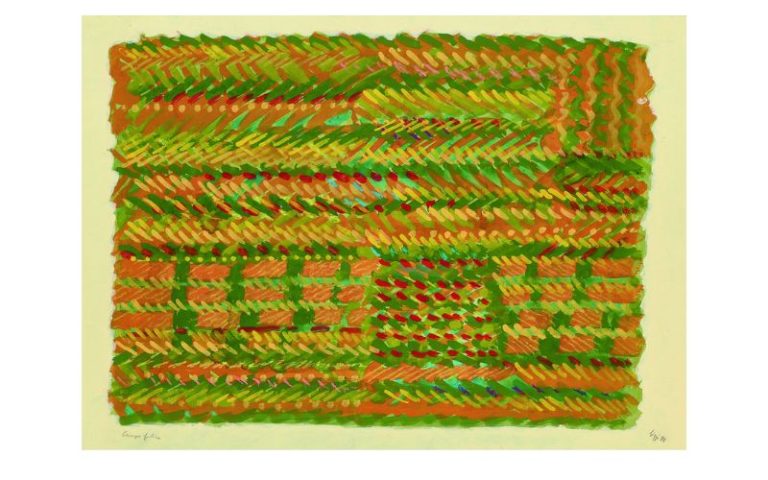
On the occasion of Centenary of the birth of Gastone Biggi (1925–2025), the Monteparma Foundation, in collaboration with the Gastone Biggi Foundation, presents toApe Parma Museum The exhibition “Gastone Biggi in the happy hour. Painted cards 1948–2014“By Gloria Bianchino and Carla Dini.
Painter constantly engaged in the experimentation of languages and expressive means, Gastone Biggi (Rome, 12 February 1925; Tordenaso – Langhirano, 29 September 2014) is an important figure in the artistic culture of the second half of the twentieth century. The protagonist for at least three decades of art in Rome from the 1950s to the ’70s, is among the founders of Group 1 (1962) and author of the “Manifesto of abstract realism” (2005). Painting has always accompanied the activity of art writer and the interest in music, passions that strongly characterize his eclectic personality of intellectual and artist.
Biggi approaches painting with a research aimed at combine rationality and poetic expression. He made his debut in the late 1940s as a figurative artist and then measured with abstractionism, up to elaborating an original research, always working on the border between the two languages.
The exhibition explores this tension, highlighting the deep – aesthetic, spiritual and conceptual ties – with the protagonists of European abstractionism such as Paul Klee and Wassily Kandinsky. Between chromatic vibrations and sign-musical plots, Biggi’s work proves to be a meeting point between thought and perception, rigor and lyricism.
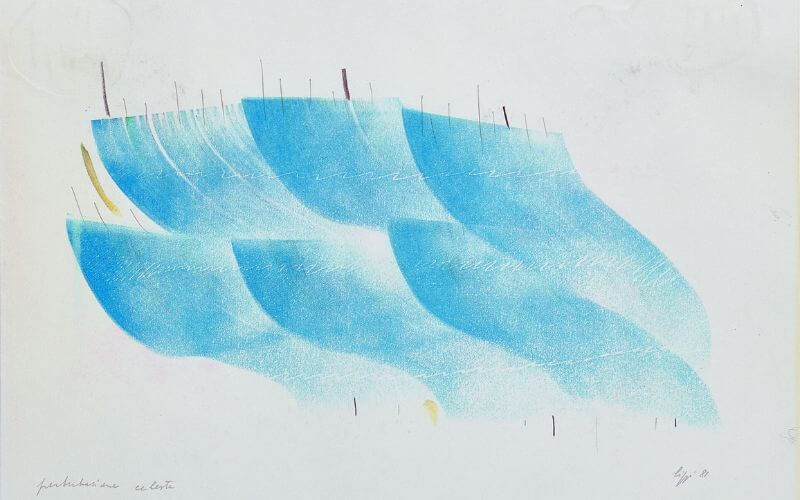 Fundamental in Biggi’s artistic production is the point, central and founding element of his poetics, protagonist of many of the works on display. Much more than a graphic sign, the “point” is for the philosophical monadic artist, formal and spiritual idea, a generating particle of the work. In his writings, Biggi considers him as a central element of his artistic experience, attributing to him the weight of “conductor” first and of “coadjutor” then, coming to declare with irony: “Give me a point and I will paint the world”.
In the early 1960s, the space of the pictorial field of his works was crossed by lines, rhythmic dark signs which, as musical notes on the score, repeat obsessively. Biggi, now launched to pictorial abstraction, continues the road with his companions of the Group 1 (Nicola Carrino, born Frascà, Achille Pace, Ninì Santoro, Giuseppe Uncini), supported by the critic Giulio Carlo Arganwhich are placed as a dominant group on the Roman and Italian scene. Subsequently, the artist’s search develops by adopting a precise texture in the various stages, which is musical counterpart, we can say, of the painted series: a fully autonomous counterbalance in the richness of variations, ideas, the invention of drawing and color.
The “Manifesto of abstract realism” that Biggi Formula in 2005 It only resumes and systematizing some basic convictions already present in his first pictorial experiences. By defining the “figurative-abstract” diarchy as an archival description, Biggi will write that the inspiring idea of the manifesto is “to make it clear even more like an apple, a house, a rose, it includes all the germs of abstraction, even for that need inherent in us to preserve or revive the images of a newspaper which we often do not understand under the underworld” … Rich in intrinsic positivity and energy, Biggi’s art is an expression of that “happy time” sense, which accompanies the artist in all its production. His refined painted cards – hence the evocative and poetic title of the exhibition – strengthen this feeling, giving the impression of a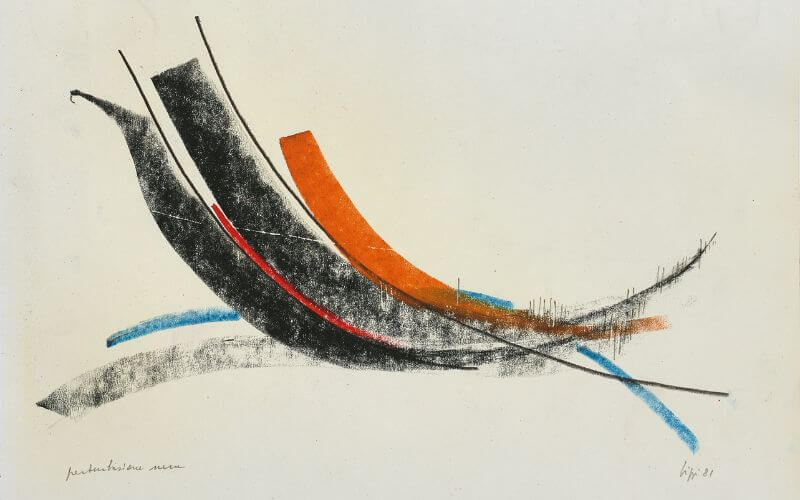 Always slight and light distance between the idea and the work accomplished.
The basic choice of the exhibition was to focus on the works on Gastone Biggi paper to rediscover a phase of its research as essential as it is not very well known. The drawing, in fact, will always accompany him, assuming a significant importance as it is not a simple project for subsequent paintings but it is a research work that leads him to catalog these works with rigor, taking the Oeuvre Katolog of Klee’s work as a model.
Biggi’s corpus has over 4000 pieces350 of which were donated to the CSAC- University of Parma, while the others, almost all of them, are preserved and strictly cataloged by the Gastone Biggi Foundation. The latter, on display at the Pepo Parma Museum, is proposed a selection of over 230 works, which traces the most significant cycles of its production.
Of the 29 cycles on displaythere are some examples: the first, “figurative” and “astracts-information” experiments, followed, linked to the “birth of the point” (1962), the geometric and bright grids of the “continuous”, the internal and musical landscapes of the “variables”, of the “dot” and “rhythms”; To characterize the 1980s, on the other hand, “fields”, “skies” and “lights” while, starting from the 90s, there is the works arising from American experiences, such as “New York”, “Constellations”, “icons” and “Events”, to arrive in the last period at “Fleurs” and “scores”.
At the end of the route, the unprecedented whole series “La Rue des Vins”a joyful divertissement of the artist who offers drawings and poems inspired by different types of wine on a visual and literary journey between landscapes and flavors.
The initiative, inserted in the celebratory program Biggi100also intends to remember the special link of the artist with the Parma area: right in the hamlet of Tordenaso in Langhirano, Biggi lived and worked on the last twenty years of his life, and in Parma, in 2004, one of his most important retrospective exhibitions was created by Arturo Carlo Quintavalle. The return of this wide exhibition to the Emilian city therefore assumes the value of a symbolic and emotional return, as well as artistic.
In continuity with the initiatives that Ape Parma Museum has recently reserved for Giovanni Chiaramonte, Riccardo Lumaca and Aldo Tagliaferro, the exhibition dedicated to Gastone Biggi fits fully in the cultural objectives pursued by the Monteparma Foundation in order to enhance the Italian artists of the second twentieth century who have had important links with Parma and who deserve to be more known by the general public.
The exhibition will be open to the Strada Farini 32/A, from 27 June to 26 October 2025, from Tuesday to Sunday 10.30-17.30, with a preview open to the public on Thursday 26 June at 18.00.
Carlo Franza