

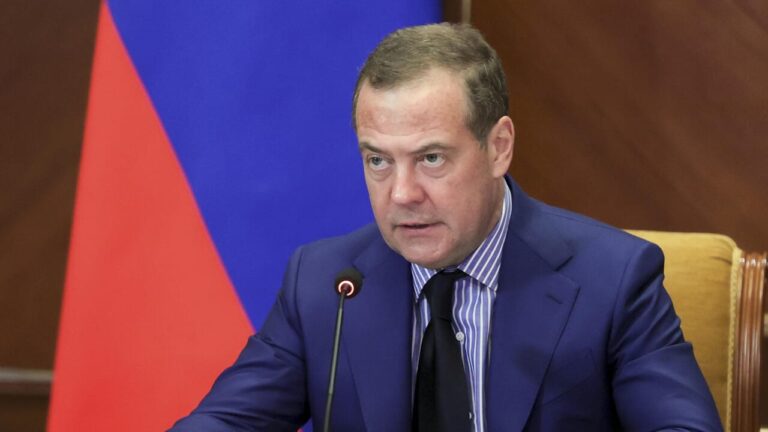
New threats from Russia against Europe. They were launched by Dmitri Medvedev, vice-president of the Security Council of the Russian Federation and former president of Russia, who warned citizens of European Union countries that they should not expect “peaceful nights” due to European involvement in the war in Ukraine.
The statements come after the case of the drone that crashed in Romania, which according to the Bucharest authorities hit a residential building in the city of Galați, near the border with Ukraine. An episode that aroused strong concern in the EU and NATO, but which Medvedev dismissed with contemptuous tones, accusing European governments of now being an active part of the conflict.
The accusation, the insults (and threats) of the former Russian president
“The Euro-powerless are throwing a fit because a drone hit a residential building in Romania,” the former Russian president wrote on Telegram. “Obviously we need to establish who launched the drone. But regardless of this, all EU countries should stop making a case of it.”
According to Medvedev, in fact, European nations would directly participate in military operations against Moscow through the supply of armaments, drone components and intelligence information to Ukraine. “European nations are direct participants in the war against Russia and no one pretends otherwise anymore,” he said.
“Blood is on the hands of scum like Ursula, Merz, Macron, Starmer and all other loathsome parasites,” he wrote, using particularly aggressive language even by the standards of Russian propaganda.
The most disturbing part of the message, however, concerns the warning addressed directly to European citizens. “This will not be the last time. There is a war going on. And citizens of EU countries, as the population of nations at war, should not go to sleep expecting peaceful nights,” he said.
Who is Medvedev and what could be the meaning of his words
It is not the first time that Medvedev has used extremely harsh tones towards the West. Since leaving the presidency of the Russian Federation in 2012, the former leader, once considered a relatively moderate figure within the Russian power system, has become one of the main interpreters of the Kremlin’s more aggressive line. In recent years he has repeatedly evoked the risk of a direct clash between Russia and NATO, even going so far as to threaten the use of the nuclear arsenal in the event of an escalation of the conflict.
His statements do not necessarily represent operational announcements or imminent decisions by the Russian government, but are generally interpreted as part of the strategy of pressure and psychological deterrence adopted by Moscow towards Western countries that militarily support Kiev.