

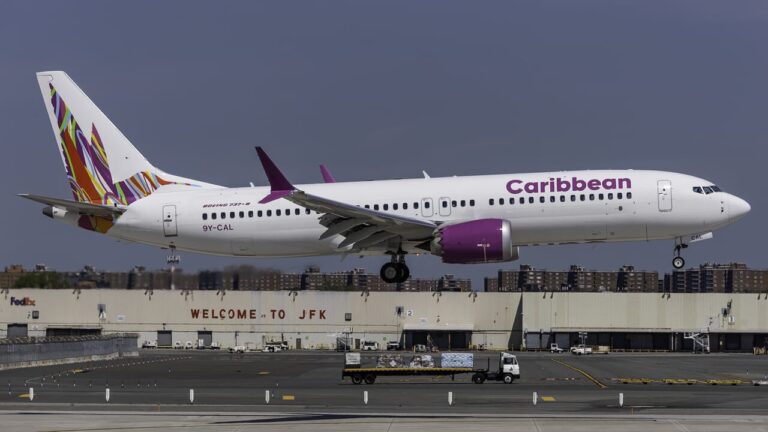
A Caribbean Airlines plane departing from Kingston, Jamaica, landed in New York with one more passenger than it took off. In fact, a pregnant passenger gave birth during the journey: the newborn is fine, but a very delicate situation arose which concerns her citizenship.
Birth in flight
As confirmed by the company through a note, the “medical event” occurred last Saturday. The sex of the unborn child was not specified: “Upon their arrival, the mother and newborn were assisted by medical staff and are receiving the necessary care.” The woman gave birth thanks also to the flight staff, who remained calm in an emergency situation. During a conversation between the pilot of Flight BW005 and the control tower reported by CBS, one controller even suggested a name: “Tell mom she should call him Kennedy.”
The issue of citizenship
Beyond the name, what sparked the debate is the newborn’s citizenship, which remains uncertain. If at least one of the parents is American, the unborn child will be American by right; otherwise, Department of State regulations based on the exact location of the birth will apply. US airspace is defined as within 12 miles of the coast: a child born in that area would acquire US citizenship by jus soli. It will therefore be necessary to view the captain’s logbook to establish the exact latitude and longitude at the time of birth.
According to the 14th Amendment of the United States Constitution, “all persons born or naturalized in the United States are citizens of the United States.” The executive order issued by Donald Trump at the beginning of his second term, which aimed to limit this right, was blocked by a federal court and is now awaiting a final ruling from the Supreme Court, after oral arguments on April 1.
The rules of the Caribbean
Such an event is rare: a study from Bowling Green State University counted only 74 births on commercial flights between 1929 and 2018. Airlines usually ban pregnant women from flying after the 36th week. Caribbean Airlines, specifically, allows travel without medical authorization until the end of the 32nd week. As explained by the company, an emergency was not declared during the flight and the family asked for privacy: “The crew handled the situation with extreme professionalism, ensuring the safety of everyone on board.”