

The bait video, the rioting crowd and the lies about Muslims: the death of an 18 year old becomes a social bomb
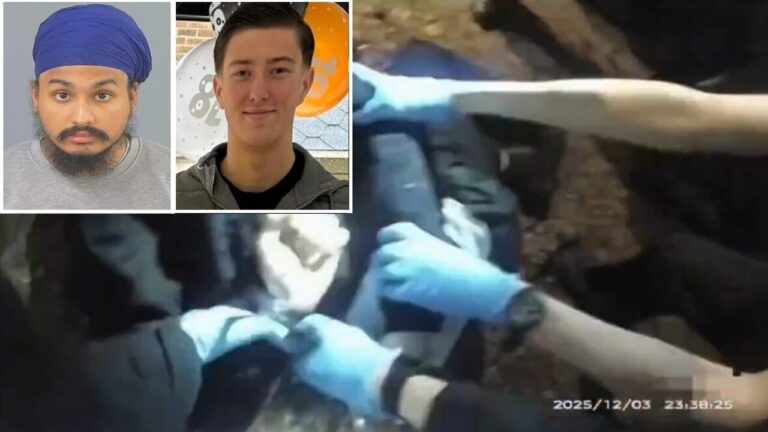
It was a given that Nigel Farage would jump on the bandwagon. All it took was bodycam footage, and the mechanism was set in motion. What happened to Henry Nowak – eighteen year old university student, killed on the night of 3 December 2025 in Southampton while walking home – is a tragic fact that highlights the terrible work of the police, but turning it into an identity crusade is another matter. Farage posted a video on An incitement to violence, no more, no less.
And there was violence. On the same evening of June 2, in front of the Southampton Central Police Station, around two thousand people had gathered in what was promoted as a demonstration in Nowak’s memory. Speakers included right-wing extremist Tommy Robinson and Laurence Fox. Meanwhile, a few blocks away, near the site of the murder, groups of protesters were throwing objects at riot police. From the stage, one of the speakers declared that the nation had been “invaded”, that many of the new arrivals bowed to the “false god of Islam”, that this remained “a Christian nation”.
The conspiracy theory (disproven by the facts)
And here the exploitation reveals itself. Nowak’s killer, Vickrum Digwa, was not a Muslim but a Sikh, a member of one of the best integrated communities in the United Kingdom, with among the lowest crime rates, known for its solidarity networks, and with an electorate that largely votes for Reform UK. Yet from the stage there was talk of an Islamic invasion. It was confirmation that in this identity grammar “Muslims” functions as an umbrella under which to include anything that is not perceived as white and indigenous.
Meanwhile, on social media, the usual moral justifications poured in: “if the authorities continue to ignore the problem”, “if they continue to hide it”. But nothing of the sort had happened. The system hadn’t ignored or covered up anything. It had worked: Vickrum Digwa had been arrested, tried and sentenced to life imprisonment with a minimum of twenty-one years. And the point is that the anger exploded not in December, when Nowak was killed, but now, with the sentence already handed down.
Putting it all into perspective was Henry’s father, Mark Nowak. In his statement he thanked the investigators, the liaison officers, the prosecutors, distinguishing between the failure of the police that night and the seriousness of those who then conducted the investigations and obtained the conviction. He then concluded that he did not want Henry’s death to be used to create further division, hatred or tension.
Almost everyone has attacked Farage’s hateful rhetoric, including Kemi Badenoch, the leader of the Conservatives, who attacked him by claiming that the real problem is not the multiracial composition of British society but its “racialisation”, or the use of race as a political category.
The police’s mistake
Real problems remain regarding the actions of the policemen who intervened on the night of the murder, who, by handcuffing Nowak, delayed his rescue. The murderer’s family had kept the operators on the phone for 12 minutes, building a scene based on a story of racism. A trap into which the police fell with both feet. Upon arrival he assumed that what was reported was true. With the result that the only person on the ground, unable to move, was the one handcuffed.
What is clear about the affair is that it was a prejudice based on credibility – a credibility then transformed into a procedure. What is less clear is whether it was linked to “race” or because the report of a Sikh family, a historically non-violent community, was considered reliable. The result was a protocol carried out without anyone looking at the scene for what it was: a perfectly healthy family accusing a dying boy on the ground. The police had already decided who was innocent or guilty from the phone call. A procedural flaw which, as such, will have to be treated and rectified, because the point is not whether the police take for granted that the most credible one is the white or the black, the Sikh or the Christian, the Muslim or the Hindu, but that they act at the scene based on what they present, not blindly believing a phone call.