

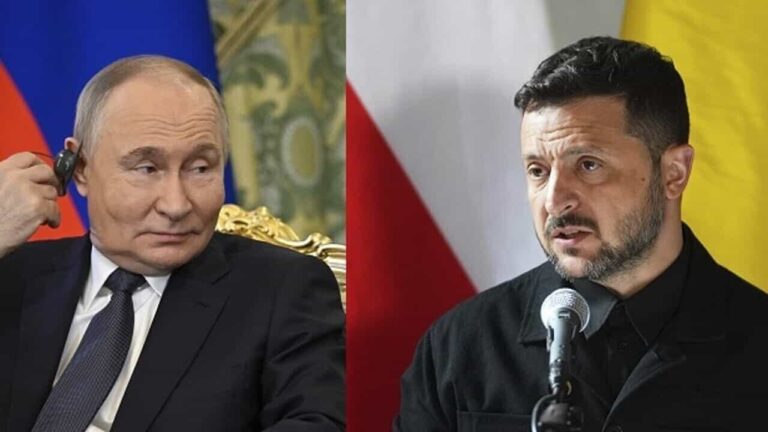
After months of stalemate and fighting along the entire front, a diplomatic glimmer of hope is once again emerging between Moscow and Kiev. It was reopened by Russian President Vladimir Putin, who from St. Petersburg reiterated Russia’s willingness to reach a negotiated solution to the war in Ukraine, while underlining that the talks do not necessarily require the interruption of military operations.
Speaking before representatives of several international news agencies, the Kremlin chief said that Moscow is ready to proceed on the basis of the lines discussed with US President Donald Trump during the summit held in Alaska in August 2025. “Russia is ready for the compromises discussed in Anchorage, but Ukraine must also agree,” Putin said.
The Russian president also argued that a political solution and Moscow’s military objectives are not necessarily incompatible. “Controlling the entire Donbass region and concluding an agreement are not mutually exclusive,” he said, adding that Russian forces continue to advance along the entire front line.
Zelensky’s response
Ukrainian President Volodymyr Zelensky responded to the overtures coming from Moscow with a long open letter addressed directly to Putin.
The Ukrainian leader proposed a face-to-face meeting between the two presidents, inviting the Kremlin head to set a date for a summit. “Ukraine proposes to end this war through direct dialogue between us and you,” Zelensky wrote. Then the direct invitation to a dialogue: “Let’s meet”.
Kiev also said it was open to a total ceasefire for the duration of the negotiations, believing that a truce represents the best way to create the conditions for a serious confrontation. Not only that, the Ukrainian president stated that “the front line today is the line from which diplomacy must begin”, a statement that would seem to allude to a negotiation.
The issues that make an agreement difficult
If on the level of declarations signs of availability for dialogue emerge, on a substantial level the distances remain.
The main one concerns Donbass. In fact, Putin continues to consider control of the entire eastern region a strategic objective of Russia and maintains that this is not incompatible with a future agreement. For Kiev, however, the defense of one of the most strategic areas of the country remains (to date) a mandatory priority.
In the same open letter, Zelensky rejected, for example, Russian ambitions over the Donetsk region. “You will not capture the Donetsk region this year either,” he wrote, addressing Putin directly, reiterating that Ukraine will retain its independence and sovereignty.
The “clash” over the ceasefire
Another divergence concerns the method by which to achieve peace. Ukraine continues to call for a preliminary truce to accompany the negotiations. Russia, however, believes that a ceasefire could turn into a military advantage for Kiev, allowing the Ukrainian army to regroup and receive new Western aid.
For this reason, Putin made it clear that, from the Kremlin’s point of view, talks can take place even while the war continues.
Putin also addressed the topic of possible mediators. While saying he was in favor of European participation in the talks, he ruled out the possibility that the European Union could play the role of neutral arbiter, arguing that Brussels is now directly involved in the conflict through the political, economic and military support provided to Kiev.
The Russian president then relaunched the figure of former German chancellor Gerhard Schröder as a possible interlocutor, defining him as a politician capable of maintaining an autonomous position.
The declarations of the last few hours show how, after years of war, both sides continue at least formally to leave the door to negotiation open. However, the conditions posed by Moscow and Kiev still remain profoundly different. And the work of a possible mediator already promises to be uphill.